Week 4- Rolling operation
Aim: To conduct a malleability test by pushing the workpiece made of copper through a roller.
Procedure:
Materials: The material used at the rollers are structural steel and for the workpiece is copper. This material must be added from the engineering data before starting the setup.
Geometry: Drag the model in space-claim. Use the pull feature to decrease the width by 8mm on both sides and increase the height of the bar by 60mm.
Setup:
Components: Name the components and assign the appropriate materials to them. The plate will be copper and the roller will be structural steel.
Connections:
- Contact:
- A frictional contact is specified between the rollers and the bar. The coefficient of friction is 0.2.
- The formulation is frictional.
- Set normal stiffness to Factor and set the factor to 0.1
- Joints: We specify 2 cylindrical joints that are body - ground to the inner faces of the roller.
Mesh: Default mesh is used and a body sizing of 2.0 mm is applied on the workpiece.
Analysis Settings:
- Number of steps: 14
- Auto time-stepping: Program Controlled
- Large Deflection: On
- Non-Linear controls:
- Stabilization: constant
- Method: Energy
- Energy Dissipation: 0.1
Load Settings: A rotational load of 15 degrees is applied at every time step such that the rotation is inwards.
Solution: There are 4 types of results to be obtained, namely:
- Equivalent stress for the whole setup
- Equivalent Plastic strain for the workpiece
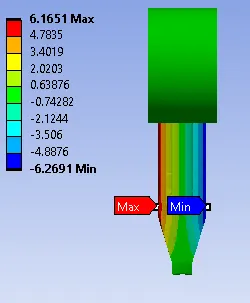
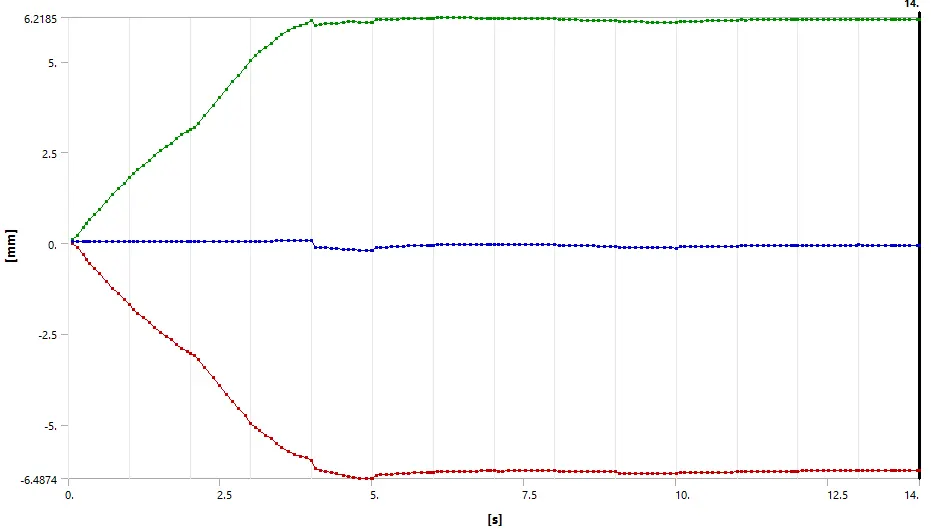
- Directional Deformation in the Z-axis for the workpiece
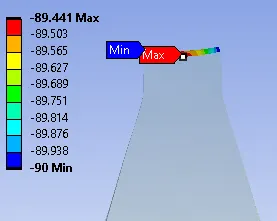
- A proof that the workpiece has moved 90mm.
Results & Discussion:
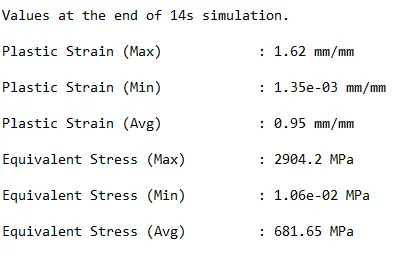
1. Equivalent stress of the setup
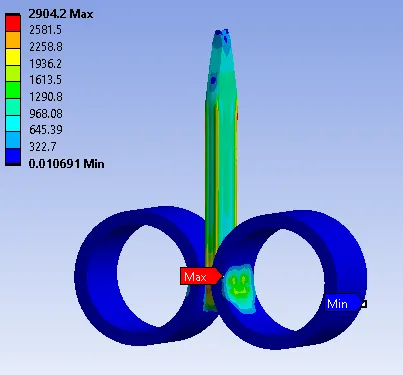
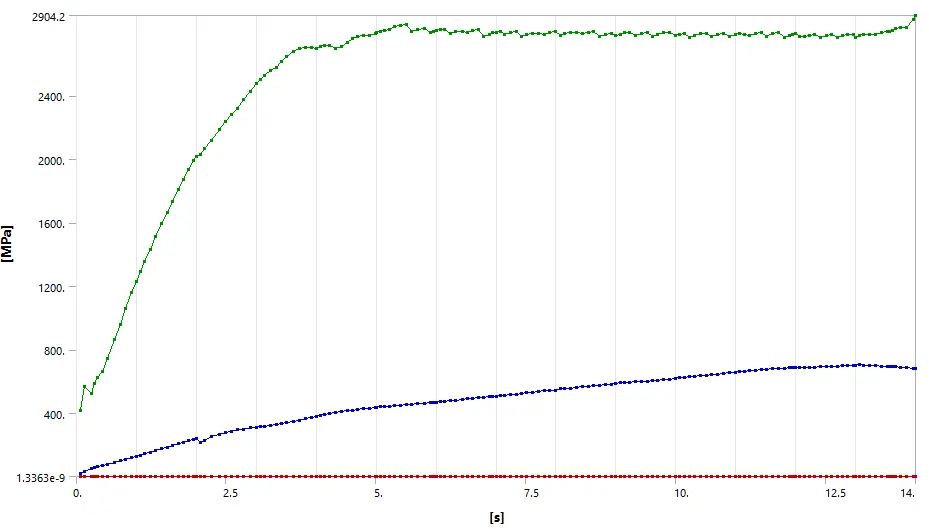
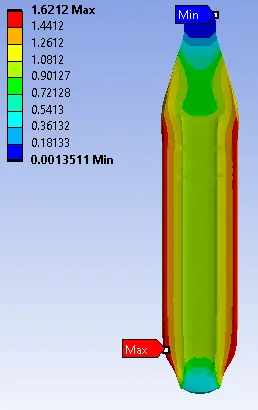
2. Equivalent plastic strain on the workpiece
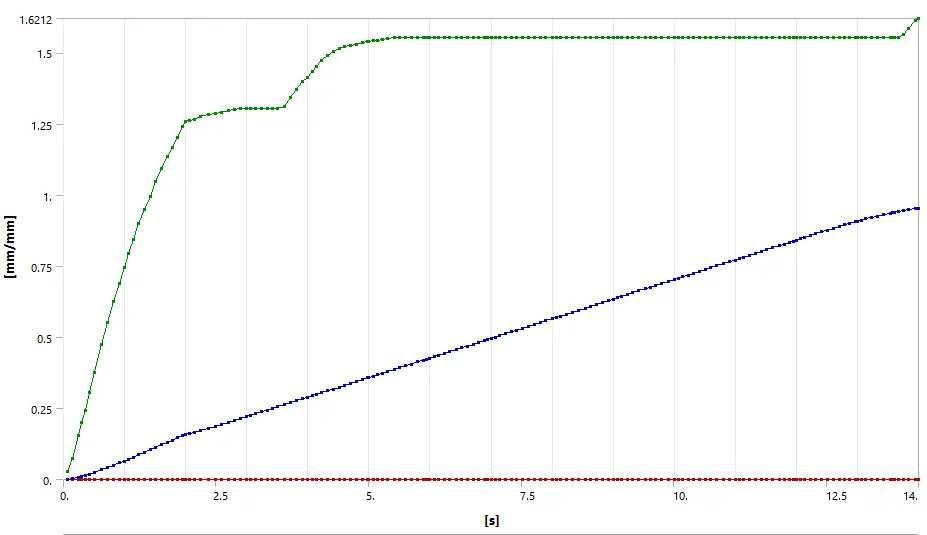
3. Directional deformation:
- 6.1651 for one edge and 6.2691 for the other edge.
4. Proof of 90mm displacement:
To do this the bottom-most surface of the bar is selected and a solution for directional deformation of that plane in the direction of motion is obtained. This contour shows that the maximum deformation is 90mm.
Conclusion: The simulation of the rolling mechanism was successfully done using ANSYS structural. Here the workpiece is made of copper and the rollers are structural steel.