Week 4 - Genetic Algorithm
- What is a Genetic Algorithm??
A genetic algorithm (GA) is a method for solving both constrained and unconstrained optimization problems based on a natural selection process that mimics biological evolution. The algorithm repeatedly modifies a population of individual solutions. At each step, the genetic algorithm randomly selects individuals from the current population and uses them as parents to produce the children for the next generation. Over successive generations, the population "evolves" towards an optimal solution.
You can apply the genetic algorithm to solve problems that are not well suited for standard optimization algorithms, including problems in which the objective function is discontinuous, nondifferentiable, stochastic, or highly nonlinear.
The genetic algorithm differs from a classical, derivative-based, optimization algorithm in two main ways, as summarized in the following table:

- AIM:
Write code in MATLAB to optimize the stalagmite function and find the global maxima of the function.
- CODE OF STALAGMITE FUNCTION:
function y=stalagmite(input_vector)
x=input_vector(1);
y=input_vector(2);
f1_x=(sin(5.1*pi*x+0.5))^6;
f1_y=(sin(5.1*pi*y+0.5))^6;
f2_x=exp(-4*log(2)*((x-0.0667)^2/0.64));
f2_y=exp(-4*log(2)*((y-0.0667)^2/0.64));
y=-[f1_x*f1_y*f2_x*f2_y];
end
Three studies performed in this project:
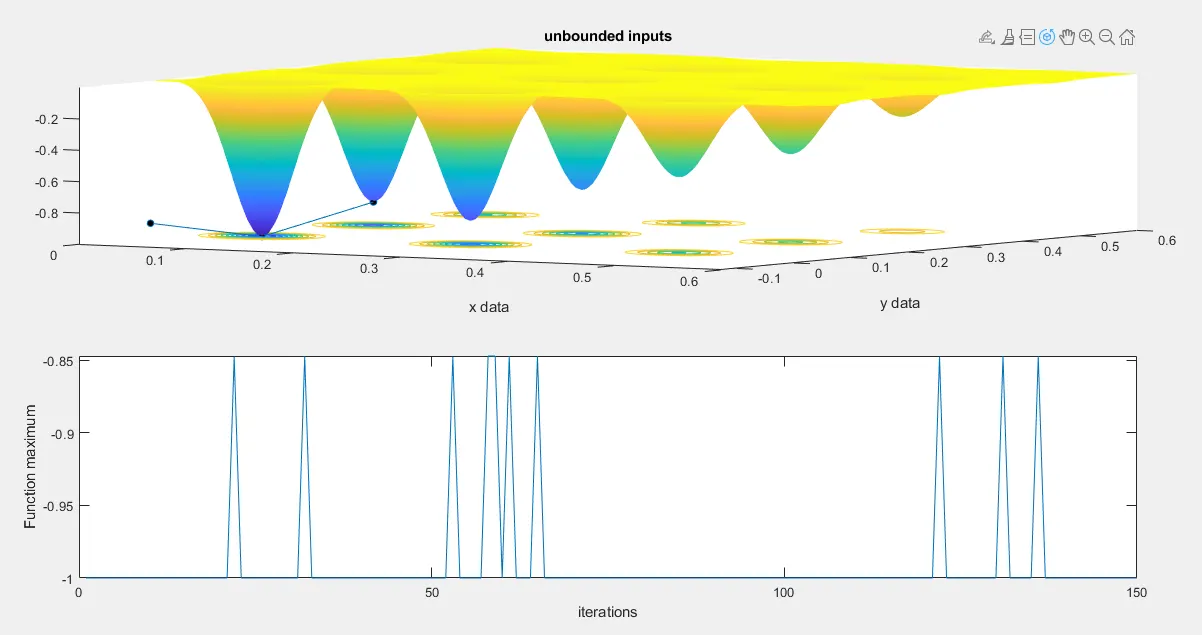
- Study of Genetic Algorithm for random sampling.
- Study of Genetic Algorithm with upper and lower bound sampling.
- Study of Genetic Algorithm with upper and lower bound and increase the population size.
- CODE:
close all
clear all
clc

%inputs
x=linspace(0,0.6,150);
y=linspace(0,0.6,150);

[xx yy]=meshgrid(x,y);
num_case=150;

for i=1:length(xx)
    for j=1:length(yy)
        input_vector(1)=xx(i,j);
        input_vector(2)=yy(i,j);
        F(i,j)=stalagmite(input_vector);
    end
end

%STudy 1
tic
for i=1:num_case
    [inputs,Fopt(i)]=ga(@stalagmite,2);
    xopt(i)=inputs(1);
    yopt(i)=inputs(2);
end

Study_time_1=toc

figure(1)
subplot(2,1,1);
hold on
surfc(xx,yy,F);
shading interp;
ylabel('y data');
xlabel('x data');
plot3(xopt,yopt,Fopt,'marker','o','markersize',5,'markerfacecolor','k');
title('unbounded inputs');
subplot(2,1,2);
plot(Fopt);
xlabel('iterations');
ylabel('Function maximum');

%Study 2
tic
for i=1:num_case
    [inputs,Fopt(i)]=ga(@stalagmite,2,[],[],[],[],[0:0],[1:1]);
    xopt(i)=inputs(1);
    yopt(i)=inputs(2);
end

study_time_2=toc

figure(2)
subplot(2,1,1);
hold on
surfc(xx,yy,F);
shading interp;
ylabel('y data');
xlabel('x data');
plot3(xopt,yopt,Fopt,'marker','o','markersize',5,'markerfacecolor','k');
title('unbounded inputs');
subplot(2,1,2);
plot(Fopt);
xlabel('iterations');
ylabel('Function maximum');

%Study 3
options=optimoptions('ga');
options=optimoptions(options,'populationsize',450);
tic
for i=1:num_case
    [inputs,Fopt(i)]=ga(@stalagmite,2,[],[],[],[],[0:0],[1:1],[],[],options);
    xopt(i)=inputs(1);
    yopt(i)=inputs(2);
end

study_time_3=toc

figure(3)
subplot(2,1,1);
hold on
surfc(xx,yy,F);
shading interp;
ylabel('y data');
xlabel('x data');
plot3(xopt,yopt,Fopt,'marker','o','markersize',5,'markerfacecolor','k');
title('unbounded inputs');
subplot(2,1,2);
plot(Fopt);
xlabel('iterations');
ylabel('Function maximum');

max_value=Fopt- RESULTS:
Figure_1:
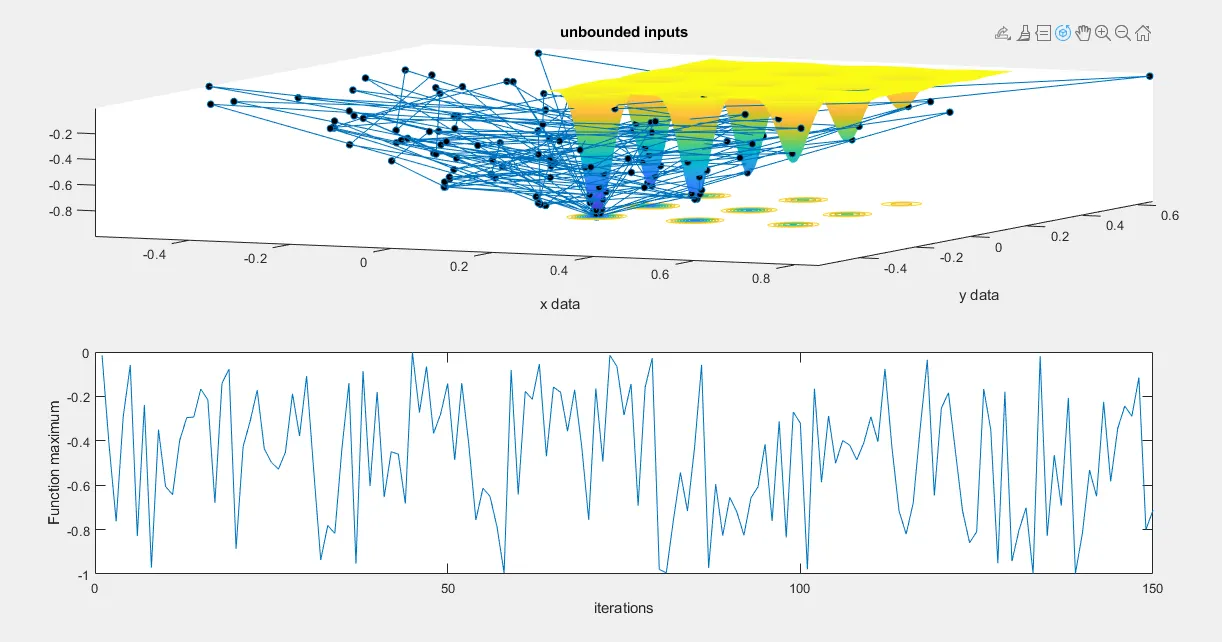
Figure_2:
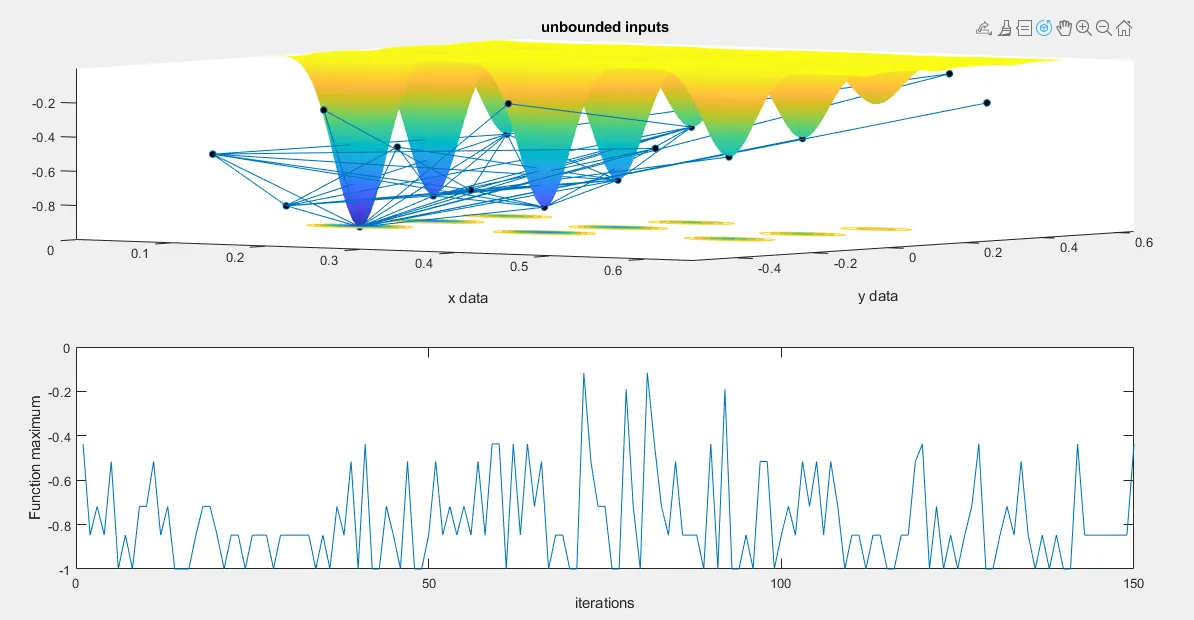
Figure_3: