Week-4 Challenge WOT Condition Part-2
Ans-1.Mapped Model
- Mapped Model are data base modeling like it makes on the basis previous collected or estimated data.
- The engine or motor torque is sensed and the engine of motor block generates the required torque output just as defined in data witout realtime sensing.
- It is faster then Dynamic model as it is not real time modeling.
- Accuracy is not that high in comparison with Dynamic Modeling.
Dynamic Model:
- Dynamic are component based model, what particular type of components has been used in making of the model.
- It runs in real time and takes input from Drivecycle.
- Provides sum of the results of all the components.
- Accuracy is high as it is in real time.
- Simulation will take more time as it goes with lots of subsystem or components.
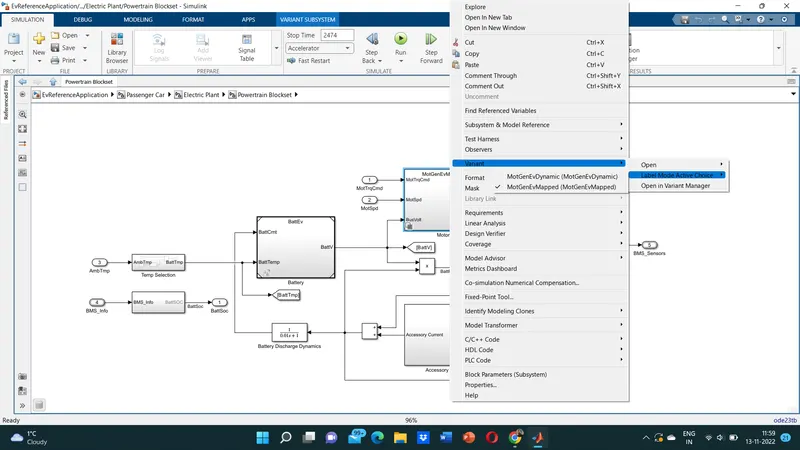
Model type change steps:
- First we have to select the Vehicle like FullEv or Hybrid Vehicle form Powertrain Blockset.
- Then the model appers with work flow blocks of the model.
- We need to go isde Passenger Car, then in Electric Plant,then in powertrain Blockset, then in Motor/generator.
- Right Click on Motor From Variant Label mode Active Choise and select the mode.
Ans-2. Miles per gallon is a rating - How far a car can travel on a gallon or power in case of Electric vehicle.
In the powertrain blockset we have a model calculates the miles per gallon and power, named as performance Calculations.
Factors considered to Model Fuel flow or Battery Power.
The model Takes 2 input in case of an Ev
- Vehicle Speed
- Battery Power
and 3 inputs in case of an HEv,
- Vehicle Speed
- Fuel Flow
- Battery Power
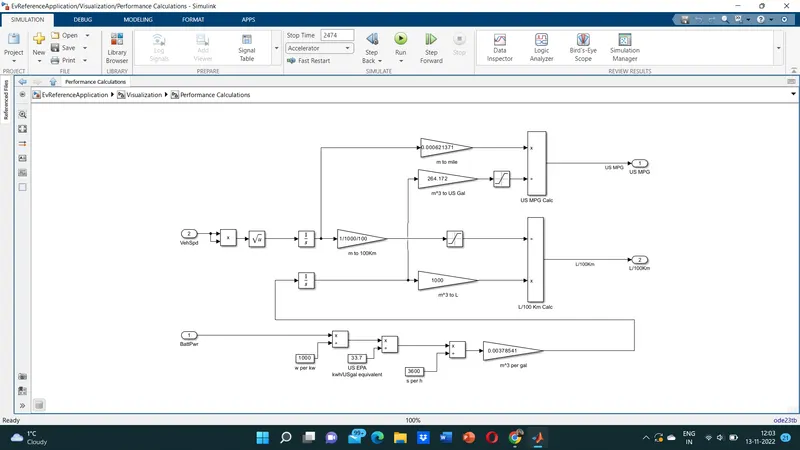
Vehicle Speed is important factor of fuel/power consumption throughout the drivecycle.
Here for finding the distance the Speed/velocity along with time gets integrated gets converted from meters to Km using ((1/1000)*100) and Saturation for Lower & Upper Set value.
Battery power-
- Converting battery w to kw for dividing by 1000 and then
- Conversion of Energy KWh to Us gallon Divide by 33.7
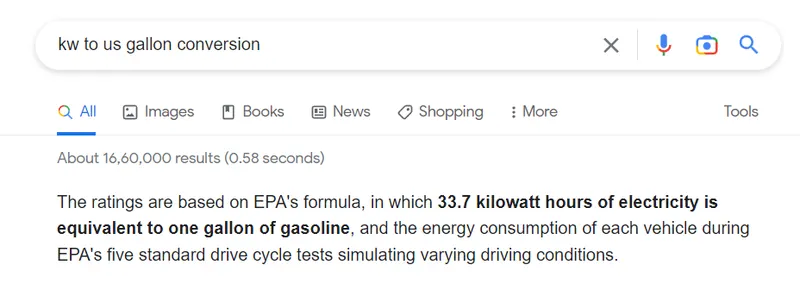
- For getting energy of equivalent gallons per seconds by dividing with 3600 converting Seconds to Hrs.
- Then multiplying with 0.00378541(m^3/s) convert the Us gallons per sec to the volume of the fuel flow into m^3 per gallon.
- By integrated and converting the m^3 to litre.
On getting Distance from Vehicle Speed and liters from Battery power
Divide the Distance with the Battery power we get liter per 100Km.
For getting the Miles per Gallon multiply the 0.000621371 for converting the m to miles. from Vehicle Speeed reference.
and getting gallons Convert meter cube to US gallon multiply with 264.172 . From Battery power Reference.
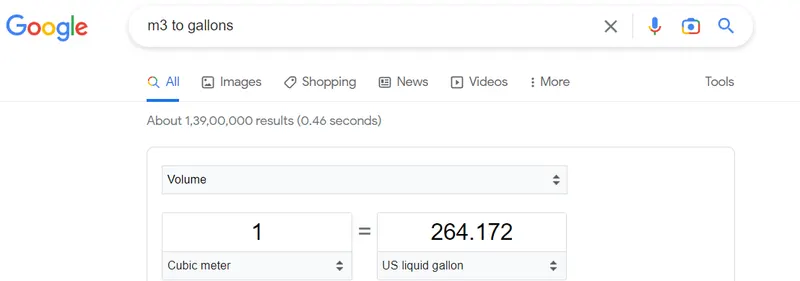
and by dividing miles with gallons we get Miles per Gallon.
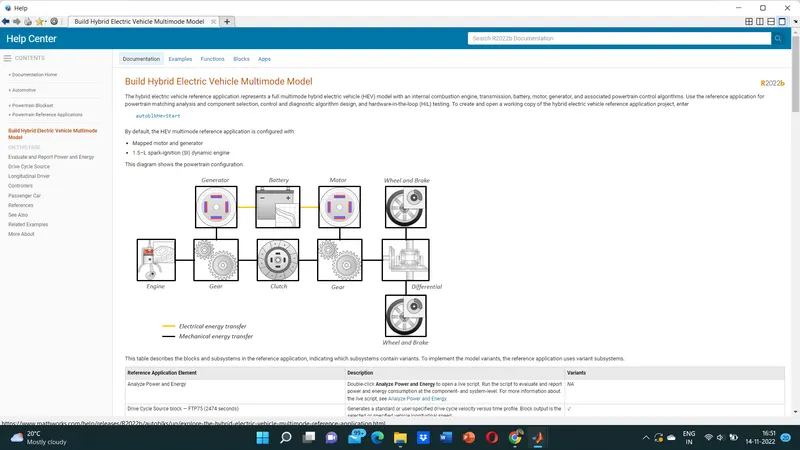
Ans-3. Select the Build hybrid Electric Vehicle Multimode Model From Powertrain Blockset.
Change the Drive Cycle to WOT In the model and simulation time as 50sec.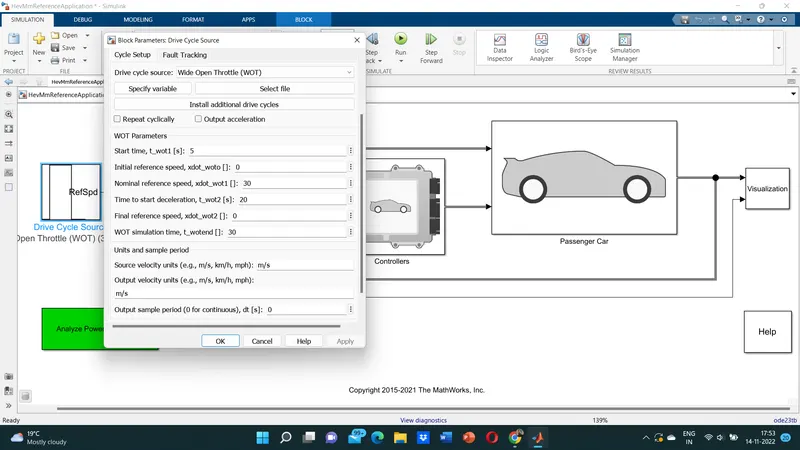
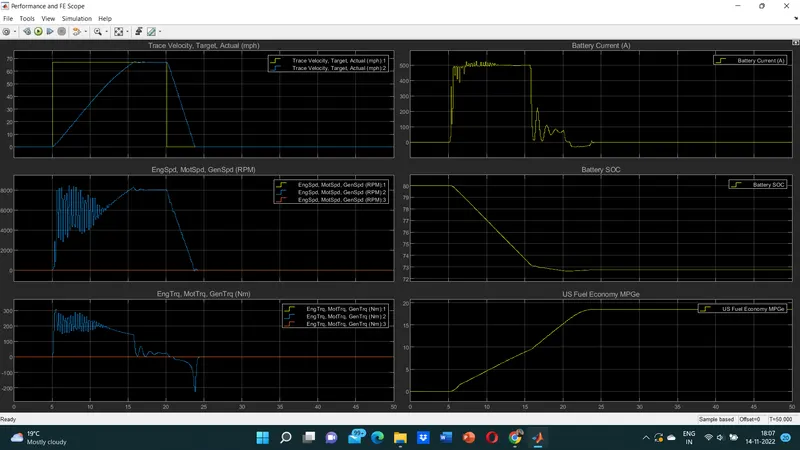
The Scope:
.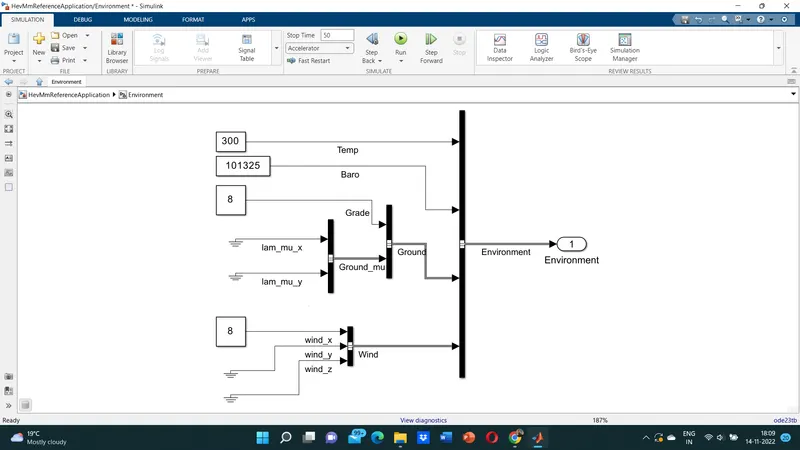
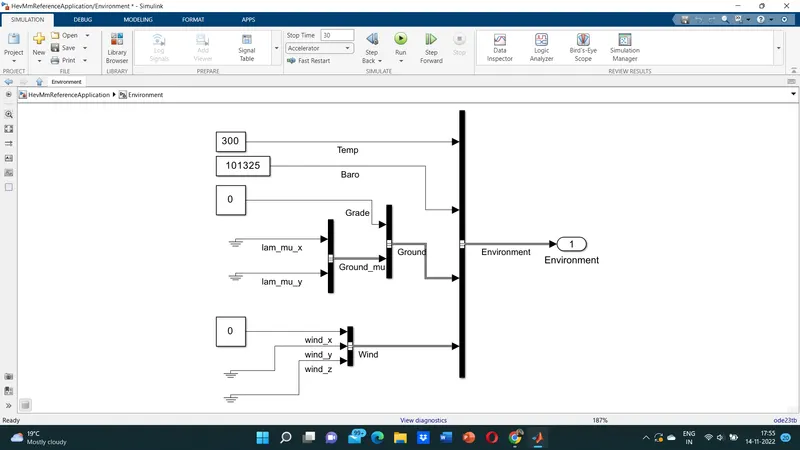
Then On changing the Grade and Wind velocity:
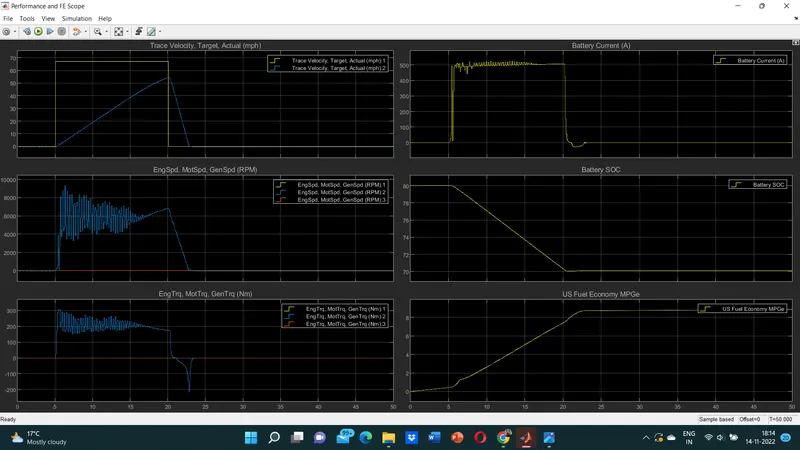
From Above Graphs Comparision we can say that:
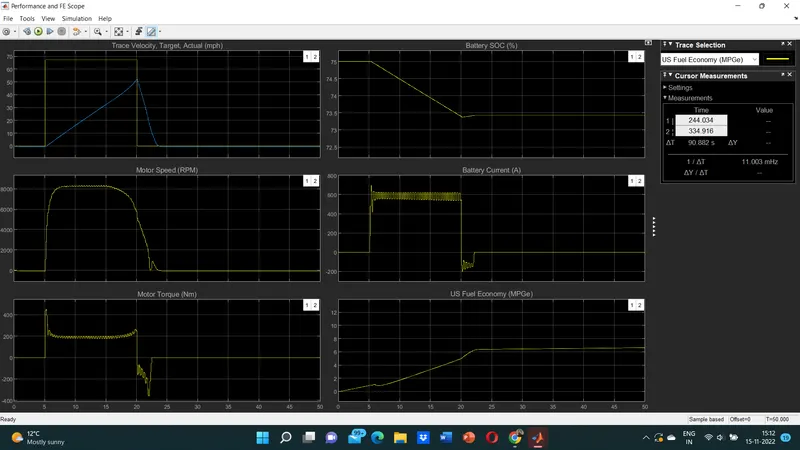
Trace Velocity traget and actual graph: The yellow line indicated the desired path and blue line is the actual path. The battery power is not enough to meet the requirements of the grade and wind velocity but with no grade and wind velocity it meets the requirement after some seconds and battery power is capable to meet it.
Battery Current Graph: When the vehicle is accelerating the battery current is also increasing. when the velocity is constant the current is also constant but with some rise and fall and when vehicle starts deceleration battery current becomes negative indicates that regenerating is happening.
Battery SOC: The Battery SOC keeps depleting until regeneration happens. Regeneration increase the small level of SOC. it decrease more in case of Grade and wind velocity.
Motor,engine and generator speed:Only motor is used Initially to run the vehicle it has high torque. as we set the run time less so the engine is not in role at that time but for a long run the engine will take place and generation is also at zero due to less run time and only motor is working.
Motor,engine and generator torgue:Initially motor torque is high so the vehicle run on it. as we set the run time less so the engine is not in role at that time but for a long run the engine will take place and generation is also at zero due to less run time and only motor is working.
US fuel Economy: The graph shows the fuel consumption in miles per gallon.
Ans-4. Keeping all the parameters same in case of Ev and run it. Setting Grade and Wind velocity same as previous.
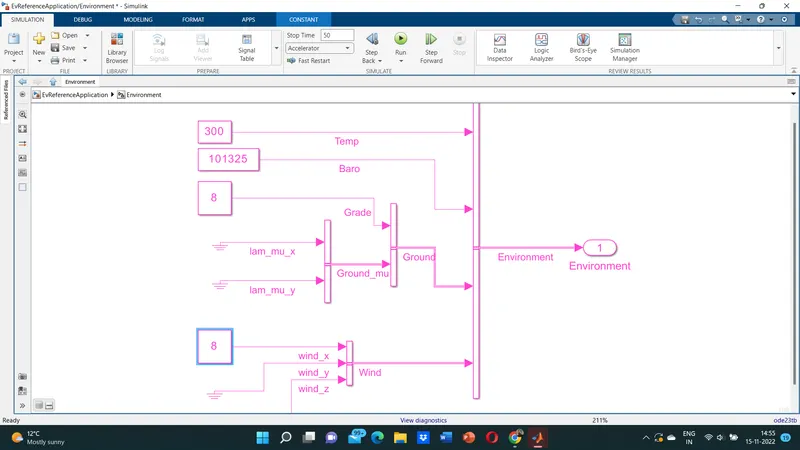
Setting Grade and wind speed =8units
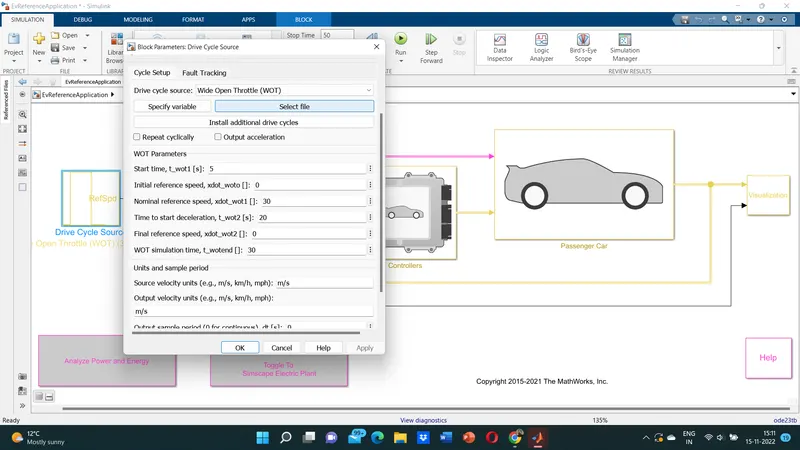
On comparing the graphs of both EV and HEV We can say that:
Trace Velocity traget and actual graph: There is the same performance as in both the cases only motor was operating so the performance is same.
Battery Current Graph: It increases from 500A to 600A because the engine and generator is present there in case of HEV, and the negative current flows for a longer time in EV so we can say that regenerative braking is more aggressive in EV.
Battery SOC: Soc increase by 70% like only 3 units fall in case of EV and in Case of HEV falls of 10 units. Reason engine and generator is present there in case of HEV.
Motor,engine and generator speed: Its very stable speed in case of Ev but in Case of HEV a lot of fluctuations were there and also peak rpm is high in case of HEV.
Motor,engine and generator Torque: Its very stable torque in case of Ev but in Case of HEV a lot of fluctuations were there and here peak Torque is high in case of EV.
Fuel Economy: EV is more economic than HEV. This is due to electric Motor is more efficient than engine. EV has less number of rotating parts.