Week-4 Challenge WOT Condition Part-2
Wide Open Throttle - Hybrid Electric Vehicles
Power Train Blockset:-
Power Train Blockset is specifically designed for simulation & to study the Hybrid & Electric Vehicles. Powertrain Blockset provides a library of automotive components as well as a pre-assembled engine dynamometer and complete vehicle models for fast desktop simulation and real-time HIL testing.
The Powertrain library includes the components essential for modeling automotive systems. You can assemble these library blocks to create a complete engine subsystem. You can then connect this engine with other components to create a complete vehicle model that you can simulate under a variety of test conditions.
Powertrain Blockset also provides virtual dynamometer reference applications. You can use them to generate steady-state engine maps and check if it meets requirements. For example, the initial calibration may not meet the torque command. You can use other built-in experiments to automatically calibrate inputs such as the throttle and wastegate to match the commanded torque. These virtual experiments can save you significant time by proving out the calibration procedures and creating initial calibration maps before you begin testing the real hardware.
Finally, Powertrain Blockset includes complete vehicle reference applications for fuel economy analyses and controls development. These models capture important physical effects such as turbo windup while achieving fast simulation performance. The models are open and can be customized. You can parameterize components with your own data, look under block masks or modify the contents of a subsystem to include additional effects relevant to your project. You can even replace entire subsystems with your own models, for example, a custom drivetrain created using Simscape products. With these reference applications, you can quickly assess the impact of design changes at the system level.
more information:- Power Train Blockset
1.What is the difference between the mapped and dynamic models of engine, motor, and generator? How can you change the model type?
Powertrain Blockset provides two types of combustion engine models: Mapped and Dynamic. You can switch between engine model types based on your application
Mapped:-
Mapped engines represent macro engine behavior as a set of lookup tables (brake torque, fuel flow, air mass flow, exhaust temperature, efficiency, and emissions) as functions of commanded load and measured engine speed. Dynamic engines decompose engine behavior into individual component models that account for engine dynamics, most notably intake airflow and turbocharger dynamics.
Dynamic:-
Dynamic engine models are suitable for designing control, estimator, and diagnostic algorithms that depend on dynamic subsystem states, for example, in closed-loop AFR control algorithm development. Mapped engine models are suitable for analysis and design activities that do not require engine subsystem dynamic characteristics, for example, in engine and transmission powertrain matching analysis for fuel economy, emissions, and performance tradeoffs.
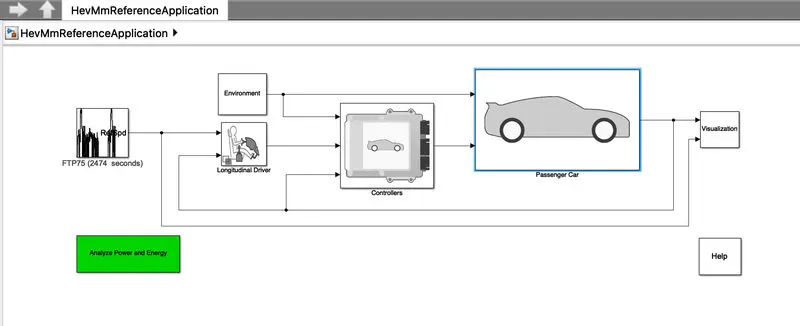
Mapped & Dynamic Models of Engine:-
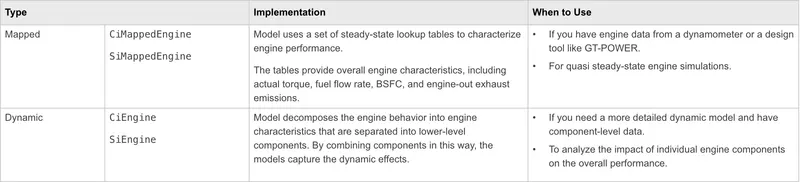
Mapped Models of Motor:-
The Mapped Motor block implements a mapped motor and drives electronics operating in torque control mode. The output torque tracks the torque reference demand and includes a motor-response and drive-response time constant. Use the block for fast system-level simulations when you do not know detailed motor parameters, for example, for motor power and torque tradeoff studies. The block assumes that the speed fluctuations due to mechanical load do not affect the motor torque tracking.
You can specify:
-
Port configuration — Input torque or speed.
-
Electrical torque range — Torque speed envelope or maximum motor power and torque.
-
Electrical loss — Single operating point, measured efficiency, or measured loss. If you have Model-Based Calibration Toolbox™, you can virtually calibrate the measured loss tables.
Dynamic Models of Motor:-
The Dynamic Motor block implements the modes of change in Motor subsystem parameters.
Mapped Models of Generator:-
These are the same as the mapped model of Motor.
Dynamic Models of Generator:-
Considering the Dynamic Model of Motor, these values are more accurate.
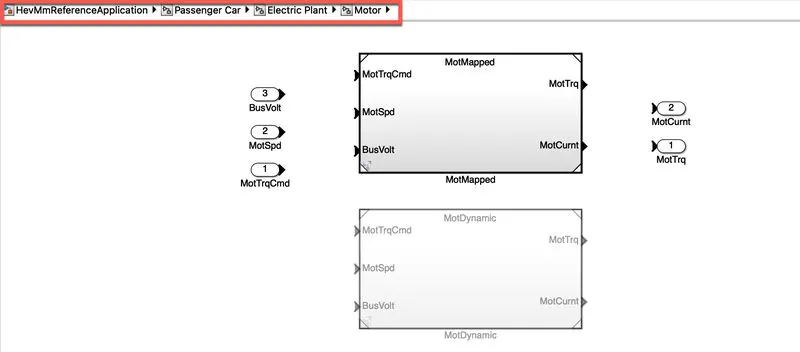
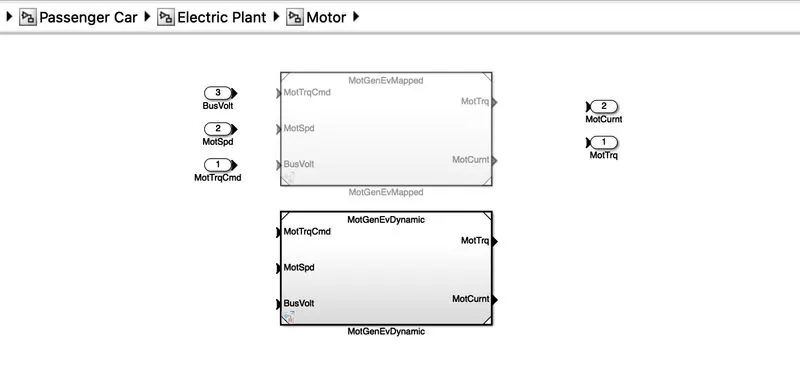
Changing Motor Mapped to Motor Dynamic:-
Making Dynamic Motor as default under variant modeling.
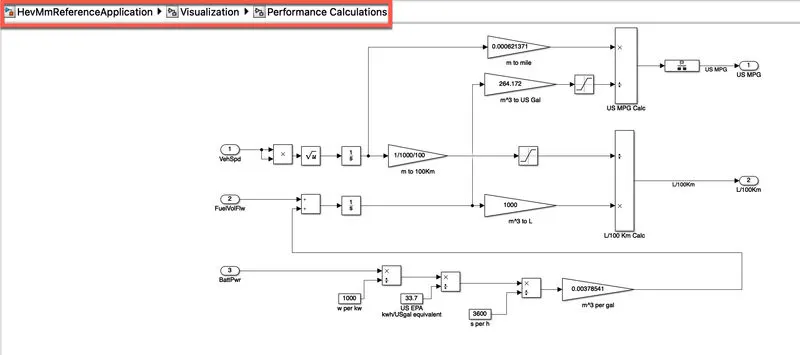
2.How does the model calculate miles per gallon? Which factors are considered to model fuel flow?
Factors to model fuel flow:-
Road Conditions, Driving conditions, hybrid or pure gasoline engines.
Calculating miles per gallon in a model:-
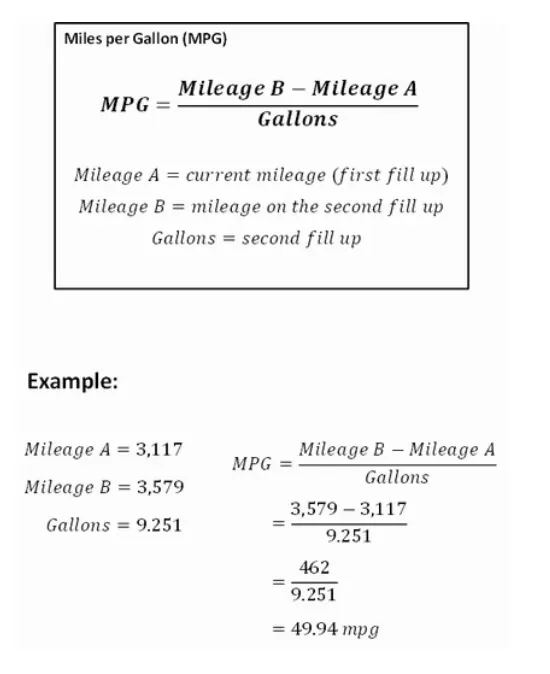
We can visualize the results of performance calculations from the above model and can compare both Ev's and Hybrid Electric vehicles.
3. Run the HEV ReferenceApplication with WOT drive cycle. Change the grade and wind velocity in the environment block. Comment on the results.
The electric vehicle (EV) reference application represents a fully electric vehicle model with a motor-generator, battery, direct-drive transmission, and associated powertrain control algorithms. Use the electric vehicle reference application for powertrain matching analysis and component selection, control and diagnostic algorithm design, and hardware-in-the-loop (HIL) testing.
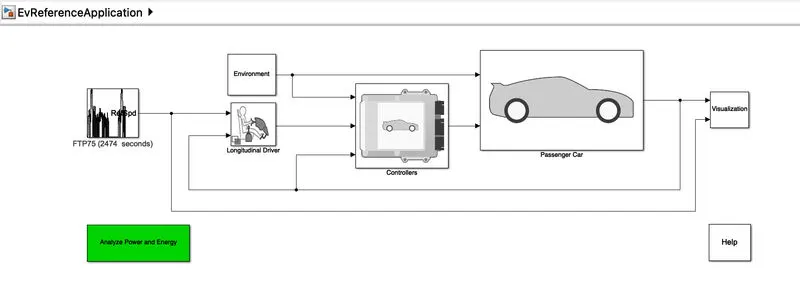
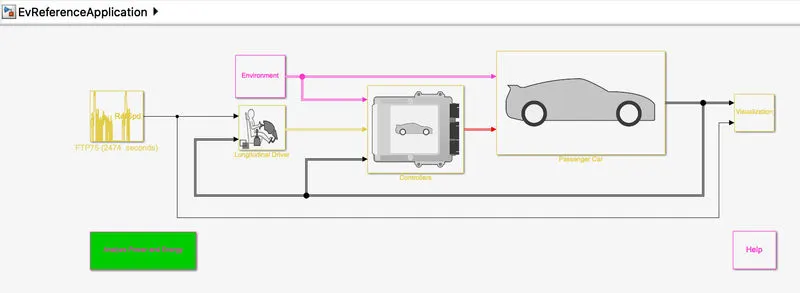
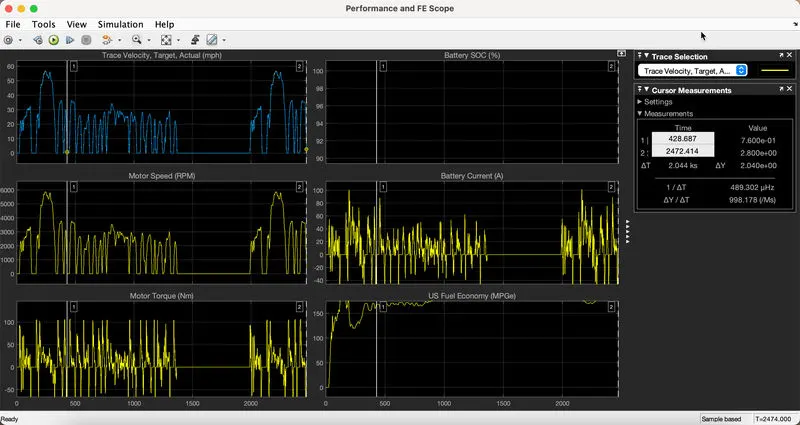
When the simulation is Run, all the parameters are given differently and noted with different colors.
Initial Scope Result:-
Trace velocity, Motor Speed, Motor Torque, Batter SOC, Battery current, Fuel Economy are analyzed.
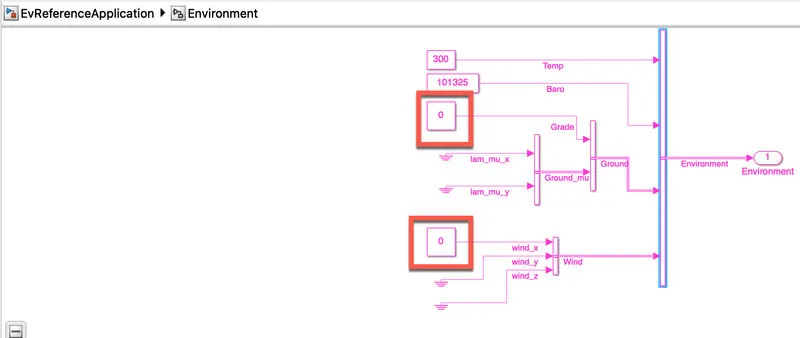
Changing the grade and wind velocity in the environment block:-
Initially the values of grade and wind velocity are 0 inside the environment block
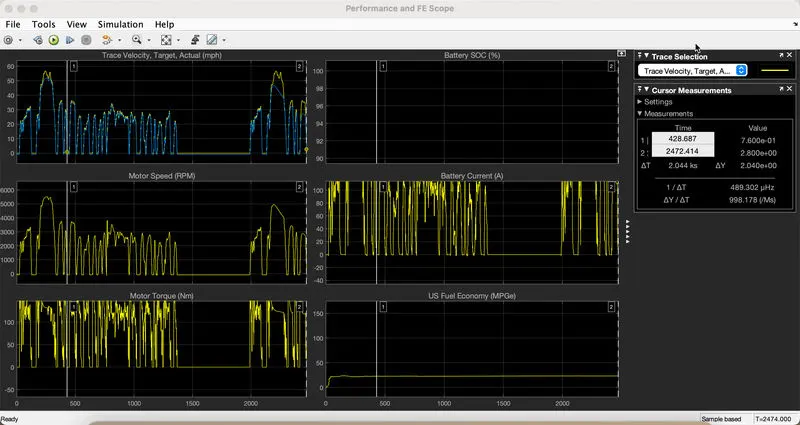
Change in results:-
The wind & Grade constants are change to 10, 10 each to observe and note the changes in the output.
Battery current, Fuel Economy & Motor Torque have been changed significantly.
4.Keeping all other parameters same, compare the simulated results of hybrid and pure electric powertrains.
simulated result for HEV
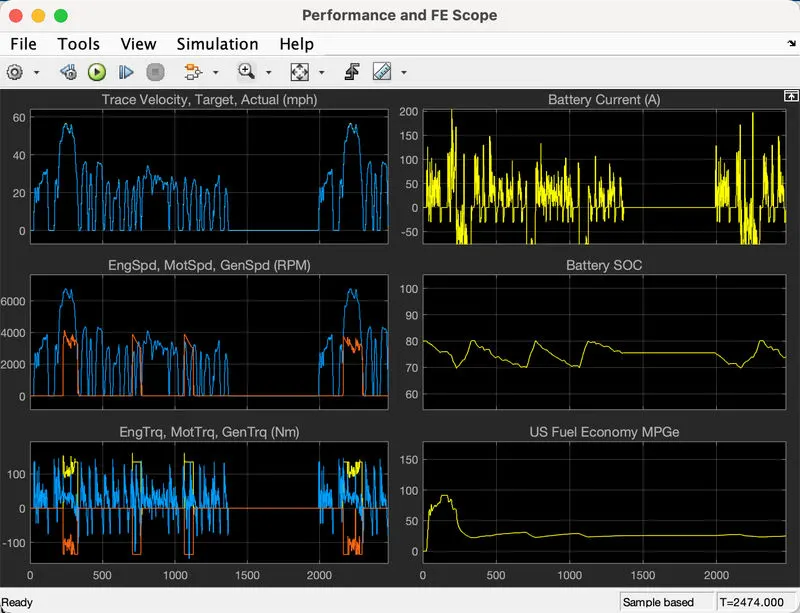
Simulated result for EV
Key Differences from EV to HEV:-
Fuel Economy is bit low in HEV.
Battery SOC in HEV is constant as the engine regernates its battery. I couldn't find the error befind the SOC in EV, on a general note it should decrease.
Velocity & Torque are almost similar.