Week-4 : Basic Calibration of Single cylinder CI-Engine
1.Compare SI vs CI and list down differences (assignment no 2-SI)
A Same volume model is considered ( major difference being compression ratio)
Keeping the RPM constant below are the results in comparision between SI and CI engine models.
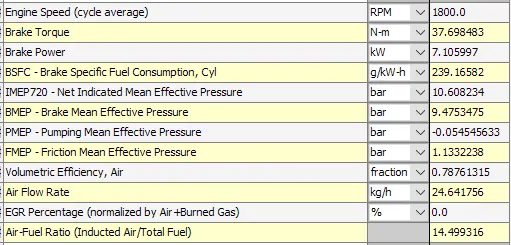
SI Engine:
- air flow rate : 24.641 kg/hr
- BMEP :9.4753 bar
- BSFC : 239.166 g/ kWh
- In-cylinder pressure : 48.88 bar
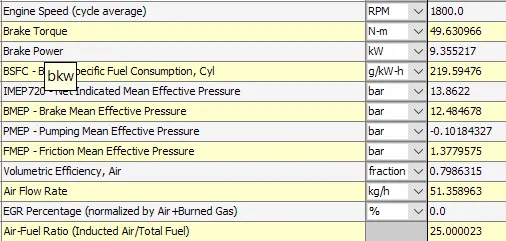
CI Engine:
- air flow rate : 51.358 kg/hr
- BMEP :12.48 bar
- BSFC : 219.59 g/ kWh
- In-cylinder pressure : 97.19 bar
2.Comments on following parameters
1. Brake Specific Fuel Consumption (BSFC):
- CI Engine BSFC: 219.59 g/kWh
- SI Engine BSFC: 239.166 g/kWh
CI engine shows better (lower) BSFC, which is expected due to:
- Higher thermal efficiency from higher compression ratios.
- Leaner combustion: Diesel engines often run leaner than SI engines.
- Absence of throttling losses, which improves part-load efficiency.Conclusion: The CI engine uses less fuel to produce the same power, demonstrating better fuel economy.
2. Air Flow Rate and Air-Fuel Ratio (AFR):
- CI Engine air flow rate: 51.358 kg/hr
- SI Engine air flow rate: 24.641 kg/hr
Let’s estimate AFR. Assuming ideal conditions and common fuel types:
- SI Fuel (Gasoline): Approx. 43 MJ/kg
- CI Fuel (Diesel): Approx. 42.5 MJ/kg
Assuming engine output remains similar (since RPM is constant and BMEP is close), let's assume 10 kW for simplification:
- Fuel flow rate (approx):
- CI: (219.59 g/kWh × 10 kW) / 3600 s ≈ 0.610 kg/hr
- SI: (239.166 g/kWh × 10 kW) / 3600 s ≈ 0.665 kg/hr
Now, estimate AFR:
- CI AFR = 51.358 / 0.610 ≈ 84.2:1
- SI AFR = 24.641 / 0.665 ≈ 37.1:1
- Conclusion:
The CI engine operates at a much leaner AFR, consistent with diesel engine operation, which allows:
- Higher efficiency
- Lower pumping losses
- Reduced exhaust temperatures (discussed next)
3. Exhaust Temperature:
- CI Engine: 831 K
- SI Engine: 984 K
This difference is due to:
- CI engines operating with excess air (lean mixtures), reducing combustion temperature.
- More complete expansion due to higher pressure and longer burn duration.
- Higher thermal efficiency: Less heat is rejected in the exhaust.
Conclusion:
The lower exhaust temperature in CI engine reflects better utilization of heat
energy for mechanical work, rather than being lost as waste heat.
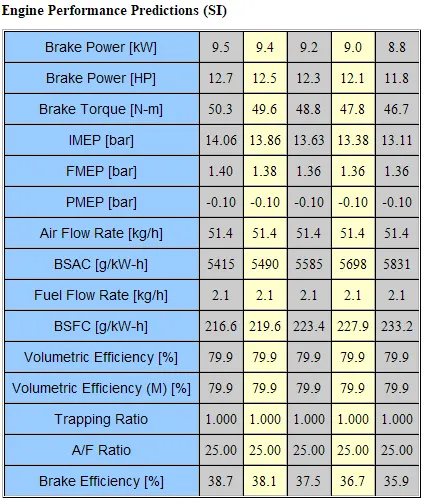
3.Change MFB 50 and observe impact on performance
MFB 50 is varied as below:
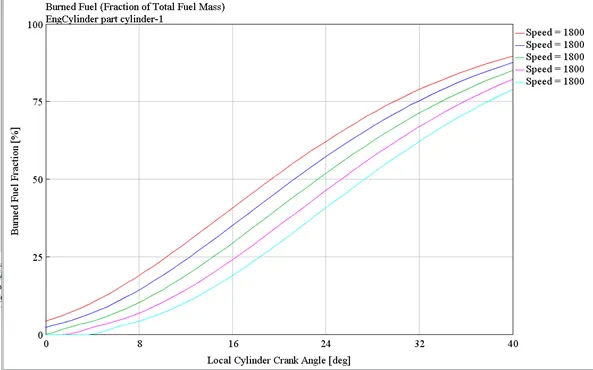
As can be seen below:
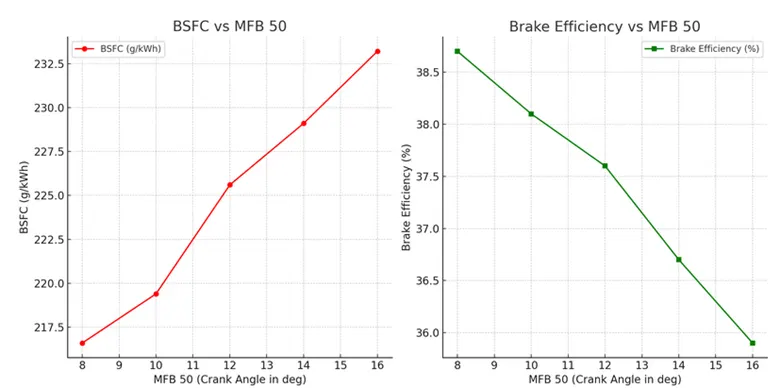
Early MFB 50 (advanced combustion)
- Pros:
- Higher peak pressure occurs closer to TDC, leading to better mechanical advantage and improved brake efficiency.
- Lower BSFC due to more efficient combustion and work extraction.
- Cons:
- Higher in-cylinder pressure and rate of pressure rise, which can cause knocking or mechanical stress.
- May increase NOx emissions due to higher peak temperature.
Late MFB 50 (retarded combustion)
- Pros:
- Lower peak pressures reduce mechanical stress and NOx emissions.
- Cons:
- Less of the expansion stroke is used effectively, reducing thermal efficiency.
- BSFC increases (less efficient fuel usage).
- Brake power drops, as combustion contributes less effectively to torque.
- Likely increase in exhaust temperature, as unconverted energy exits the cylinder.