Week 4.2 - Combustion Efficiency Calculation after Preheating
Abstract: To study the effect of preheating on the adiabatic flame temperature and combustion efficiency.
Recuperator:
A recuperator is a special purpose counter-flow energy recovery heat exchanger positioned within the supply and exhaust air streams of an air handling system, or in the exhaust gases of an industrial process, in order to recover the waste heat.
Here we use stoichiometric mixture of Methane and air for the study. And the temperature of air is varied from 298K to 600K.
Stoichiometric mixture: CH4 + 2(O2+3.72*N2)=>CO2+2H2O+7.52N2
Program to compute the effect of AFT with preheated air:
import cantera as ct
import matplotlib.pyplot as plt

gas=ct.Solution('gri30.cti')


A=ct.Quantity(gas)
A.TPX=298.15,ct.one_atm,'CH4:1'
A.moles=1

T_min=298
T_max=600

B=ct.Quantity(gas)
for T in range(T_min,T_max):

	B.TPX=T,ct.one_atm,{'O2':0.21, 'N2':0.79}
	B.moles=9.52

	M=A+B
	M.equilibrate('HP','auto')
	plt.plot(T,M.T,'*',color='red')

plt.title('EFFECT OF PRE-HEATING ON AFT')
plt.xlabel('PRE_HEATING TEMPERATURE')
plt.ylabel('AFT')
plt.show()
Plot shows the effect of pre heating on AFT
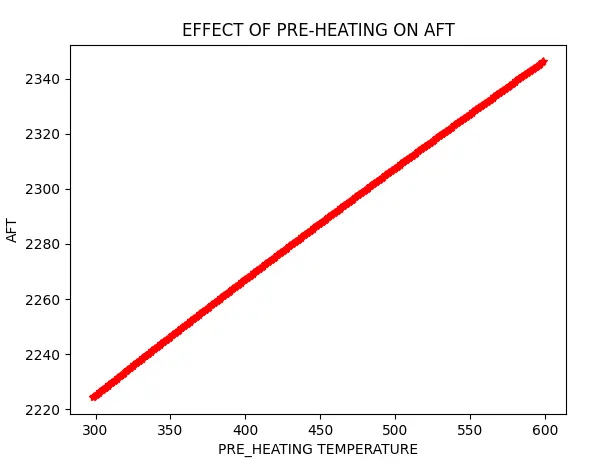
Conclusion: Preheating is directly proportional to AFT. By increasing the inlet air temperature the resulting AFT increases.
Program to compute the combustion efficiency with respect to preheated air:
import cantera as ct
import matplotlib.pyplot as plt
gas = ct.Solution('gri30.cti')

A=ct.Quantity(gas)
A.TPX=298.15,ct.one_atm,'CH4:1'
A.moles=1
M_A=A.mass

products=ct.Quantity(gas)
products.TPX=1700,ct.one_atm,{'CO2': 0.095, 'H2O':0.1901, 'N2':0.7148}
products.moles=10.52
M_products=products.mass

Tpre_min=298
Tpre_max=600
LHV=50e6


"""
Stoichiometric mixture: CH4 + 2(O2+3.72*N2)=CO2+2H2O+7.52N2
Lean Mixture: CH4+(2/phi)*(O2+3.72*N2)=CO2+2H2O+((2/phi)-2)O2+(7.52/phi)*N2
Rich Mixture: CH4+(2/phi)*(O2+3.72*N2)=((4/phi)-3)CO2+2H2O+(4-(4/phi))CO+(7.52/phi)*N2
"""
for T_pre in range (Tpre_min,Tpre_max):
	B=ct.Quantity(gas)
	B.TPX=T_pre , ct.one_atm, {'O2':0.21,'N2':0.79}
	B.moles=9.52
	M_B=B.mass

	H_B=B.enthalpy_mass
	H_A=A.enthalpy_mass
	H_products=products.enthalpy_mass

	Air_to_fuel=M_B/M_A

	Q=M_B*H_B+M_A*H_A-M_products*H_products
	Qsp=Q/M_A
	eff=Qsp/LHV
	plt.plot(T_pre,eff,"*",color='Green')

plt.title('EFFECT OF PRE-HEATING ON COMBUSTION EFFIECIENCY')
plt.xlabel('PRE_HEATING TEMPERATURE')
plt.ylabel('Combustion efficiency')
plt.show()import cantera as ct
import matplotlib.pyplot as plt
gas = ct.Solution('gri30.cti')

A=ct.Quantity(gas)
A.TPX=298.15,ct.one_atm,'CH4:1'
A.moles=1
M_A=A.mass

products=ct.Quantity(gas)
products.TPX=1700,ct.one_atm,{'CO2': 0.095, 'H2O':0.1901, 'N2':0.7148}
products.moles=10.52
M_products=products.mass

Tpre_min=298
Tpre_max=600
LHV=50e6


"""
Stoichiometric mixture: CH4 + 2(O2+3.72*N2)=CO2+2H2O+7.52N2
Lean Mixture: CH4+(2/phi)*(O2+3.72*N2)=CO2+2H2O+((2/phi)-2)O2+(7.52/phi)*N2
Rich Mixture: CH4+(2/phi)*(O2+3.72*N2)=((4/phi)-3)CO2+2H2O+(4-(4/phi))CO+(7.52/phi)*N2
"""
for T_pre in range (Tpre_min,Tpre_max):
	B=ct.Quantity(gas)
	B.TPX=T_pre , ct.one_atm, {'O2':0.21,'N2':0.79}
	B.moles=9.52
	M_B=B.mass

	H_B=B.enthalpy_mass
	H_A=A.enthalpy_mass
	H_products=products.enthalpy_mass

	Air_to_fuel=M_B/M_A

	Q=M_B*H_B+M_A*H_A-M_products*H_products
	Qsp=Q/M_A
	eff=Qsp/LHV
	plt.plot(T_pre,eff,"*",color='Green')

plt.title('EFFECT OF PRE-HEATING ON COMBUSTION EFFIECIENCY')
plt.xlabel('PRE_HEATING TEMPERATURE')
plt.ylabel('Combustion efficiency')
plt.show()
The above program is computed with the following input parameters such as
Exit Temperature: 1700k
LHV=50MJ/kg
Q=m`Q=underset(f)(m)*underset(f)(h)+underset(a)(m)*underset(a)(h)-underset(p)(m)*underset(p)(h)`
Qspecific=Q/Fuel mass
Combustion efficiency=Qspecific/LHV
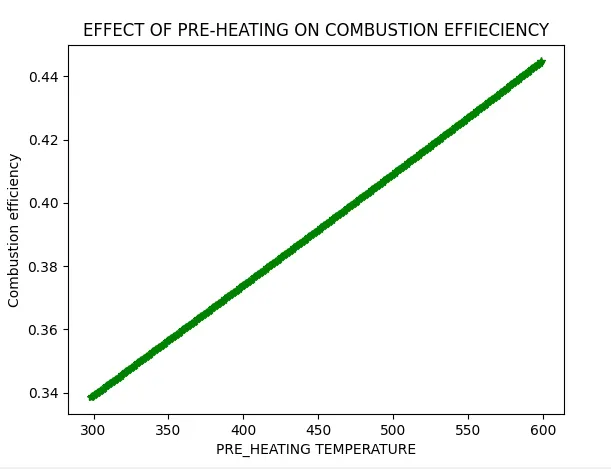
Conclusion: From the above plot we conclude that there is a increase in combustion efficiency with respect to pre heating of air.