Week 3 Verification of Weld Joints
OBJECTIVE:
The main objective of this project is to compare and find the best materials for welding two plates and two ribs with each other. This objective is fulfilled by comparing stress, strain ,deformation & maximum deformation on the welding joint bead as well as on the plates. The material for analysis used are
- PLATES – Stainless steel, aluminum alloy
- RIBS - Stainless steel, copper
- Welding bead- Stainless steel, alluminum, bronze.
The analysis is done in different cases using above mentioned materials in respective cases. Also to simulate the brazing process we consider the weld bead of bronze on copper ribs.
CASE SET UP & EXCECUTION
- GEOMETRY : The geometry consists of four parts namely Big plate, small plate, rib-1, rib-2 this is named in the geometry.
- MATERIALS : The materials are allocated to above mentioned parts depending on the case. For example:
In case 1: Ribs, small plate, large plate, weld beads- Stainless steel
In case 2: Ribs, Weld beads – Aluminum alloy
Plates- Stainless steel
In caase-3 : Ribs- copper
Plates- stainless steel
Weld bead- bronze
- CONTACTS : In this set up there are two different types of joints/contacts are defined
- Bonded- All the weld bead is in contact with the ribs and plates as bonded
- Frictional- The plates and ribs are in frictional contact with each other
- MESH : The sizing of the mesh is provided for the plates, the mesh sizes of the plate is 7mm elment.
- ANALYSIS SETTINGS : The only setting done here is the large deflection is ON.
- STATIC STRUCTURAL : The fixed support is given to the 5 holes at the center and at ends of large plate. Because at this points bolting or riveting to be done.
Force – The force = 15000N is applied at the center rectangular hole in downward direction. While X & Y component of force is zero.
- SOLUTION : The above analysis is done for the following results :
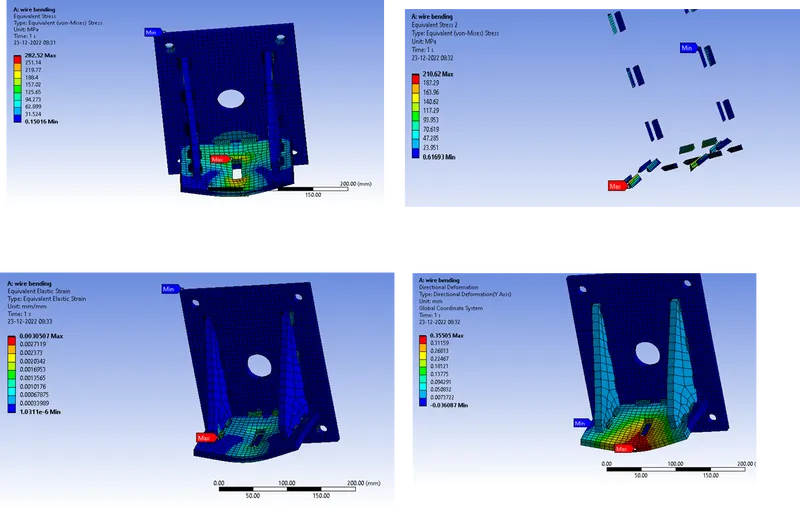
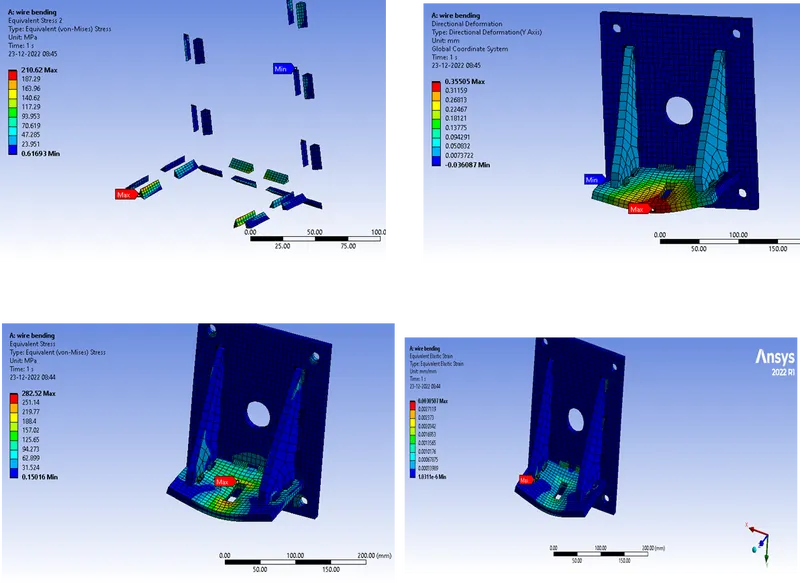
- Equivalent stress on all body
- Equivalent strain on all body
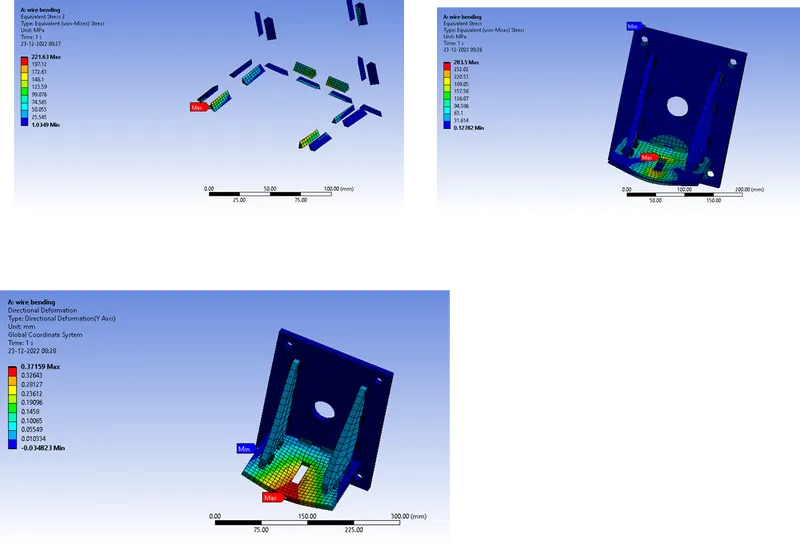
- Max stress on welding bead
- Max deformation of the plate
- Safety factor
RESULTS OF CASE-1 : STAINLESS STEEL PLATE
RESULT :2 – ALUMINUM ALLOY PLATE
RESULT- 3: COPPER RIBS & BRONZE WELDMENTS
The result data are tabulated as follows
|
MATERIAL |
DIRECTIONAL DEFORMATION |
STRESS IN WELD JOINT |
STRESS IN PLATES |
STRAIN |
|
Stainless steel |
0.342 mm |
248 MPa |
277 MPa |
0.0015 |
|
Aluminium alloy |
0.355 mm |
210 MPa |
280 MPa |
0.003 |
|
Copper ribs |
0.371 mm |
222 MPa |
283 MPa |
0.002 |
CONCLUSION :
From this analysis result it is clear that the maximum weld stresses are developed in Copper ribs case with bronze brazing. However, the comparative yield strength of the bronze weldment are much higher than other components. Hence, We can go for third case welding which has the highest factor of safety.
Apart from that all the weld components are safe because the stresses developed on the weld bead of each and every case here is within the elastic limit of the weldment material.