Week 3 - External flow simulation over an Ahmed body.
External flow simulation over an Ahmed body
Task: For this challenge, you will have to provide answers to the following questions:
Q1. Describe Ahmed's body and its importance.
Q2. Explain the reason for the negative pressure in the wake region.
Q3. Explain the significance of the point of separation.
Expected Results:
- Velocity and pressure contours.
- The drag coefficient plot for a refined case. (For velocity of 25m/sec, the drag coefficient should be around 0.33).
- The vector plot clearly showing the wake region.
- Perform the grid independency test and provide the values of drag and lift with each case.
Theory:
Ahmed Body is a simplified car body used to study the impact of the flow pattern on the drag. The external aerodynamics of the car defines many major traits of an automobile like stability and fuel consumption. The Ahmed Body, described originally by S.R.Ahmed in 1984 is a simplified car made of round front part, movable Z slant plane in the rear end to study the flow separation at different angles, and a rectangular box which link the front and rear ends.
Importance: The Ahmed body is a benchmark for aerodynamic simulation in the automotive industry. Its shape is simple enough to allow for accurate flow simulation but retains some important practical features. In the experiment, 3 main features were seen in its wake:
- The A-recirculation region is formed as the flow separates at the top of the vertical back surface of the model
- The B-recirculation region is formed due to the separation at the base of the model.
- The C-pillar vortices form as the vorticity in the boundary layers on the sides roll up over slant edges
The wake is dependant on the slant angle. When the slant angle is less than 12deg, the flow remains attached over the slant. In other words, the flow is 2D and has low drag. Between 12deg and 30deg the flow becomes much more three-dimensional as the C-pillar vortices form. These reach max. strength at 30deg. The drag increases significantly as the low-pressure cores act on the rear surfaces. Beyond 30deg, the flow separates fully off the slant. The results in a sudden decrease in drag and weaker C-pillar vortices.
Geometry Preparation:
Import the given Ahmed body model into Spaceclaim.
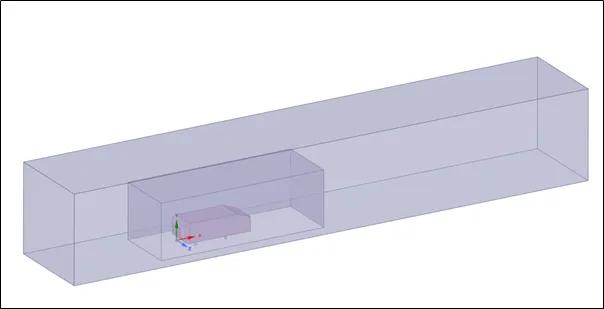
Outer Enclosure: Create an outer enclosure that is 3m in front of ahmed body, outlet wall at 5m distance from the rear of the model. Side walls are 0.5m away on each side. The top wall is 1 meter higher than the model and the bottom section of the enclosure is level with the low part of the body.
Inner Enclosure: A smaller enclosure is made to incorporate finer mesh around the ahmed body.
Note:
- Make sure the Interference between Outer Enclosure and Inner Enclosure are removed in Spaceclaim. (PrepareàInterference)
- Switch on “Share Topology” to ensure the mesh between outer enclosure and inner enclosure is connected.
Meshing:
The cases in this analysis are classified based on the grid dependency test. The follow are the details:
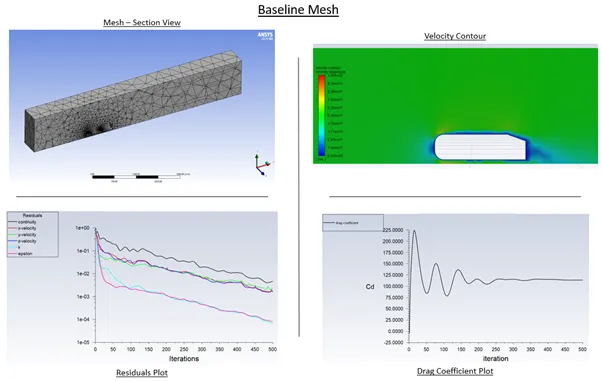
Baseline Mesh:
Overall Element Size: 413.6mm (Default)
Statistics: 16541 Nodes & 83781 Elements
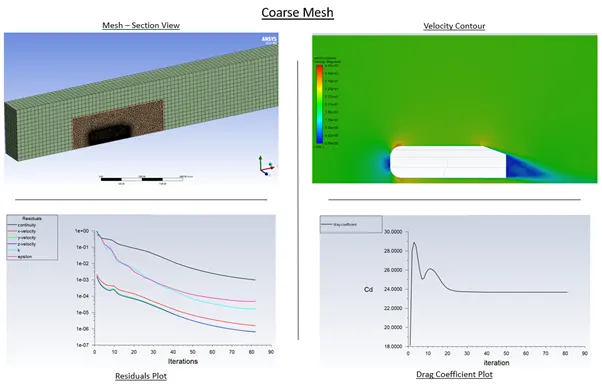
Case 1: Coarse Mesh
Overall Element Size: 100mm
Outer Enclosure – Multizone Mesh
Inner Enclosure – Body Sizing 50mm
Ahmed Body – Face Sizing 10mm (Except legs - 5mm)
Statistics: 180187 Nodes & 589806 Elements
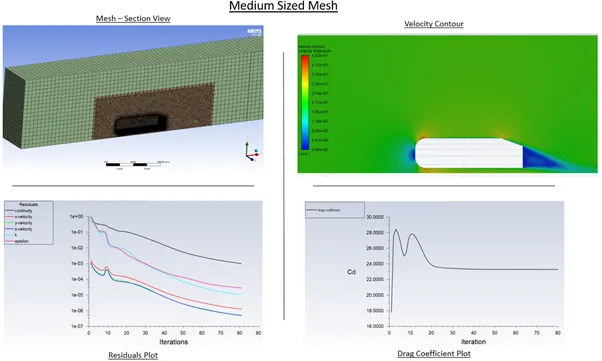
Case 2: Medium sized Mesh
Overall Element Size: 80mm
Outer Enclosure – Multizone Mesh
Inner Enclosure – Body Sizing 30mm
Ahmed Body – Face Sizing 10mm (Except legs - 5mm)
Statistics: 254083 Nodes & 946571 Elements
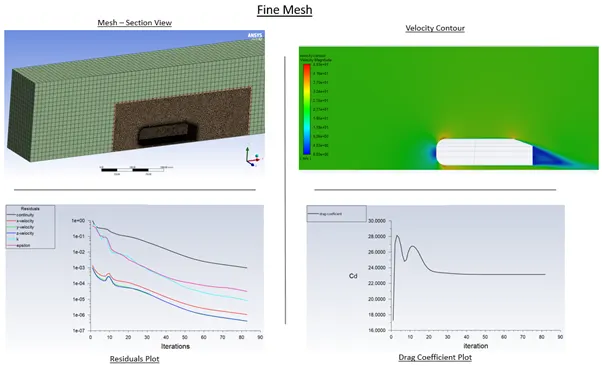
Case 3: Fine Mesh
Overall Element Size: 70mm
Outer Enclosure – Multizone Mesh
Inner Enclosure – Body Sizing 25mm
Ahmed Body – Face Sizing 10mm (Except legs - 5mm)
Statistics: 322556 Nodes & 1293975 Elements
Boundary Conditions:
Standard k-epsilon model with inlet velocity of 25m/s.
Working Fluid = Air
Temperature = 300K
Uniform Velocity at Inlet, Unform Pressure at outlet, Symmetry at Wall
Results: