Week 3 Challenge
Aim:- To discuss in detail the hydrological and geological parameters needed to fix the span of the bridge and thereby to calculate the scour depth of the foundation.
Explanation:-
- How hydrology and geotechnical studies are used in fixing span and type of bridge?
- Mostly in the hydrological aspect, scouring is one of the most important parameters. The hydrological study will give us a detailed idea about the intensity of the water at the location and also will help us to find out the scour depth at that location.
- Hydrological data will enable us to know that whether the bridge will be a high-level bridge or a submersible bridge. Finding a linear waterway so that the scouring should be less is also one of the most important aspects.
- Topographical sheets will provide us the information about the catchment area, upstream side downstream side & the ridgeline of the waterway so that the location of the bridge should be decided.
- Countour sheets and contour plans of the location should also be studied to get an idea about the difference in the level of the surfaces in the nearby vicinity of the bridge.
- When we are fixing the location and the height of the bridge the following information should also need to be gathered such as previous year flood data that can be obtained from various government departments, markings available on the existing bridges about HFL, etc. Also if there are some nearby dams that should be taken into consideration for design discharge calculation.
- Also, STP should give the necessary details about the sub-surface strata for fixing the bridge location.
- Determine the scour depth at the pier and abutment location having silt factor =3
Design discharge = 1000 cumecs
Linear waterway = 128 m
Silt factor Ksf = 3
Design discharge = 1000 m^3
Linear water way = 128m
Design discharge/unit width = Db = 1.3Q/L = 1.3(1000)/128 = 10.156 m^3----------------(1)
Mean depth of scouring Dsm = 1.34((Db^2/Ksf)^1/3) = 1.34((10.156^2/3)^1/3) = 4.375 m -------(2)
maximum scour depth of pier and abutment will scour all around
Dm = 2Dsm; Dm = 2*4.375; Dm = 8.75m----------------------------------------------------(3)
Maiximum scour depth for the abutment with approach retained
Dm = 1.27Dsm; Dm = 1.27*4.375; Dm = 5.556m---------------------------------------------(4)
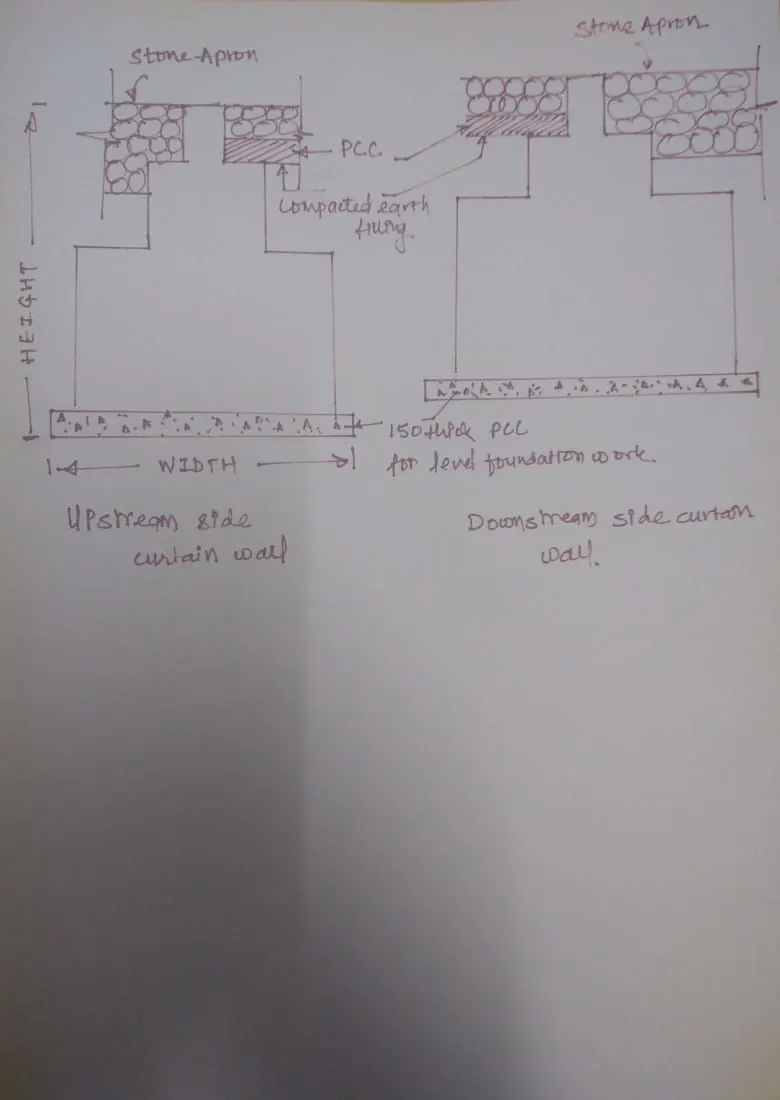
- What measures can be taken to avoid scour at the bridge? Draw sections of the curtain wall upstream and downstream of the bridge.
Scouring is the most difficult problem that is needed to be overcome to make the foundation stable. If the velocity of the river is greater than the mean velocity then the scouring will occur that can be backed by soil particles. Greater the size of particle more will be the scouring, which ultimately disturbs the stability of the foundation because of exposure of footing and this needs to be avoided.
Following are some of the methods to avoid scouring:-
- The depth of the foundation should be adequate.
- An appropriate apron should be provided.
- Protection work.
- Cut-off wall/Curtain walls.
Curtain wall section:-
- What is uplift and how it can affect the foundation? (loss of contact)
Uplift is the pressure exerted by the water on the structure. This is a very dominating force if water finds a way to percolate it will exert an uplift force on bridges. The uplift force is not good if its magnitude is greater than the self-weight of the structures. It ultimately reduces the weight of the structure and affects the stability also.
Uplift in U-Trouh with the different water levels on the top of ramp wall:-
The magnitude of uplift force at (3m) height:- γw*h*A = 10*3*(10.21*0.58) = 117.654 kN--------(A)
The magnitude of uplift force at (4m) height:- γw*h*A = 10*4*(10.21*0.58) = 236.872 kN--------(B)
The magnitude of uplift force at (5m) height:- γw*h*A = 10*5*(10.21*0.58) = 296.090 kN--------(C)
- Measurement to avoid uplift
Uplift is caused if there is tension in the foundation, if such is the case then the redistribution of the forces and the moment has to be for uniform distribution of pressure underneath.
Two cases of the distribution can be done in order to avoid tension in the foundation that is e<b/6 or e=b/6.