Week 3.5 - Deriving 4th order approximation of a 2nd order derivative using Taylor Table method
Derivation:-
to derive the fourth order approximation for the second order derivative .
`(del^2 u)/(delx^2)=(af(i-2)+bf(i-1)+cf(i)+df(i+1)+ef(i+2))/dx-------------(1)`
taylor series derivation above eqaution.
`af(i-2)=af(i)-(2af'(i)dx)/(1!)+(4af''(i)dx^2) /(2!) +(8af'''(i)dx^3)/(3!)+(16af''''(i)dx^4)/(4!)`
Using taylor method express in table form
dx2 f''(i) f(i) f'(i)dx f''(i)dx2 f'''(i)dx3 f''''(i) dx4
af(i-2) a -2a 2a -4a/3 2a/3
bf(i-1) b -b b/2 -b/6 b/24
cf(i) c 0 0 0 0
df(i+1) d d d/2 d/6 d/24
ef(i+2) e 2e 2e 4e/3 2e/3
sum of 0 0 1 0 0
cofficient
euation conert into the matrix form
AX=B
<!--[endif]--><!--[endif]-->
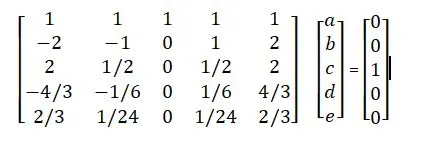
<!--[endif]--><!--[endif]-->
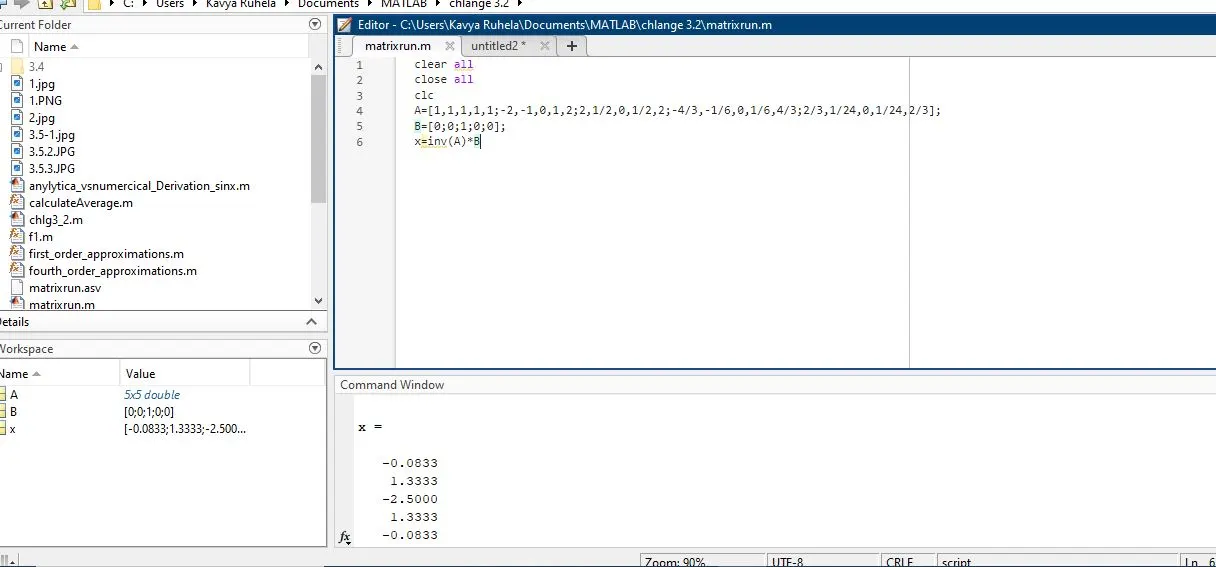
x=inv(A)*B
respectively cofficient values.
Values put in equation (1):-
a=-0.8333
b=1.3333
c=-2.5000
d=1.3333
e=-0.0833
`(del^2 u)/(delx^2)=((0.0833)f(i-2)+(1.3333)f(i-1)+(-2.5000)f(i)+(1.3333)f(i+1)+(0.0833)f(i+2))/dx`
SKEWED RIGHT HAND DIFFERENCE SCHEME:
NO OF NODES:
The number of nodes = p+q
Where, p is order of derivative.
q is order of approximations.
The no of nodes = 2+4 =>6.
DERIVATION:
To derive a fourth order approximation for the second order derivative,we start with these approximation,
`(del^2u)/(delx^2)=(af(i)+bf(i+1)+cf(i+2)+df(i+3)+ef(i+4)+gf(i+5))/dx^2`-----------------------(2)
Using taylor method express in table form
| `dx^2f''(i)` | f(i) | f'(i)dx | f''(i)dx2 | f'''(i)dx3 | f''''(i) dx4 | `f'''''(i) dx^5` |
| af(i) | a | 0 | 0 | 0 | 0 | 0 |
| bf(i+1) | b | b | `b/2` | `b/6` | `b/24` | `b/120` |
|
cf(i+2) |
c | 2c | `(4c)/2` | `(8c)/6` | `(16c)/24` | `(32c)/120` |
| df(i+3) | d | 3d | `(9d)/2` | `(27d)/6` | `(81d)/24` | `(243d)/120` |
| ef(i+4) | e | 4e | `(16e)/2` | `(64e)/6` | `(256e)/24` | `(1024e)/120` |
| gf(i+5) | g | 5g | `(25g)/2` | `(125g)/6` | `(625g)/24` | `(3125g)/120` |
| sum of co-efficients | 0 | 0 | 1 | 0 | 0 | 0 |
Linera eqaution convert into the mtrix form;-
AX=B
`[[1,1,1,1,1,1],[0,1,2,3,4,5],[0,1/2,4/2,9/2,16/2,25/2],[0,1/6,8/6,27/6,64/6,125/6],[0,1/24,16/24,81/24,256/24,625/24],[0,1/120,32/120,243/120,1024/120,3125/120]]`.`[(a),(b),(c),(d),(e),(g)]`=`[(0),(0),(1),(0),(0),(0)]`
x=inv(A)*B
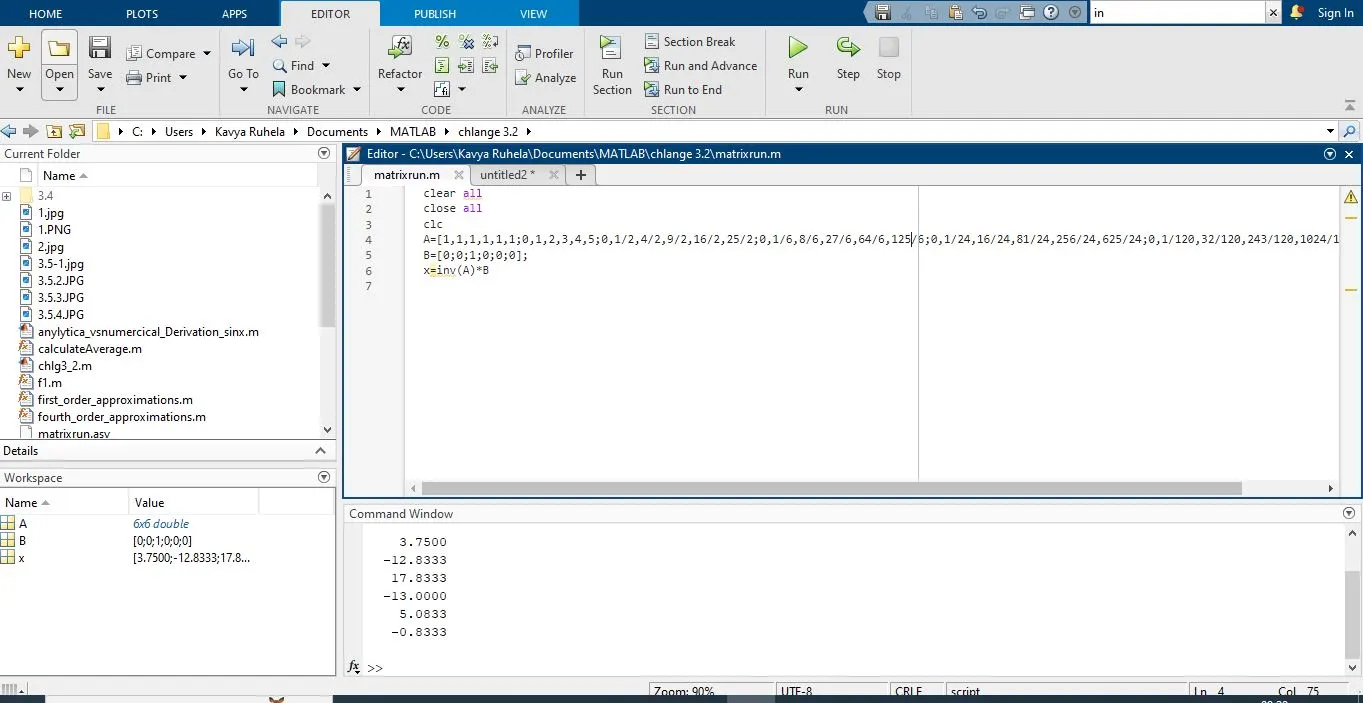
a=3.7500
b=-12.8333
c=17.83333
d=13.0000
e=-12.8333
g=-0.8333
Subsistue these values in equation-(2)
`(del^2u)/(delx^2)=((3.7500)f(i)+(12.8333)f(i+1)+(-17.8333)f(i+2)+(-13.0000)f(i+3)+(5.0833)f(i+4)+(-0.8333)f(i+5))/dx^2`
skewed left hand differnce scheme:-
no of nodes
=p+q
Where, p is order of derivative.
q is order of approximations.
The no of nodes = 2+4 =>6.
derivation
fourth order approximation for the second order derivation:-
`(del^2u)/(delx^2)=(af(i-5)+bf(i-4)+cf(i-3)+df(i-2)+ef(i-1)+gf(i))/dx^2`------------------(3)
| `dx^2f''(i)` | f(i) | f'(i)dx | f''(i)dx2 | f'''(i)dx3 | f''''(i) dx4 | `f'''''(i) dx^5` |
| af(i-5) | a | -5a | `(25a)/2` | ``-(125a)/6`` | ``-(625a)/25`` | `-(3125a)/120` |
| bf(i-4) | b | -4b | `(16b)/2` | `-(64b)/6` | ``(256b)/24`` | `-(1024b)/120` |
|
cf(i-3) |
c | -3c | `(9c)/2` | `-(27c)/6` | `(81c)/24` | `-(243c)/120` |
| df(i-2) | d | -2d | `(4d)/2` | `-(8d)/6` | `(16d)/24` | `-(32d)/120` |
| ef(i-1) | e | -e | `(e)/2` | `-(e)/6` | `(e)/24` | `-(e)/120` |
| gf(i) | g | 0 | `0` | `0` | `0` | `0` |
| sum of co-efficients | 0 | 0 | 1 | 0 | 0 | 0 |
linear Equation in matrix form:-
AX=B
``[[1,1,1,1,1,1],[-5,-4,-3,-2,-1,0],[25/2,16/2,9/2,4/2,1/2,0],[-125/6,-64/6,-27/6,-8/6,-1/6,0],[625/24,256/24,81/24,16/24,1/24,0],[-3125/120,-1024/120,-243/120,-32/120,-1/120,0]]``.`[(a),(b),(c),(d),(e),(g)]`=`[(0),(0),(1),(0),(0),(0)]`
x=inv(A)*B
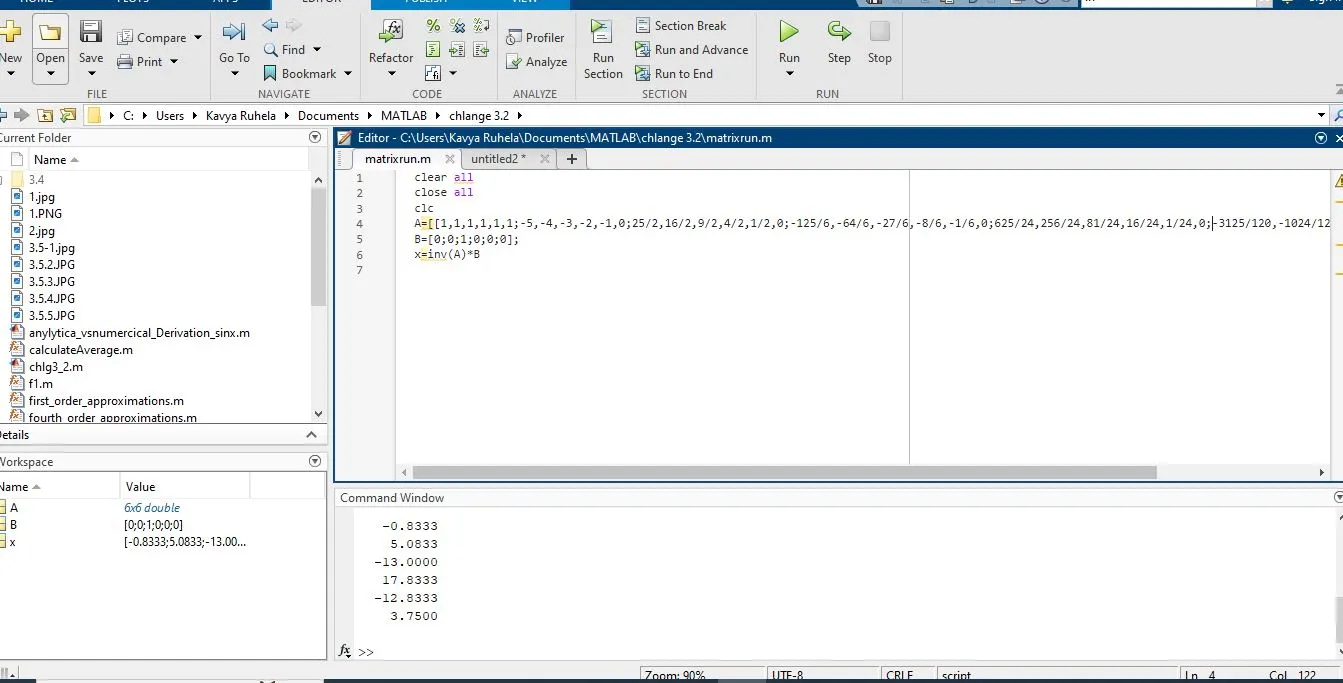
a= -0.8333
b= 5.0833
c=-13.0000
d= 17.83333
g=3.7500
Subsistue these values in equation-(3)
`(del^2u)/(delx^2)=((-0.8333)f(i-5)+(5.0833)f(i-4)+(13.0000)f(i-3)+(17.8333)f(i-2)+(-12.8333)f(i-1)+(3.7500)f(i))/dx^2`
Matlab Code:-
FOURTH ORDER CENTRAL DIFFERNCING:-
function error_cental_differncing=fourth_central_differncing(x,dx)
% anyltic function =exp(x)*cos(x)
%analytic_derivative
% f'(x)=exp(x)*cos(x)-exp(x)*sin(x)
% f''(x)=-2*exp(x)*sin(x)
analytic_derivative=-2*exp(x)*sin(x);

%numerical_derivative
�ntral differncing
central_differncing=(((-0.0833)*((exp(x-(2*dx)))*(cos(x-(2*dx)))))+((1.3333)*((exp(x-dx))*(cos(x-dx))))-((2.5000)*((exp(x))*(cos(x))))+((1.3333)*((exp(x+dx))*(cos(x+dx))))-((0.0833)*((exp(x+(2*dx)))*(cos(x+(2*dx))))))/(dx^2);
error_cental_differncing=abs(central_differncing-analytic_derivative);
end
SKEWED RIGHT HAND DIFFERENCE SCHEME:
function error_skewed_right_hand=fourth_order_skewed_right_differnce(x,dx)
% anyltic function =exp(x)*cos(x)
%analytic_derivative
% f'(x)=exp(x)*cos(x)-exp(x)*sin(x)
% f''(x)=-2*exp(x)*sin(x)
analytic_derivative=-2*exp(x)*sin(x);

%numerical_derivative
�ntral differncing
right_side_skew=(((3.7500)*((exp(x))*(cos(x))))-((12.8333)*((exp(x+dx))*(cos(x+dx))))+((17.8333)*((exp(x+(2*dx)))*(cos(x+(2*dx)))))-((13.0000)*((exp(x+(3*dx)))*(cos(x+(3*dx)))))+((5.0833)*((exp(x+(4*dx)))*(cos(x+(4*dx)))))-((0.8333)*((exp(x+(5*dx)))*(cos(x+(5*dx))))))/(dx^2);
error_skewed_right_hand=abs(right_side_skew-analytic_derivative);
end
SKEWED LEFT HAND DIFFERENCE SCHEME:
function error_skewed_left_hand=fourth_order_skewed_left_differnce(x,dx)
% anyltic function =exp(x)*cos(x)
%analytic_derivative
% f'(x)=exp(x)*cos(x)-exp(x)*sin(x)
% f''(x)=-2*exp(x)*sin(x)
analytic_derivative=-2*exp(x)*sin(x);

%numerical_derivative
�ntral differncing
left_side_skew=(((-0.8333)*((exp(x-(5*dx)))*(cos(x-(5*dx)))))+((5.0833)*((exp(x-(4*dx)))*(cos(x-(4*dx)))))-((13.0000)*((exp(x-(3*dx)))*(cos(x-(3*dx)))))+((17.8333)*((exp(x-(2*dx)))*(cos(x-(2*dx)))))-((12.8333)*((exp(x-dx))*(cos(x-dx))))+((3.7500)*((exp(x))*(cos(x)))))/(dx^2);
error_skewed_left_hand=abs(left_side_skew-analytic_derivative);
end
MAIN CODE:-
close all
clear all
clc
% value of x
x=pi/3;
% range of dx
dx=linspace(pi/4,pi/4000,20);

for i=1:length(dx)
    central_differncing(i)=fourth_central_differncing(x,dx(i));
    right_side_skew(i) =fourth_order_skewed_right_differnce(x,dx(i));
   left_side_skew(i) =fourth_order_skewed_left_differnce(x,dx(i));
end

figure(1)
loglog(dx,central_differncing)
hold on
loglog(dx,right_side_skew,'r')
hold on
loglog(dx,left_side_skew,'g')
xlabel('range of dx')
ylabel('truncation error')
legend('central differncing','right side skew','left side skew')
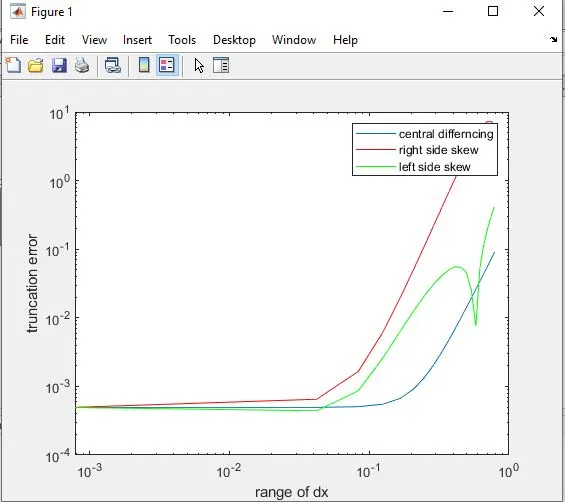
LOGLOG GRAPH REPRESNTION
Conclusion:-
as per graph curve central differncing is very less error as compared to the right side skews scheme & left side skews scheme.ln the left and right skewed differnce method uses data only it gives the approximate and accurate values.
Why skewed scheme is useful:- the system is dose not