Week 2 Session 7
QUE:1
ANSWER:Architecture of HEV
The key components in an HEV consist of an electric
motor (EM), battery, convertor, ICE, fuel tank and control
board. These components can be categorized into three
groups:
1. Drivetrains—physically integrate the ICE power
source and electric drive.
2. Battery/energy storage system (ESS)—emphasizes
large or modest energy storage and power capabilities.
3. Control system—instructs electric systems/ICE and
manages the HESS.
These components can be integrated in different ways and
sizes which results in variation in vehicle design. Based on
the component integration, drivetrains mainly include series, parallel and power split designs. In [6] the HEV’s
architecture has been classified into six different categories,
which are mild/microparallel, parallel, series, power split,
combined and through-the-road (TTR) hybrids.
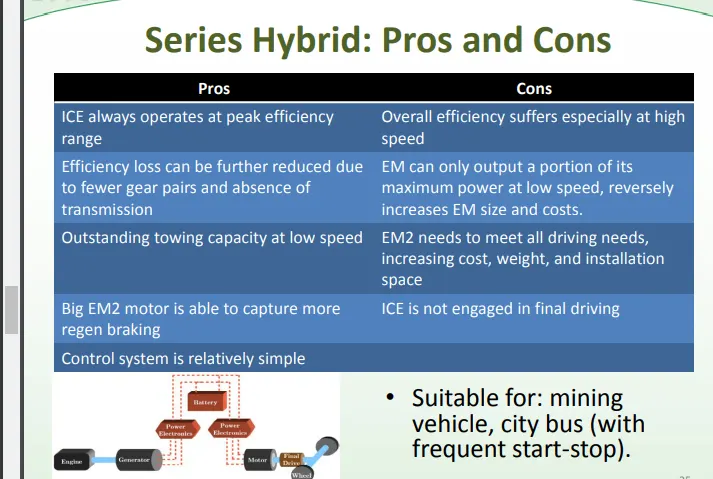
In series HEV, the power sources provide electrical
energy at DC bus, which is then converted to traction
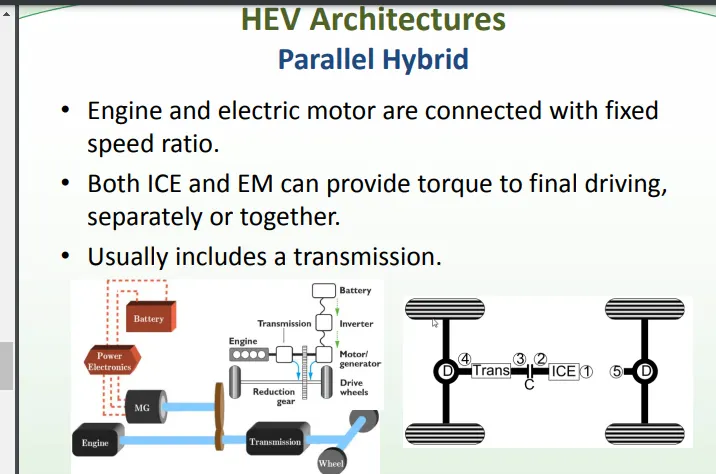
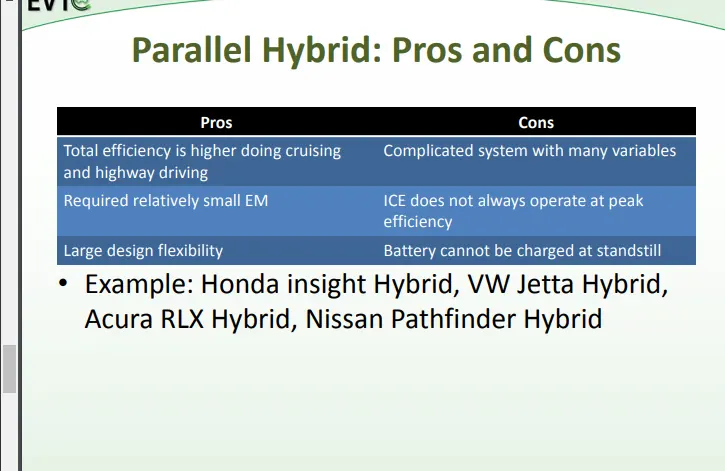
power [7]. In parallel HEVs, traction power can be supplied by ICE or EM alone, or together by both the sources.
The EM is used to charge the HESS by means of regenerative braking [8]. The parallel mild HEV is an ideal
option as they provide a prime trade-off between the cost of
vehicle and its performance [9]. Complex HEVs incorporate features of both parallel as well as series architecture.
They are almost like the series–parallel hybrid except for
the variance in power flow of the motor, which is bidirectional in complex hybrid and unidirectional in series–
parallel HEVs. The disadvantage of complex hybrid is its
complexity in design. A pictorial representation of these
architectures is given in Fig. 2.
Architecturally, PHEV is similar to HEVs except for a
large-size onboard battery, having high energy density and
efficiency. The combination of CS and CD modes requires
a more complex control strategy than in an HEV. PHEVs
begin operation in CD mode; and as soon as the battery
reaches a threshold value of SOC, the battery shifts to CS
mode until the vehicle is parked and recharged. The
architecture of a solar-driven HEV (PVHEV) is similar to
the PHEV except for an additional photovoltaic (PV) panel,
which charges the battery during a sunny day. To extract
the maximum power from PV panels, the maximum power
point tracker (MPPT) algorithms are applied. The block
diagram of PVHEV is shown in Fig. 3.
Patterns of power flow:
The power flows in HEVs to encounter the load demand
are given in Fig. 4. There are many possible patterns as
given below [10]:
1. powertrain 1 alone delivers power to load;
2. powertrain 2 alone delivers power to the load;
3. both powertrains 1 and 2 deliver power to load at the
same time;
4. powertrain 2 obtains power from load (regenerative
braking);
5. powertrain 2 obtains power from powertrain 1;
6. powertrain 2 obtains power from powertrain 1 and load
at the same time
Electric Vehicle Characteristics;
Must have One or more electric machines (EMs)
• Must have an energy storage system (ESS) other than the
fossil fuel tank.
• The EMs must provide propulsion power (partially or full)
Key components of an EV powertrain:
– Electric Machines (EM)
– Power electronics
– Energy management system (EMS)
– Energy Storage system (ESS)
• EV classification and their electrification levels.
• Powertrain architecture design philosophy.
• EV powertrain architectures:
– Battery Electric vehicle (BEV)
– Hybrid electric vehicle (HEV)
– Plug-in hybrid vehicle (PHEV)
– Fuel cell electric vehicle (FCEV)
Some Useful Terminology:
Internal combustion engine (ICE): an engine that drives a piston by the
hot air produced by the burning of gasoline, oil, or other fuel with air
inside.
• Transmission: A gearbox that use gears and gear trains to provide speed
and torque conversion between one rotating power source to another.
• Differential (D): a geartrain that splits the torque two ways, allowing each
output to spin at different speed when vehicle is turning.
• Clutch: a mechanism for connecting and disconnecting a vehicle’s engine
from its transmission system.
• Electric machine (EM): a general term for electric motors and electric
generators.
• Energy management system (EMS) : A system that controls the flow of
energy from multiple energy sources
Powertrain Architecture Design Philosophy:
HEV Architectures:
Series hybrid
Parallel hybrid
Split-power hybrid
Compound hybrid
HEV Architectures
Series Hybrid
• ICE and EM are connected in series
• Basic components: ICE, electric generator (EM1),
electric motor (EM2), and ESS (battery)
• Only EM provides torque to the final drive