Week 2 Session 7
2. The various architecture of HEV are as follows
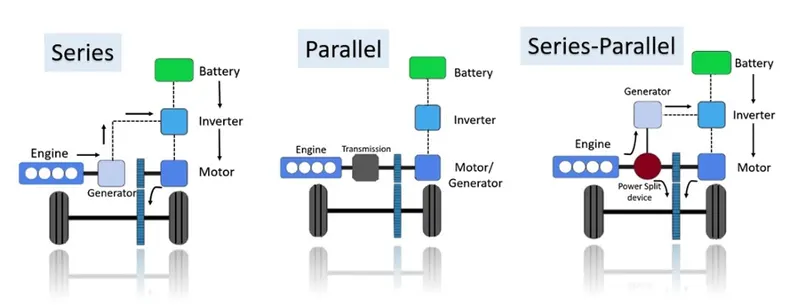
i)Series architecture
In a series hybrid even though there is both motor and IC engine, only the motor is connected to the transmission system. In such a system, the IC engine is used to produce electrical power through a generator placed inside the system. The electrical power produced in the generator is either used to charge the battery or to aid the battery by directly powering the electric motor when peak power is in demand. The advantage of this kind of architecture is that complex gear arrangements can be avoided. Comparatively lower efficiency is the disadvantage of this system as the energy is wasted while converting mechanical energy to electrical energy and vice versa. Also, the generator demands additional space of vehicles and therefore this kind of system is commonly used in large vehicles and military vehicles where space is not a concern.
eg:Military vehicles
A series hybrid vehicle can have 4 modes of operation.
a)Engine only
In this mode of operation, the electrical energy produced in the generator by the IC engine is only used to drive the wheels.
b)Battery only
In this mode, the motor takes power only from the battery
c)Hybrid
This mode is generally activated when there is a high power or torque requirement. In such a situation, both the IC engine and the battery will be supplying power to the motor based on the inputs from the controller.
d)Regenerative
In this mode of operation, during deceleration or braking, the kinetic energy in the wheels is converted to electrical energy by the motor as it will be operating in the 4th quadrant as a generator. The generated energy will be stored back to the battery.
Advantages
The need for a complicated multi-speed transmission and clutch is eliminated in series hybrids since only the electric motor directly drives the transmission, which may have one gear.
The engine operates at its maximum efficiency point as it can work independent of the wheels and transmission.
Disadvantages
The series hybrid requires a larger, more complicated battery and motor to meet its power needs.
The system is costlier as an additional generator is used.
Losses are comparatively high as energy is converted multiple times among electrical and mechanical energy.
ii)Parallel architecture
In this architecture, both the motor and the IC engine are connected to the transmission system and can independently drive the wheels as per the situation.This is the popular configuration in passenger cars. Similar to Series architecture parallel also has 4 modes of operation
eg Honda civic
a)Engine only
In this mode of operation, the IC engine is only used to drive the wheels.
b)Battery only
In this mode, only the motor is used to power the vehicle.
c)Hybrid
This mode is generally activated when there is a high power or torque requirement. In such a situation, both the IC engine and the battery will be driving the transmission based on the inputs from the controller.
d)Regenerative
In this mode of operation, during deceleration or braking, the kinetic energy in the wheels is converted to electrical energy by the motor as it will be operating in the 4th quadrant as a generator. The generated energy will be stored back to the battery.
Advantages
Has a higher transmission efficiency due to the mechanical connection between the engine, electric machine and vehicle wheels.
More responsive than Series hybrid as there is minimum transmission lag from the ICE.
Disadvantages
It has a complex design.
iii) Series parallel architecture (Power Split)
This architecture employs a power split unit and can act as series architecture and parallel architecture as it is having 2 paths for the power flow.
a)Acting as a series hybrid.
In this arrangement, the power is transferred from the engine to the wheels as in a series architecture where a generator converts the mechanical power to electrical power and is supplied to the motor.
b)Acting as parallel architecture.
In this arrangement, Bot the IC engine and Motor is connected parallel and can operate independently through a power split unit, based on the controller input.
This system was first introduced in Toyota Prius.
In this system, the motor and IC engine can be switched based on the driving condition
Eg:Toyota Prius.
Advantages
Efficiency is high.
Power is available instantly.
Disadvantages.
System is bulky
It is more expensive as complex design and extra generator are involved.