Week 2 Railwheel and Track
Aim:
Conduct a structural analysis of the rail wheel assembly. Carry out the simulation to compare the behavior of the assembly to different loading conditions.
Objective:
- Conduct structural analysis on rail wheel assembly with the structural steel as material.
- Generate a mesh to the geometry.
- Define the case using contacts, joints, and loads.
- Appropriate analysis settings are given and solve for the required outputs.
- Compare the results and also validate the user-defined result request with the solver-generated result.
Theory:
In general, the load from the carriage of the train will be acting on the wheel through-axle and thus wheel of a trail will be under continuous loading. The wheel is supported by a rail that is fixed to the ground. The rolling movement can be observed at the wheel while carrying the load acting through the axle.
Here, the wheel is assumed to carry a load of 1,00,000N and a displacement of 500mm along the rail is given.
As the wheel is under loading, deformation will happen in all three directions along the direction of standard axes. To find the total deformation, the resultant of all these three deformations will be considered.
`"Total deformation", d = sqrt((d_x)^2+(d_y)^2+(d_z)^2`
Procedure:
- The static structural analysis system is loaded into the project schematic.
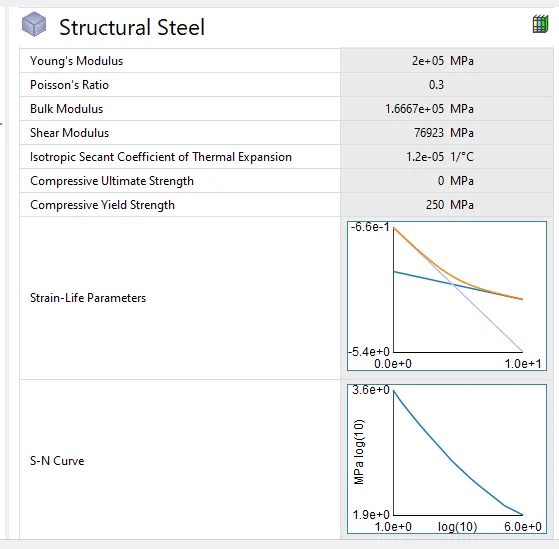
- Structural steel is taken as the default material.
- The rail wheel assembly is imported into the geometry panel.
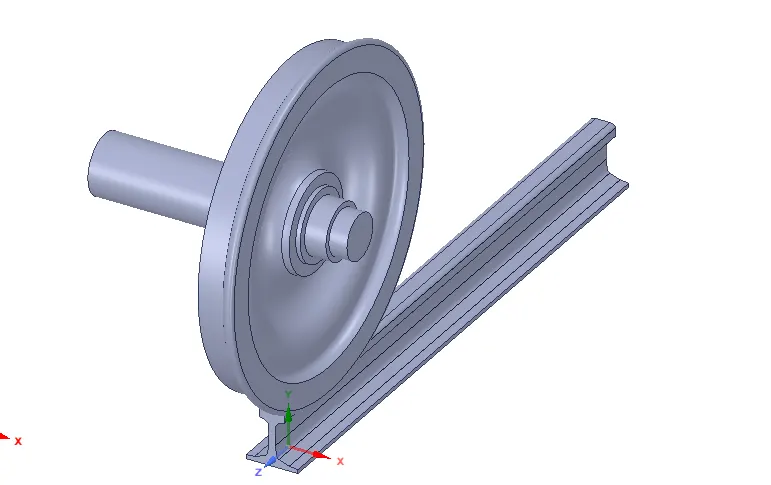
- The mechanical module is loaded and structural steel is assigned as the material under the properties.
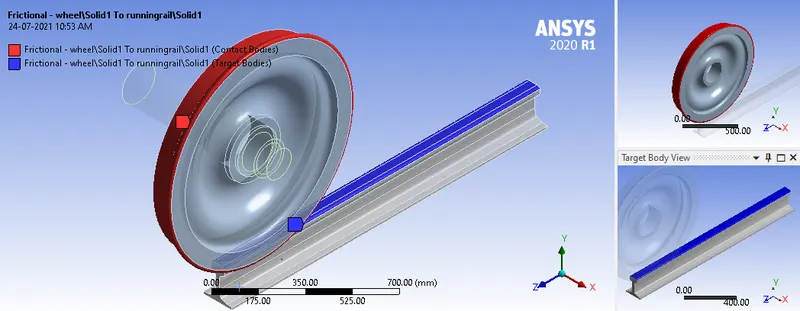
- Frictional contact with a frictional coefficient of 0.2 is applied, while the wheel is defined under contact, and rail is defined under the target body.
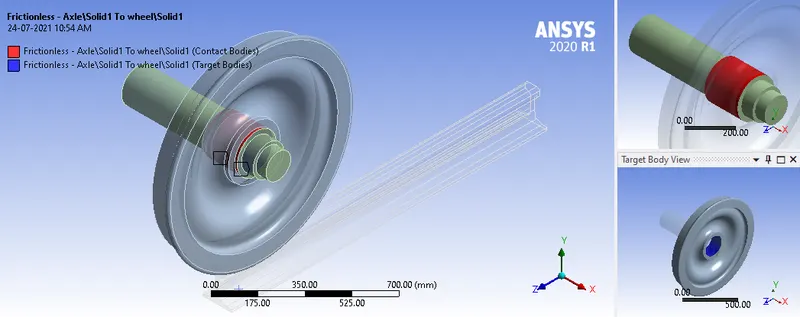
- A fiction-less contact is also applied, while the axle is kept under contact and the wheel is kept under the target body.
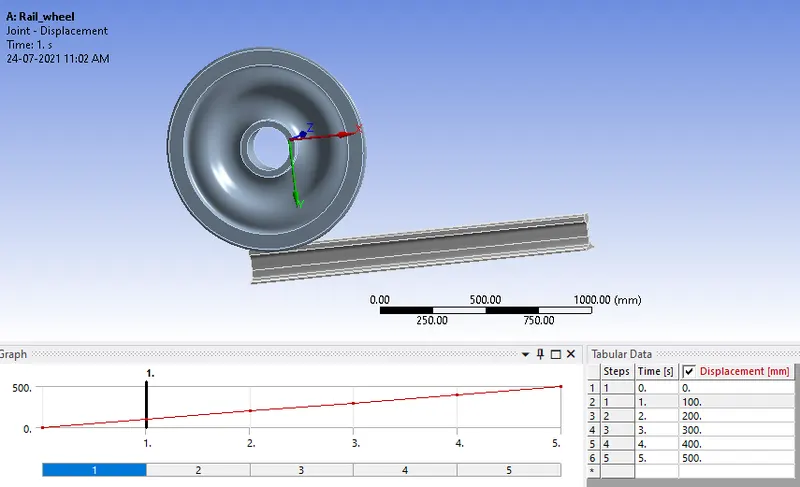
- The rail is fixed, the axle is allowed to translate along the rail and the wheel is restricted to be in plane with the appropriate joint definitions.
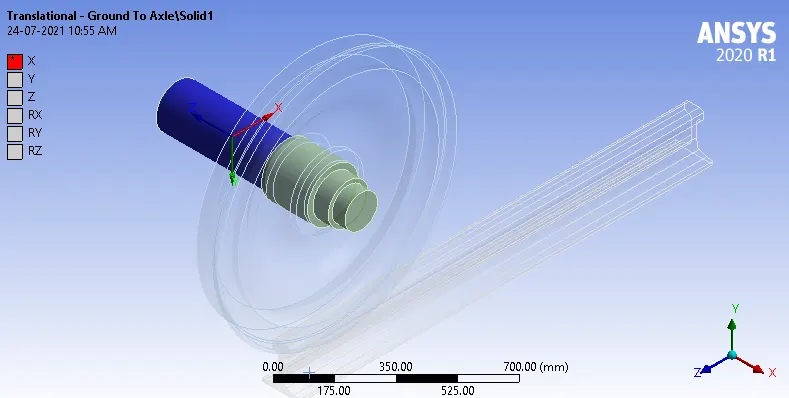
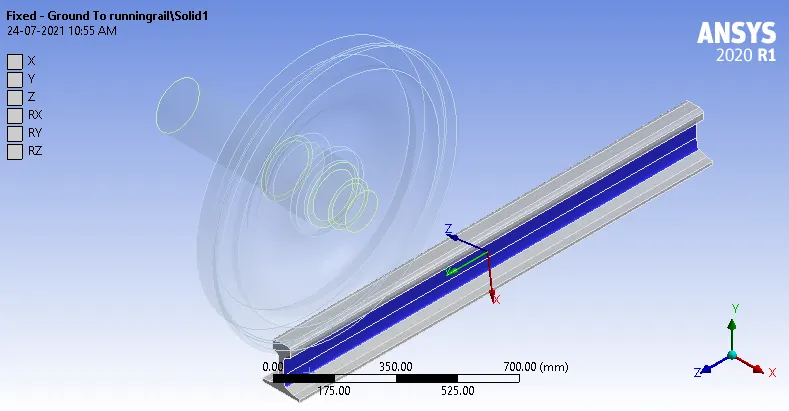
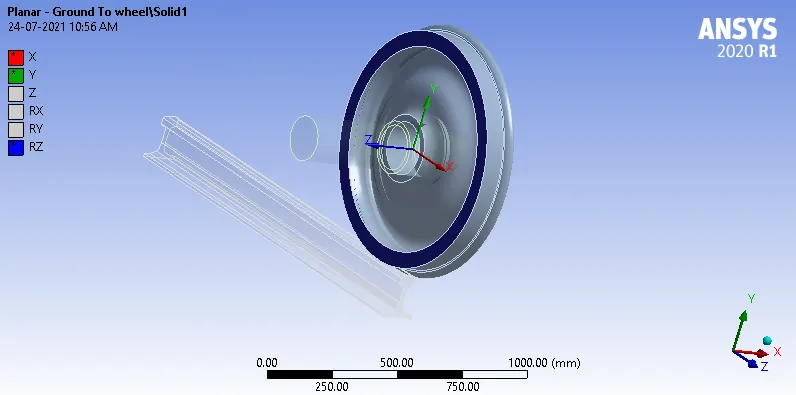
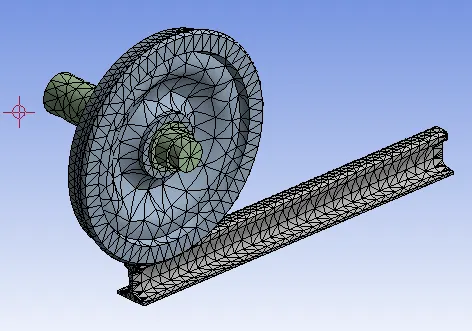
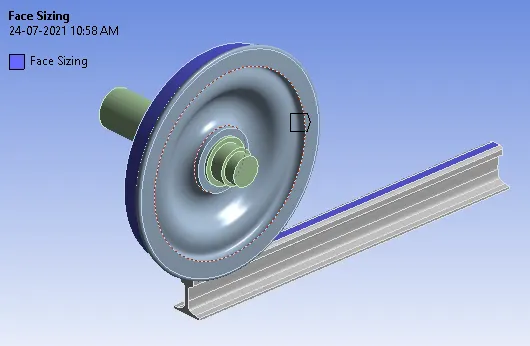
- Mesh with an element size of 50mm while having a face sizing of 35mm at the below-shown faces is generated.
- Appropriate analysis settings with 5 steps are defined.
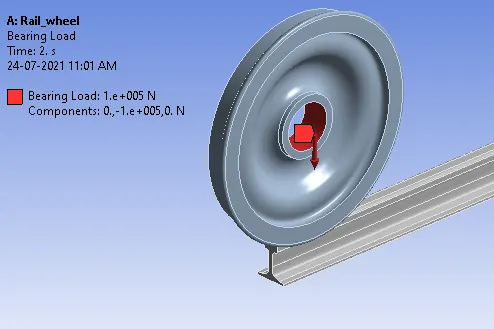
- A bearing load of 1,00,000N is applied to the wheel inner face at the axle position in the –Ve Y direction.
- Translational displacement of 500mm along the rail i.e., X direction is applied.
- Required results are requested and the model is solved.
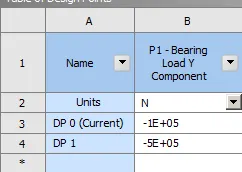
- The design points are defined under the parameter set and the solution is obtained at different parameters.
Results:
|
Bearing Load Y Component (N) |
Total Deformation Maximum (mm) |
User-Defined Result, Total deformation Maximum (mm) |
Equivalent Stress Maximum (MPa) |
Life Minimum (Cycles) |
|
| Case 1 | -100000 | 997.557 | 997.557 | 89.37 | 8.123e+5 |
| Case 2 | -500000 | 997.198 | 997.198 | 353.85 | 3949.8 |
Conclusions:
Total deformation (mm):
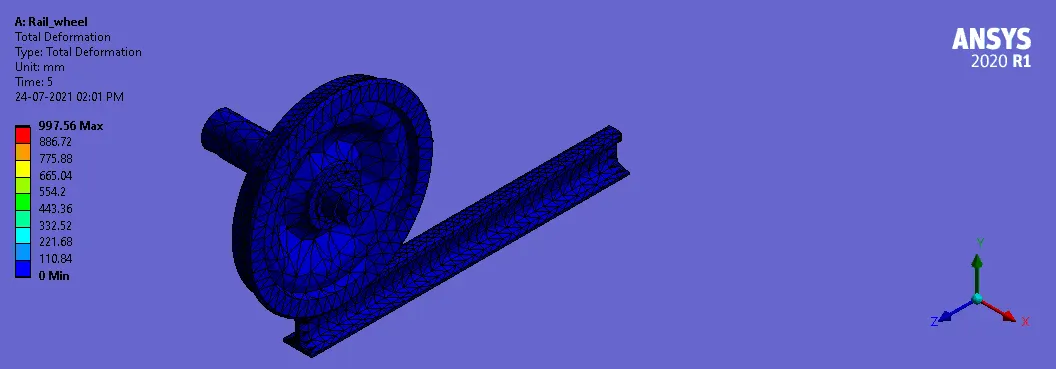
User-defined result for the total deformation defined using an appropriate mathematical expression is found to generate the same results as the in-built result for the total deformation.
The maximum total deformation occurred in case 1 load condition is 997.56mm, maximum total deformation occurred during case 2 load condition is 997.12mm. No significant difference is observed in the total deformation between both loading conditions.
Equivalent stress (MPa):
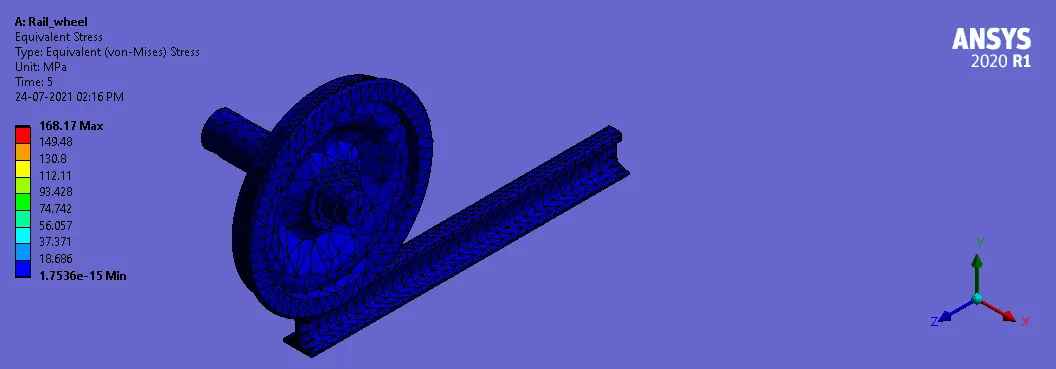
The maximum equivalent stress developed during the case 1 load condition is 89.37MPa. The maximum equivalent stress developed during the case 2 load condition is 353.85MPa. Large stress development is observed in case 2 load condition compared to case 1 load condition, showing that increase in the load results in a significant increase in the stress developed.
Life (Cycles):
Under a load of 100000N, the fatigue performance is observed to have a minimum life of 8.123e+5 cycles whereas, under a load of 500000N, the fatigue performance is observed to have a minimum life of 3949.8 cycles.
The model is found to have a better life under fatigue conditions with case 1 compared to case 2 i.e., smaller loads will be suitable for better life performance.