Week 2 - Flow over a Cylinder.
1) Aim -
- Simulate the flow over the cylinder and explain the phenomenon of Karman vortex street.
- First,simulate the flow with steady and unsteady case and calculate the Strouhal Number.
- Second,calculate the coefficient of drag and lift over a cylinder by setting the Reynolds number to 10,100,1000,10000 & 100000(run with
steady solver)
- Then,discuss the efffects of Reynolds number on the coefficient of drag(results should be validated with any standard literature and
error should be within 5%)
- In both approaches show that the flow has converged.Mention the quantities or plot which determine that the flow has converged.
- Plot the coefficient of drag and lift.
- Plot to show vortex shedding behind the cylinder.
2) Objective -
- Study and understand the Karman vortex street phenomenon.
- Using Ansys SpaceClaim create a 2D geometry of given dimensions.
- Generate fine enough mesh and inflation layers around the cylinder wall.
- Simululate,
1)At Re = 100,simulate the flow with steady and transient method and calculate the Strouhal number.
2)For the given Reynolds number values calculate the coefficient of drag and coefficient of lift over a cylinder.
- Discuss the effects of reynolds number on coefficient of drag.
- Show that the flow has converged with the help of the quantities or plot which determine that the flow has converged.
- Plot the graphs of coefficient of drag and coefficient of lift.
- Plot to show vortex shedding behind the cylinder.
- Write down the detailed report of the project.
3) Introduction -
The flow around a circular cylinder is a simple flow and has been studied for long time.However,it is often by gaining a deeper
understanding of simple phenomena that we learn useful lessons for wider contexts.This project shows some of the results of numerical simulations that modelled laminar flow around a circular cylider.An understanding of this flow can yield insights into the flow fields surrounding airplanes,submarines,buildings and bridges.
4) Theory -
The Reynolds number is a key parameter in fluid dynamics.It describes the fluid,geometry and flow.This allows us to compare different fluid systems.It is the measure of the ratio of inertial to viscous forces in the flow of a fluid and defined as ,
Re=ρ⋅D⋅Uμ��=�⋅�⋅��
where,
ρ� = Density of the Fluid
U = Inflow Velocity
D = Diameter of Cylinder
μ� = Dynamic viscosity of Fluid
As we inncrease the flow rate(and Reynolds Number),the flow develops into the variety of structures.After a perticular value of Reynolds number,the flow becomes unstable resulting in a moving wake,famously known as Karman vortex street.This increases drag.
Why does the wake form like this ?.
Near the wall, fluid slows down.Pressure increases as the wall falls away.This pushes the fluid back,which causes boundary layer separation.The separation of the boundary layer can distinguish the wake.The further upstream separation occurs,the more drag is experienced by the cylinder.
Now consider a stream of fluid flow past a circular cylinder.As the fluid passes the top most point of the cylinder,it finds itself
unable to negotiate the rear half of the cylinder where there is an uphill pressure gradient.Hence the fluid separates from the leading surface and the flow is separated individually with highly organized and typically consists of two sequences of vertices,one from each side of the body,with circulations of opposite signs.Depending on the shape and motion of the body more complicated patterns of vortices may arise.
In the wake of the cylinder,the flow pattern consists of an alternating system of vortices or regions of rotation.This repeating pattern of swirling vortices at the wake of the cylinder is known as Karman vortex street.
As stated above vortex street can be observed only over a given range of Reynolds Number.At sufficiently large reynolds number the vortex street persists for many cylinder diameters,but,it can break down far downstream and reorganise itself into a secondary structure.
Strouhal made the first measurements of the frequencies associated with the shedding of vortices by defining a Strouhals number(S). At high Strouhal numbers oscillation dominate the flow while,at low Strouhal numbers oscillations are swept up by the fast moving flow.
S = fD/U
where,
D - Diameter
U - Speed
f - Frequency.
On the practical side ,the Karman street can lead to unwanted noise or even cause failure of structures when the vortex shedding frequency coincides with the natural frequency of the structure.This type of vortex induced oscillations can occur in a variety of situations such as,chimneys,bridges,heat exchanger tubes,overhead power cables and marine structures.Hence,understanding the physics of karman vortex street is crucial to avoide disasters in these situations.
5) Procedure -
We are supposed to consider 2 cases for simulation,
Case 1) At Re = 100,simulate the flow with steady and transient method and calculate the Strouhal number.
Case 2) Compairing the fluid at steady case with different Reynolds number 10,100,1000,10000 & 100000.
GEOMETRY --> MESHING --> SETUP & SOLUTION --> RESULT.
5.1) Geometry Creation -
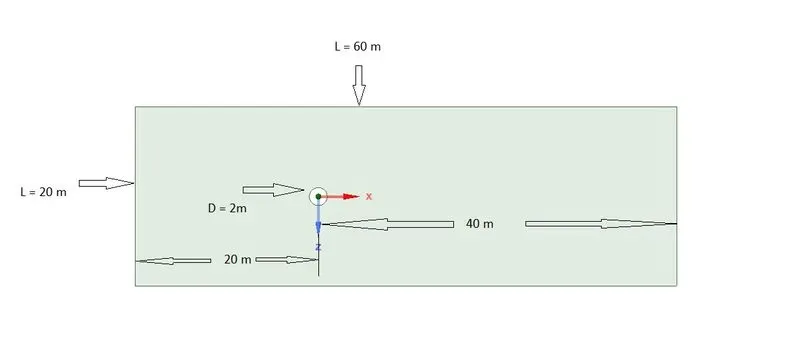
5.2) Meshing -
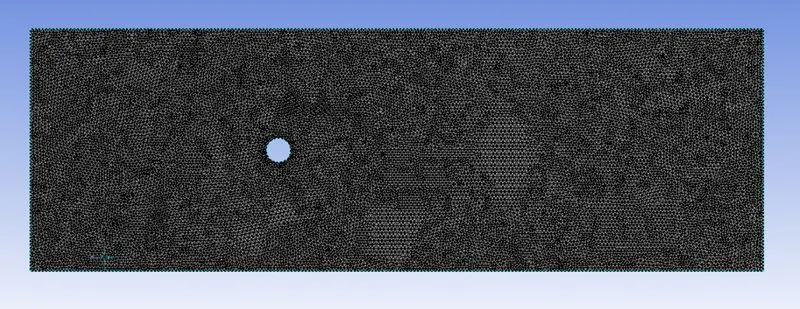
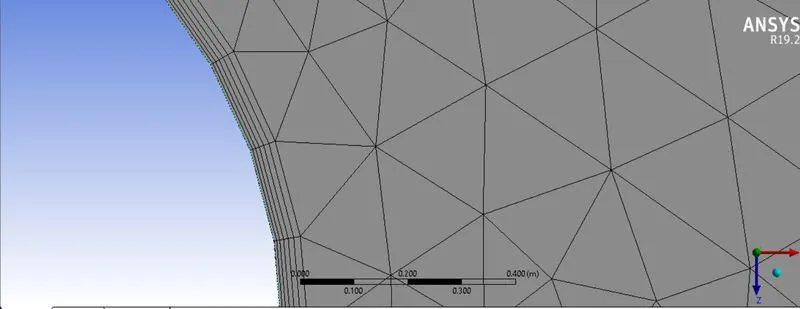
The generated 2D geometry meshed with element size of 0.25 m.The mesh was generated and proper inflation layers are given around the cylinder all to capture the wall boundary with growth rate of 1.2.Number of the generated elements is 39728.
5.3) Setup and Solution-
Setup parameters :
- Viscous model - Laminar
- Solver type - Pressure bases
- Solving Scheme - SIMPLE
- Initializing method - Hybrid(for Steady case)
Standard(for Transient case) - No. of Iterations - 1000
Case A) At Re = 100,simulate the flow with steady and transient method and calculate the Strouhal number.
- Material - User defined fluid with rho = 1kg/m^3
- mu - 0.02 kg/m-s
- Inlet velocity(U) -
- Re = UL/nu
- U = Re*(mu/rho)/L
In our case,diameter of the cylinder is 2 m ,therefore our characteristics length will be 2 m. - U = 100*(0.02/1)/2
- U = 1 m/s
-
From below plots and contours we can see that,ass the value of reynolds number increased further and further ,the wake region is characterized by a pair of counter rotating vortices that remain attached.At higher Re,as the wake becomes unstable,the viscous forces are no longer sufficient to squash these disturbances.Although the flow is still laminar and 2D,the instability grows further with the increasing Reynolds number,i.e icreased levels of turbulence in the boundary layer and wake region.
As per our discussion above,in the vortex street simulation we may probably never get our results fully converged.Thus we need alternate options to see our results are converged or not.If we look at the residual plots,we can't determine the solution convergence. But,from the velocity magnitude plots,we can see the repeation of velocity frequency after certain number of iterations for each run. Which validates our confidence in converged results.
5.4) Drag Coefficient -
Drag coefficient is a dimensionless factor of proportionality between the overall hydrodynamic force vector on a body in a fluid and the product of reference area of the body and velocity head.
6) Effect of Re number on Drag -
As it can be seen through the results,the coefficient og drag keeps decreasing whe the reynolds number is increasing.This is because, the flow becomes turbulent for reynolds number greater than 2000,which means laminar flow though present is negligible leading to a lower skin friction drag.Also,for low reynolds number(Re=10),the alternating vortices cannot be visualized due to the low velocity values.In such case only boundary layer separation occured.
@ Re = 10
At very slow flow there is no separation of flow and no wake downstream of the cylinder,as wee have neglected viscosity.Since the flow
is symmetric from upstream to downstream,there is no drag on the cylinder.But this type of flow does not occur in nature,where there
is always some small amount of viscosity is present in the fluid.@ Re = 100
Stable vortices are formed.The flow is separated but steady.The vortices gererate a high drag on the cylinder.
@ Re = 1000As the flow velocity increases,the down stream vortices becomes unstable,separate from the body and are alternatively shed from the downstream.The wake is wide and generate large amount of drag.
@ Re = 10000
The flow velocity is increased even more and the periodic flow breaks down into chaotic wake.The flow is laminar and orderly while on the back side of the cylinder,it is turned into a chaotic wake causing drag.
@ Re = 100000
The boundary layer transioned into turbulent flow and vortices of different scales are being shed in the wake region.But since the separation point is slightly downstream from the laminar separation point,which cause a slightly smaller wake and the drag is than the corresponding laminar drag.
7) Conclusion -- The Karman Vortex Street phenomenon for flow over a cylinder is studied and observed in this project.
- Increasing velocity eventually brings the turbulent drag up to and even higher than laminardrag value,but during transition from laminar to turbulent ,there is a range of reynolds number,for which turbulent drag is less than laminar drag.
- Vortex shedding can be seen i the case of both steady and transient simulation.But transient simulation produces better and more realistic results.
- Strouhal Number calculation is only possible in the case of transient simulations as the frequency changes with respect to time.Reference -
https://www.sciencedirect.com/science/article/pii/S0307904X08000243