Week - 2 - Explicit and Implicit Analysis
Explicit and Implicit Analysis
Abstract
Implicit and Explicit analysis differ in the approach to time incrementation. In Implicit analysis, each time increment has to converge, but you can set pretty long time increments. Explicit on the other hand doesn’t have to converge each increment, but for the solution to be accurate time increments must be super small.As demonstrated in the PDF, F(u) = u3+9u2+4u use this equation and solve using both Explicit and Implicit Methods.
Introduction
Implicit and Explicit are two types of approaches that can be used to solve the finite element problem. The implicit approach is useful in problems in which time dependency of the solution is not an important factor [e.g. static structural, harmonic, modal analysis, etc.] whereas the Explicit Dynamics approach is most helpful in solving high deformation time-dependent problems such as Crash, Blast, Impact, etc.
The prime difference between the implicit and explicit scheme lies in the consideration of velocity or acceleration. You must be aware of the equation relating mass (m), damping (c), stiffness (k), and force (F). In equation 1, ‘x’ stands for displacement whereas ẋ and ẍ are resp. the first and second-time derivatives of ‘x’. In other words, they stand for velocity and acceleration resp.
mẍ + cẋ + kx = F (1)
Implicit Scheme: In an implicit scheme, the displacement is not a function of time (i.e. x = constant). Hence the velocities and accelerations which are time derivatives of displacement turn out to be zero and the mass and damping factors can be neglected. The implicit method can be based based on Newark’s method, Newton Raphson Method etc. In order to solve an FEM problem using implicit method, inversion of stiffness matrix (k) is required. Very Large deformation problems such as crash analysis can result in millions of degrees of freedom effectively increasing the size of stiffness matrix. Larger the stiffness matrix longer is the computational time required for its inversion. Hence there is a need for an explicit method which would prevent the inversion of stiffness matrix. Implicit methods are mainly used in softwares such as Ansys, Nastran, Abaqus etc.
Explicit Scheme: As opposed to Implicit methods, explicit scheme is a function of time. Being a function of time, the velocity and acceleration as well as the mass and damping need to be considered in this scheme. In an explicit method, Central Difference time integration (CDTI) is used to calculate field variables at respective nodal points. Since only a numerical solution is possible for a non linear ordinary differential equation, this method is particularly suited for non linear problems. It requires the inversion of the lumped mass matrix as opposed to that of the global stiffness matrix in the implicit methods. In the CDTI, the equation of motion is evaluated at the previous time step (tn-1, where tn is the current time step).
The explicit method or algorithm works in Time step increments i.e. the displacements are calculated as the time proceeds. Consider the simulation of a crash analysis. At time step 1 (t=0 ms), there is no deformation since the impact is yet to occur. Gradually as time would progresses the deformation also would change. Assume that at time step 2, t is 5 ms, now the explicit algorithm will calculate the values of field variables at time when t=5 ms. This is the way in which the solution proceeds.
LS Dyna is one software which is based on explicit dynamics and is especially used for solving problems such as Crash, Impact, Penetration etc. Pam crash and Abaqus explicit are also based on the same.
Calculation-:
Explicit method-:
F(u) = u3+9u2+4u………..(1)
For stiffness ,
K(u)= Df(u)/du = 3u^2+18u+4………..(2)
From equ (1) and (2),
ΔF=K ΔU…………………… (3)
STEP 1-:
For initial condition where,
ΔF =1
u(0)=0
Substituting in equation (2)
K(0)= 3(0)^2 + 18(0)+ 4
K(0)=4
Then (3) implies,
ΔU1 =1/4= 0.25
u1 = u(0)+ ΔU1
u1 =0.25
STEP 2-:
Consider u= u1 then
K(u1)= 3(0.25)^2 + 18(0.25)+ 4
K(0)=8.687
ΔU2 =1/8.687= 0.115
u2 = u1(0)+ ΔU2 =0.365
STEP 3-:
Consider u= u2 then
K(u2)= 3(0.365)^2 + 18(0.365)+ 4
K(0)=10.96
ΔU3 =1/10.96= 0.091
u3 = u2 (0)+ ΔU2
u3 =0.456
From the above, we can get,
Fext = ΔF + ΔF + ΔF= 3
f1 = (u1^3)+(9u1^2)+4u1= 1.578
f2 = (u2^3)+(9u2^2)+4u2= 2.707
f3 = (u3^3)+(9u3^2)+4u3= 3.791
|
step |
ΔF |
ΔU |
u |
Fext |
fi |
R= fi - Fext |
|
1 |
1 |
0.25 |
0.25 |
1 |
1.578 |
0.57 |
|
2 |
1 |
0.11 |
0.36 |
2 |
2.707 |
0.70 |
|
3 |
1 |
0.09 |
0.45 |
3 |
3.791 |
0.79 |
Table.1. A.all value of explicit methods
Implicit analysis-:
In implicit analysis, newton-Raphson iteration is used to bring equilibrium and then work on further,
STEP 1-:
condition where,
u=0
Substituting in equation (2)
K(0)= 9(0)^2 + 18(0)+ 4
K(0)=4
Then (3) implies,
ΔU =1/4= 0.25
u1 = u(0)+ ΔU
u1 =0.25
u1=u(0)+ΔU=0.25
Fext=1
fi=(u1^3)+(9u1^2)+4u1 =1.518
residual R^0= fi - Fext = 0.578
newton-Raphson model use because R^0 is grater than 0.01
U1=U1 ^0
δU^1=[-k(U1)^0]^-1.R^0=-0.06
The value of u1 will be,
u1 ^1 = u1 ^0 + δu^1=0.184
R^1=fi-Fext =0.04
0.04 > 0.01
U1=U1 ^0
δU^2=δU^1-[k(U1)^1]^-1.R^1=-0.0713
u1 ^2 = u1 ^0 + δu^2=0.178
R is less then 0.01
Therefore, the value of u1 is 0.178
STEP 2
u= u1 = 0.178
K(u1)= 9(u1)^2 + 18(u1)+ 4
K(u1)=7.489
ΔU2=1/7.489= 0.133
u2=u1+ΔU2=0.311
Fext=1
fi=(u2^3)+(9u2^2)+4u2 =2.144
residual R^0= fi - Fext = 0.144, which is >0.01
The updated u2 is
u2=0.296
STEP 3
u= u2 = 0.296
K(u2)= 9(u2)^2 + 18(u2)+ 4
K(u2)=10.116
ΔU2=1/10.116= 0.098
u3=u2+ΔU3=0.394
Fext=1
fi=(u3^3)+(9u3^2)+4u3 =3.034
residual R^0= fi - Fext = 0.034, which is >0.01
The updated u3 is
u2=0.391
|
step |
ΔF |
ΔU |
u |
Fext |
fi |
R= fi - Fext |
|
1 |
1 |
0.25 |
0.17 |
1 |
1.007 |
0.07 |
|
2 |
1 |
0.11 |
0.29 |
2 |
2.004 |
.004 |
|
3 |
1 |
0.09 |
0.39 |
3 |
3.001 |
.001 |
Table.1. B.all value of implicit methods
Result-:
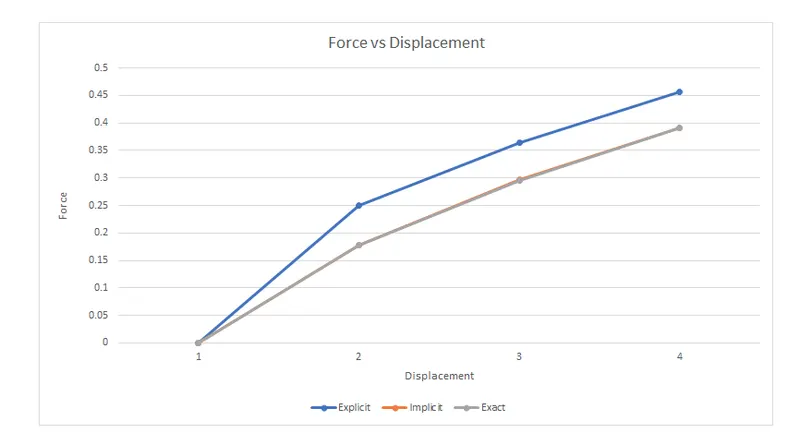
Fig.1.plot force vs displacements
The result show in to the two graph, the graph represent force with respect to displacement. As per the graph Shows that, in Explicit method has more divergent than exact values nevertheless implicit show the similar value as an exact value.
Conclusion
Explicit describes something that is very clear and without vagueness or ambiguity. Implicit often functions as the opposite, referring to something that is understood, but not described clearly or directly, and often using implication or assumption.
Reference-:
1. https://enterfea.com/implicit-vs-explicit/
2. https://caeanalysis.wordpress.com/2011/04/03/implicit-explicit-finite-element-analysis/
3. www.merriam-webster.com/words-at-play/usage-of-explicit-vs-implicit