Week - 2 - Explicit and Implicit Analysis
Objective : To solve a non linear Equation with both implicit and Explicit Analysis
Explicit Analysis : It is used to calculate the state of sysytem At a different time from a current time , from the current time Explicit analys is offers a faster solution in the events where there is a dynamic Equillibrium .Explicit Analysis is fast Inexpensive computationally . Each increment is calculated extremly fast .
Sum of all force = mass * acceleration
The Explicit should be used when the strain rate/ velocity is over 10 units/sec , these evenets can be best exampled by extreme scenarious such as automotive crash or meteor impact In this strain rate plays a important role.
Implicit Analysis: An implicit analysis finds a solution by solving an equation that includes both current and later states of the system
the implicit method should be used when the events are minimal . once the growth of the stress as a function of strain can be Established the solution can be found using implicit analysis
Sum of all forces = 0
Implicit method take a lot oif time to solve dynamic and non linear problema, but the accuracy is more compared to Explicit
Procedure :
The Equation of force is f(u) = u3 +9u2 +4u
Equation of stiffness is K = df/du
k = 3u2 +18U +4 ________(1)
To solve this Equation and find load vs displacement effect for simple bar under tension we can use implicit and explicit method
- Implicit method of analysis
solving these equation with 3 equal load increment with `Delta` F = 1
Step -1
U(0) = 0
k(u) = 4
`Delta`F = 1
`Delta`U1 = `Delta`F/`Delta`k(u)
= 1/4 =0.25
u1 = U0+`Delta`U1 = 0+0.25 = 0.25
F1int = (0.25^3)+9(0.025^2)+4(0.25)
= 1.578125
Step -2
u1 =0.25
K(u1)= 3(0.25^2)+9(0.25^2)+4
=8.6875
`Delta`F=1
`Delta`U2= `Delta`F/`Delta`(u2)
= 1/8.6875
= 0.1151
U2 =u1=`Delta`U2
= 0.25+0.1151
= 0.3651
f2int = (0.365^3)+9(0.365^2)+4(0.3+651)
= 2.708
Step - 3
U2 = 0.3651
k(u2) = 3(0.3651^2)+18(0.3651)+4
= 10.97
`Delta`F=1
`Delta`u3 =`Delta`F/k(u2)
= 0.09114
u3 = u2+
`Delta`u3= 0.365+0.09114
=0.4562
f3int = (0.4652^3)+9(0.4652^2)+4(0.4562)
=3.77928
| step | `Delta`F | U | Fext | Fint | residual = Fint-Fext |
| 1 | 1 | 0.25 | 1 | 1.5781 | 0.5781 |
| 2 | 1 | 0.3651 | 2 | 2.7087 | 0.7087 |
| 3 | 1 | 0.4562 | 3 | 3.792 | 0.792 |
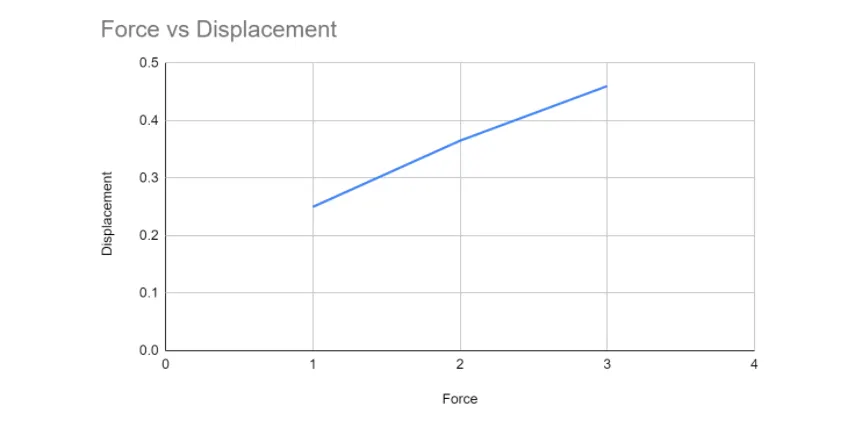
So from the table , it is noted that the difference in force i.e Residual is considerable , but the processing time is also very less,
To reduce the residual . more no of Iteration must be performed.
Graph for force vs displacement for explicit.
IMPLICIT ANALYSIS :
Step -1
U(0) = 0
K(u) = 4
`Delta`F =1
`Delta`U1 =`Delta`F/`K(u) from k = df/du
= 1/4 = 0.25
fint = (0.1834^3)+9(0.1834^2)+4(0.1834)
= 0.578125
R1 = f1int-f1ext = 0.578125
since R1> 0.01 newton raphson iteration are done
NEWTON RAPHSON METHOD It is a root finding algorithm which produces succesfully better approximation to the roots of a real valued function
I.e x1=x0-f(x0)/f1(x0)
Applying this we ger
`Delta`u1(1)=R1(1)/k(1U1(1)) = -0.066549
U1(2) = u1(1)+`Delta`U1(!)= 0.25-0.06654 =0.1834
F1(2) = 1.04249
R1(2) = 0.04249>0.01 so newton Raphson method is applied
`Delta`U1 (2) = R1(2)/K(u1(2))=0.07228
U1(3) = u1(2)+9(0.177^)+4(0.177)=1.00075
R1(3) = 0.000753
which is less than 0.01 so no need for Newton Raphson method
thus U1 =0.1772
F1 = 1.0007
R1=0.000753
Step -2
u1 = 0.1772
K(u) = 3(0.1772^2)+18(0.1772)+4 = 7.29
`Delta`F =1
`Delta`U2= `Delta`F/K(u) = 0.137
u2 = U1+`Delta`u2 = 0.3148
F2 int = (0.177^3)+9(0.177^2)+4(0.177) = 2.182
R2 = F1int - F1et = 0.1822
since R2 > 0.01 Newton raphson method is done
`Delta`u2(1) = R2(1)/K(u2(1)) = -0.018294
U2(2) = U2(1)+`Delta`u2(1)=0.3148-0.0182=0.2965
F2(2) = 2.0037
R2(2) = 0.00327<0.01 ; so Newton raphson method is no further needed
Thus
U2 =0.2965
F2 = 2.0032
R2 = 0.003276
Step -3
U2 = 0.2965
K(u) = 3(0.2965^2) +18(0.2965)+4 = 9.60073
`Delta`F=1
`Delta`u3 =`Delta`F/k(u) = 0.1046
U3 = U2+`Delta`U3 = 0.4006
F3 int = (0.296^3)+9(0.2965^2)+4(0.2965)
R3 = F1int-F1ext = 0.111
It is greater than 0.01 so newton raphson method is done
`Delta`U3 (1) = R3(1)/K(U3(1)) =-0.009493
U3 (2) = U3(1)+`Delta`U3(1)=0.3911
F3(@) = 3.0008
R3(2) = 0.00855<0.01
thus
u3 = 0.3911
F3 = 3.00855
R3 = 0.00855
| Step | `Delta`F | U | Fext | Fint | R=Fint-Fext |
| 1 | 1 | 0.1772 | 1 | 1.0075 | 0.000753 |
| 2 | 1 | 0.2965 | 2 | 2.003276 | 0.0032 |
| 3 | 1 | 0.3911 | 3 | 3.00855 | 0.0085 |
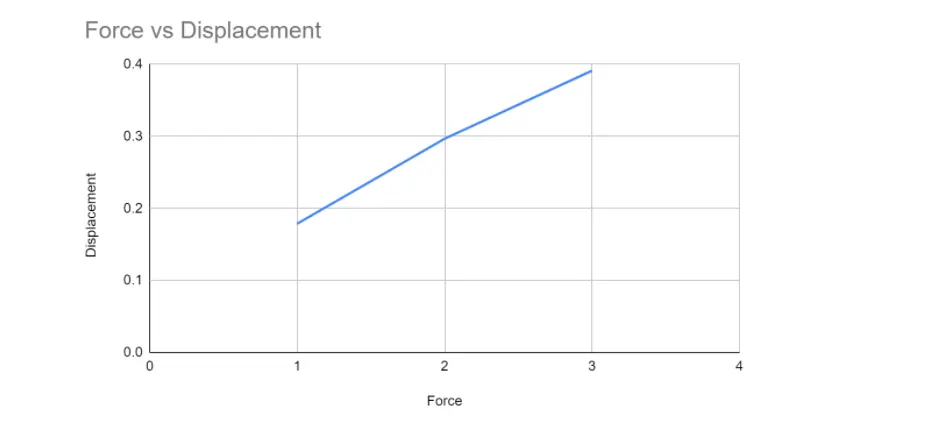
So from the table we can say that the Residual is very low and solution is accurate this is due to iteration performed by newton raphson method
But this Iteration Step has taken more time but this process is accurate and slow.
Graph for force vs Displacement for implicit .
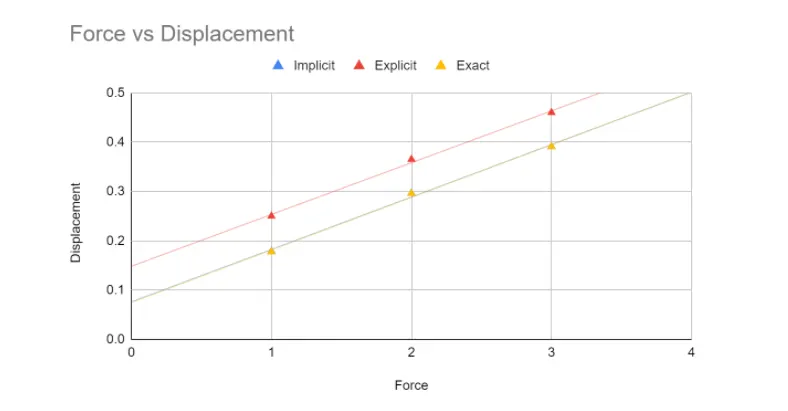
Comparision graph force vs displacement for implicit and explicit calculations
Conclusion
from the graph , it is evident that implicit analysis more accurate but time consuming and solemly depends on element size and time steps \
whereas explicit deviates slightly from exact result and needs more iteration to obtain good result.