Week - 2 - Explicit and Implicit Analysis
Objective,
Solve the given equation using Explicit and Implicit methods, F(u) = u3+9u2+4u
The equation of force,
F(u) = u3+9u2+4u ------------> 1
Equation of stiffness,
K = dF/du,
K = 3u2+18u+4 -----------> 2
Explicit Methods,
At each node point, internal and external forces are summed and acceleration at the node is computed using F=ma. By integrating acceleration in time, velocity/displacement is calculated and the solution can be advanced write time. Assumes the constant acceleration over the time step. Change in geometry depends only on the known quantities from the previous step. And capable to solve the extreme non-linear problems. This is a conditionally stable (timestep limit).
Solve the above equation and find the load and displacement for the simple bar under the tension.
Step 1;
u(0) = 0 to equation 2,
k(u) = 3u2+18u+4 = 4
And ΔF = 1
Δu1 = ΔF/K = 1/4 = 0.25
u1 = u0+Δu1 = 0+0.25 = 0.25
F1 = (0.25)3+9(0.25)2+4(0.25) = 1.578125
R = Fint - Fext = 1.578-1
R = 0.578
Step 2;
u(1) = 0.25 to equation 2,
k(u1) = 3u2+18u+4 = 8.6875
And ΔF = 1
Δu2 = ΔF/K = 1/8.6875 = 0.1151
u2 = u1+Δu2 = 0.25+0.1151 = 0.3651
F2 = (0.3651)3+9(0.3651)2+4(0.3651) = 2.708749
R = Fint - Fext = 2.708749-2
R = 0.708749
Step 3;
u(2) = 0.3651 to equation 2,
k(u2) = 3u2+18u+4 = 10.9717
And ΔF = 1
Δu1 = ΔF/K = 1/10.9717 = 0.09114
u3 = u2+Δu2 = 0.3651+0.9114 = 0.4562
F3 = (0.4562)3+9(0.4562)2+4(0.4562) = 3.792809
R = Fint - Fext = 3.792809-3
R = 0.792809
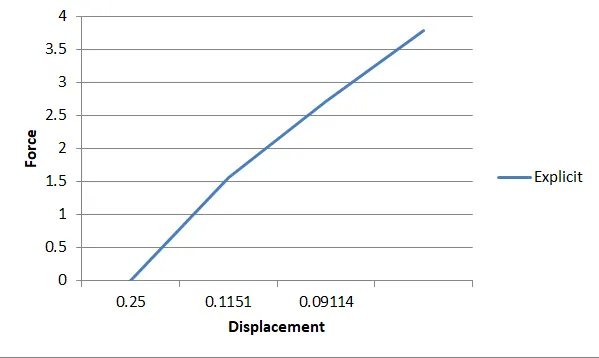
Step ΔF u Fint Fext R = Fint-Fact
1 1 0.25 1.57 1 0.57
2 1 0.1151 2.7087 2 0.7087
3 1 0.09114 3.7928 3 0.7928
Implicit Method,
A global stiffness matrix is computed and inverted and applied to the nodal out of balance force to determine the displacement (F=Ku). Assumes the acceleration varies linearly over the time step. Change in geometry depends only on the unknown quantities in current steps. Unconditionally stable (no. timestep limit). Can have a problem with non-linearity. Good for long-duration problems and large amounts of memory. Computationally expensive but good for long-duration analysis as large timestep.
Implicit analysis as, set tolerance is 0.01 then newton raphson iteration is required.
{(δu)j+1} = {-k(uj)}^-1 * Rj --------> 3
Load step one,
u(0) = 0,
K(u) = 4 and ΔF = 1
Δu1 = ΔF/K(u) = 0.25
u1 = u0 + Δu1 = 0.25
F1 = (0.25)3+9(0.25)2+4(0.25)
F1 = 1.578
K(u1) = 3u2+18u+4
K(u1) = 3(0.25)2+18(0.25)+4
K(u1) = 8.6875
R = Fint-Fext = 1.578 - 1
R = 0.578
Apply thr K(u1) abd R value to equation to 3,
{(δu)j+1} = {-k(uj)}^-1 * Rj
(δu)j+1 = (-8.6875)^-1*0.578
(δu1) = -0.0665
u1 = Δu1+(δu1)
= 0.25+(-0.0665)
u1 = 0.183467
Newton Raphson methods ite-1,
F(u) = u3+9u2+4u
F(u1) = (0.1834)^3+(0.1834)^2+4(0.1834)
F(u) = 1.0424
R(u1) = Fint- Fext = 1.0424-1
R(u1) = 0.0424
ite-2,
{(δu)j+1} = {-k(uj)}^-1 * Rj
δu = -0.066; u1 = 1.0424
K(u1) = 3u2+18u+4
K(u1) = 3(1.0424)^2+18(1.0424)+4
K(u1) = 26.0229
(δu)21 = δu{-k(u1)}^-1*R(u1)
(δu)21 = -0.066[26.0229]^-1*0.0424
(δu)21 = -0.073419
u12 =Δu1+{δu}12
u12 = 0.25+(-0.073419)
u12 = 0.181841
F(u12) = (0.181841)^3+9(0.181841)^2+4(0.181841)
F(u12) = 1.0309
Ru12 = Fint - Fext = 1.0309-1
Ru(12) = 0.0309
Ite-3,
{(δu)j+1} = {-k(uj)}^-1 * Rj
δu12 = -0.073419; u12 = 0.181841
K(u2) = 3u2+18u+4
K(u2) = 3(0.181841)^2+18(0.181841)+4
K(u2) = 7.3723
(δu)31 = δu{-k(u1)}^-1*R(u1)
(δu)31 = -0.073419[-7.3723]^-1*0.0309
(δu)31 = -0.07236
u13 =Δu1+{δu}13
u13 = 0.25+(-0.07236)
u13 = 0.17864
F(u13) = (0.17864)^3+9(0.17864)^2+4(0.17864)
F(u13) = 1.001985
Ru13 = Fint - Fext = 1.001985-1
Ru(13) = 0.001985
In load step two and u1 = 0.17764
K(u1) = 3u2+18u+4
K(u1) = 3(0.17764)^2+18(0.17764)+4
K(u1) = 7.29218
ΔF=K*Δu
Δu2 = 1/7.29218 = 0.13714
u2 = 0.31478
F1(u) = u3+9U2+4u
= (0.31478)^3+9(0.31478)^2+4(0.31478)
F1(u) = 2.182
R = Fint-Fext = 2.182-2
R = 0.182
(δu1) = {-k(u)}^-1*Rj
u2 = 0.31478
k(u) = 3u2+18u+4
= 3(0.31478)^2+18(0.31478)+4
K(u) = 9.9632
(δu1) = {-9.9632)^-1+0.182
(δu1) = -0.018262
u21 = u2+{δu1}
u21 = 0.2855
δu2 = (0.2855)^3+9(0.2855)^2+4(0.2855)
δu2 = 2.00459
R = Fint-Fext = 2.00459-2
R = 0.00459
In load step 3,
u2 = 0.2965 for Stiffness value
K(u2) = 3u2+18u+4
= 3(0.2965)^2+18(0.2965)+4
K(u2) = 9.60073
ΔF=K*Δu
Δu2 = 1/9.60073 = 0.10415
u3 = 0.40065
F1(u) = u3+9U2+4u
= (0.40065)^3+9(0.40065^2+4(0.40065)
F1(u) = 3.1116
R = Fint-Fext = 3.1116-3
R = 0.1116
(δu1) = {-k(u)}^-1*Rj
u2 = 0.31478
k(u) = 3u2+18u+4
= 3(0.40065)^2+18(0.40065)+4
K(u) = 11.69326
(δu3) = {-11.69326)^-1+0.116
(δu3) = -0.0095439
u3 = u3+{δu3}
u3 = 0.3895
F1(u)= (u3)^2+9(u3)^2+4(u3)
F1(u) = 3.00085
R = Fint-Fext = 3.00085-3
R = 0.00085
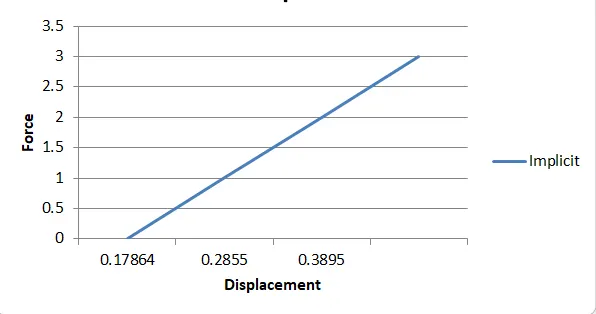
Step ΔF u Fint Fext R = Fint-Fext
1 1 0.17864 1.001985 1 0.0019985
2 1 0.2855 2.00459 2 0.00459
3 1 0.3895 3.00085 3 0.00085
Results,
Above the tables on the results from the explicit and implicit analysis, the graph can be derived. From the results that the residue in implicit solution is minimal whereas residue between forces is substantial in explicit methods. Iteration is done in implicit methods, it becomes very slow whereas explicit is fast methods. implicit methods provide a much better solution for lower steps whereas the number of steps needs to increase considerably in explicit methods to increase the accuracy and decrease the effect of residual error.