Week - 2 - Explicit and Implicit Analysis
Aim:
Solve the given non-linear static problem using explicit and implicit analysis. Compare the results obtained from both analysis.
Problem statement:
Consider a simple bar in tension and given the force in the bar is a function of displacement as given below,
`f(u) = u^3+9*u^2+4*u`
`f(u)` is the intenal force in the bar due to displacement `u`
Explanation:
If 'k' is the stiffness of the bar,
`k = (del(f))/(del(u) ) =3*u^2+18*u+4`
External force 'F' is applied to the bar and assume `triangleF` is the incremental unit load acting on the bar.
a. Explicit Analysis:
`"Since", triangleF = k*triangleu rarr triangle u = triangleF//k(u)`
Step:1
Initial condition: displscement, `u_0 =0`
Load `triangleF = 1` is applied to the bar element.
`rArr u_0 =0; k(u_0) = 3*u_0^2+18*u_0+4 = 4`
`triangleu_1 = 1/4=0.25 rarr u_1 = u_0+triangleu_1 =0+0.25 =0.25`
Step:2
Initial condition: displacement, `u_1 = 0.25`
Load `triangleF =1` is applied to the bar element.
`rArr u_1 = 0.25; k(u_1) =8.6875`
`triangleu_2 = 1/8.6875 = 0.1151 rarr u_2 = u_1+triangleu_2= 0.25+0.1151= 0.3651`
Step:3
Initial condition: displacement, `u_2 =0.3651`
Load `triangleF = 1` is applied to the bar element.
`rArr u_2= 0.3651; k(u_2) = 10.9716`
`triangleu_3 =0.0911 rarr u_3 =u_2+triangleu_3 =0.4562`
With the above three load steps, total external force applied to the bar element is
`F = triangleF+triangleF+triangleF = 3`
Intenal force in the bar element after three load steps is
`f(u_3) = (u_3)^3+9*(u_3)^2+4*u_3 = (0.4562)^3+9*(0.4562)^2+4*(0.4562)= 3.7928`
| Load step, | `triangleF` | `triangleu` | External force,`F_i` | Internal force,`f_i` | Residual,`R =f_i-F_i` |
|---|---|---|---|---|---|
| 1 | 1 | 0.25 | 1 | 1.5781 | 0.5781 |
| 2 | 1 | 0.3651 | 2 | 2.7088 | 0.7088 |
| 3 | 1 | 0.4562 | 3 | 3.7928 | 0.7928 |
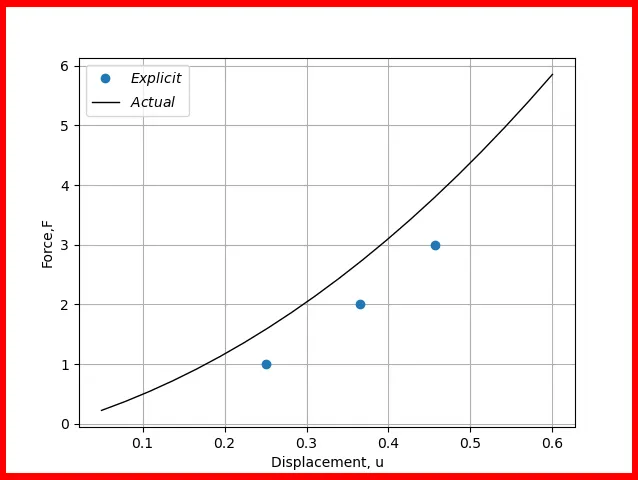
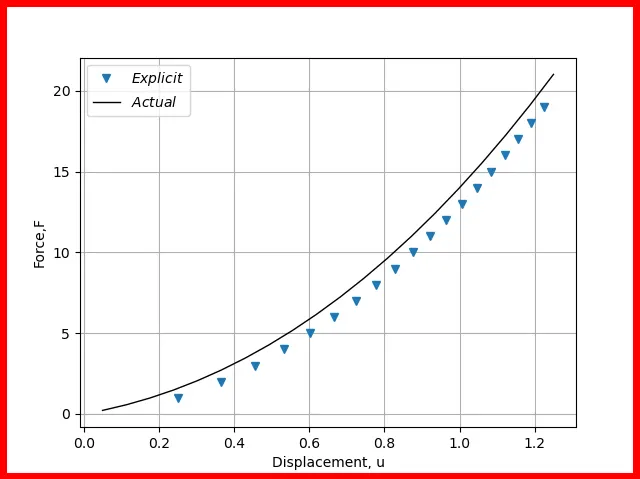
From the above plot it can be seen that with more number of load increments, solution follows the exact curve. Even with more load increments, the calculated solution is not same as exact solution.
From the above values, external forces and internal forces of the bar element are not in equilibrium i.e. `F_("ext") != f_("int")`
b. Implicit Analysis:
Implicit analysis is used to correct the solution in each stage by making the calculated result closer to the actual result, i.e. from Newton-Raphson method, residual of the forces equal to zero.
Residual, `R = f_"int"-F_(ext)`
Newton-Raphson iterations are used to minize the residual function in each step and as residual is made closer to zerro, solution will be closer to the exact solution.Expanding the residual as Taylor's series, we get
`R^(j+1) = R^j*(u^j) +(d(R(u^j)))/(du)*deltau^(j+1)+.... = R^j+k(u^j)*deltau^(j+1)+...`
Since, residual is a very small value, higher order terms are neglected. To find the displacement value for which residual will be close to zero (i.e. tolerance of `10^-2`), `R^(j+1) =0` is taken into account.
`0=R^j +k(u^j)*deltau^(j+1) rrarr deltau^(j+1) = -(R^j)/(k(u^j)`
Step:1
Initial condition; displacement, `u_0 = 0`
Load `triangleF = 1` is applied to the bar element.
`rArr u_0 =0; k(u_0) = 3*u_0^2+18*u_0+4 = 4`
`triangleu_1 = 1/4=0.25 rarr u_1 = u_0+triangleu_1 =0+0.25 =0.25`
`*** "Correction of displacement through residual":`
`F(u_1) =1; f(u_1) =1.5781, abs(R) = 0.5781`
`abs(R) >10^-2`, therefore newton iteration is carried out.
Iteration 1:-
`u_1 =u_1^"(0)" =0.25 rarr deltau_1^"(1)" =-R^(0)/(k(u_1^"(0)") )= -0.06655`
The corrected displacement is, `u_1^"(1)" = u_1^"(0)" +deltau_1^"(1)" = 0.1834`
`F(u_1) =1; f(u_1) =1.0425, abs(R) = 0.0425`
`abs(R)>10^-2`, newton iteration is proceeded.
Iteration 2:-
`u_1 =u_1^"(1)" =0.1834 rarr deltau_1^"(2)" =-R^(1)/(k(u_1^"(1)") )=-0.0057`
The corrected displacement is, `u_1^"(2)" = u_1^"(1)" +deltau_1^"(2)" = 0.1776`
`F(u_1) =1; f(u_1) =0.9998, abs(R) = 0.0001`
`abs(R)<10^-2`, tolerance is reached and final value for displacement in load step 1, `u_1 =u_1^"(2)" = 0.1776`
Step:2
Initial conditions: `u_1 = 0.1776`
Load `triangleF = 1` is applied to the bar element.
`rArr u_1 = 0.1776; k(u_1) =7.2914`
`triangleu_2 = 1/7.2914 = 0.1372 rarr u_2 = u_1+triangleu_2= 0.1776+0.1372= 0.3148`
`*** "Correction of displacement through residual":`
`F(u_2) =1; f(u_2) =2.1823, abs(R) = 0.1823`
`abs(R) >10^-2`, therefore newton iteration is carried out.
Iteration 1:-
`u_2 =u_2^"(0)" =0.3148 rarr deltau_2^"(1)" =-R^(0)/(k(u_2^"(0)") )= -0.1187`
The corrected displacement is, `u_2^"(1)" = u_2^"(0)" +deltau_2^"(1)" = 0.2965`
`F(u_2) =1; f(u_2) =2.0033, abs(R) = 0.0033`
`abs(R)>10^-2`, newton iteration is proceeded.
Iteration 2:-
`u_2 =u_2^"(1)" =0.2965 rarr deltau_2^"(2)" =-R^(1)/(k(u_2^"(1)") )=-0.0003`
The corrected displacement is, `u_2^"(2)" = u_2^"(1)" +deltau_2^"(2)" = 0.2962`
`F(u_2) =1; f(u_2) =2.0004, abs(R) = 0.0003`
`abs(R)<10^-2`, tolerance is reached and final value for displacement in load step 2, `u_2 =u_2^"(2)" = 0.2962`
Step:3
Initial conditions: displacement, `u_2 =0.2962`
Another load `triangleF = 1` is applied to the bar element. By iterating the displacement value to reduce the residual, following the same iterations process, final value for displacement at load step 3,`u_3 = 0.3911`
| Load step, | `triangleF` | `triangleu` | External force,`F_i` | Internal force,`f_i` | Residual,`R =f_i-F_i` |
|---|---|---|---|---|---|
| 1 | 1 | 0.1776 | 1 | 0.9998 | 0.0001 |
| 2 | 1 | 0.2962 | 2 | 2.0004 | 0.0004 |
| 3 | 1 | 0.3911 | 3 | 3.0009 | 0.0008 |
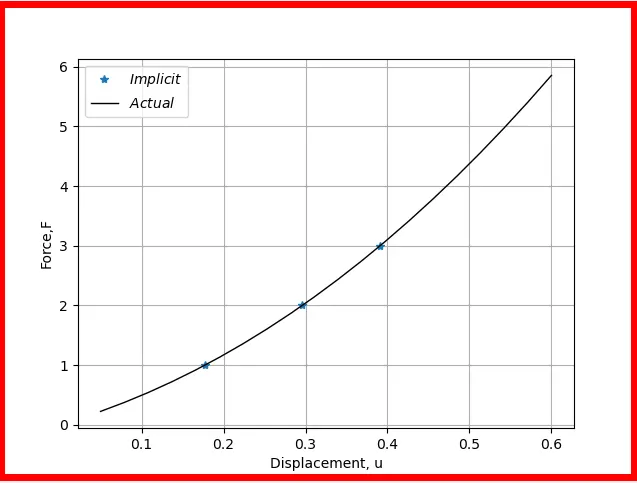
Considering the given tolerance, the external force applied on the bar element and the internal force in the bar element after applying the load are almost equal and they are considered to be in equlibrium(i.e. Under the given tolerance`F_("ext") = f_("int")`).
Conclusion:
- Both implicit and explicit analysis provides the solution to the given non-linear problem.
- From the values of the residuals in each load step, it is evident that solution from implicit analysis is more accurate than the explicit analysis.
- Implicit analysis involves additional calculations to reach the equlibrium between the external force applied and internal force developed.
- The explicit analysis follows the exact solution curve but implicit analysis provides the exact solution in each step at the cost of additional calculation to achieve the equilibrium.