Week - 2 - Explicit and Implicit Analysis
Assignment 2 - Explicit and Implicit analysis
1. Explicit and Implicit methods
The explicit and implicit methods are numerical algorythms that are used to approximate the exact solution of a function that depends of one or more variables. These metohds are useful in plenty of engineering applications where a function depends of a variable in a way that is difficult to express analytically. In both methods, the solutions are calculated by giving an increment of the function (f(u) for instance) and calculating the value of u.
1.1. Explicit method
In the explicit method, it is only required to know the conditions of the system in the time step k in order to calculate its condition in time step k+1.
A common example of an explicit method is the first order Euler method, which consists in solving the following equation for each of the steps considered, whitout performing any convergence checks.
`u_{k+1} = u_k+\DeltaFf(u)`
This is a conditionally stable numerical method, since the increment used must be small enough for the calculations to be carried in a stable way.
1.2. Implicit method
The implicit method works on the same principle as the Explicit method. The major difference is that the convergence must be checked for each step. This is done by establishing a maximum acceptable value for the absolute value of the residual. The residual is the difference between the exact and approximate solution. If that maximum value is exceeded, the solution obtained must be corrected by adding to the solution the following term:
`'\deltau_{k}^{(i+1)} = -[k(u_{k}^{(i)})]^{-1}\timesR^{(i)}'`
If the value of the residual remains too different from zero, the same procedure is repeated until a value within the established tolerance is obtained.
2. Calculations
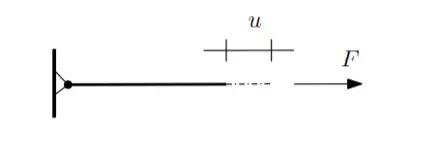
The explicit and explicit methods were used to solve a problem regarding an incremental load being applied to a beam in the axial direction. The goal is to determine the displacement of the tip of the beam as the force increases. The beam is simply constrained in one tip, and the force is applied to the opposite one, as it is shown in the following image.
The calculations an respective obtained values are present in a spreadsheet submitted as an annex.
The plots that resulted from the calculations with the explicit and explicit methods are shown in the following figure.
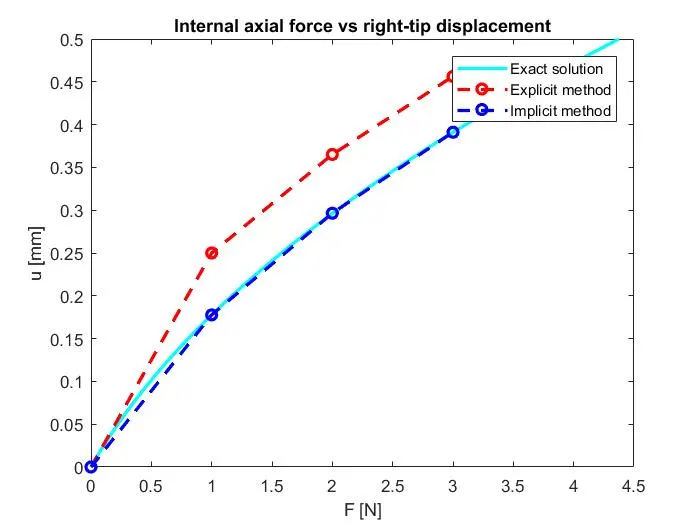
From the figure above, it is clear that the implicit method approximates the exact solution precisely compared with the explict method, especially if the tolerance stipulated for the residual is low enough.