Week - 2 - Explicit and Implicit Analysis
OBJECTIVE: -
To demonstrated in the PDF, F(u) = u3+9u2+4u use this equation and solve using both Explicit and Implicit Methods with tolerance of 10-2.
Explicit method: -
It is use in crash-worthiness, drop test and other such dynamic analysis where deformation is very large. It is very suitable compare to implicit method for complex problem with number of components and elements.
u(n+1) = u(n)+Δt × f(u(n))
Force function: - F(u)=u3+9u2+4u
Stiffness: - k(u)=f′(u)=3u2+18u+4
Implicit method: -
The implicit scheme that checks convergence after each time step and then only moves in to the calculation of variables. The convergence is brought about by Newton-Raphson iterations.
For the convergence the Fext should be equal to F or the residual R=F−Fext=0
After each time step, the residual need to be brought within the tolerance value. (Here we assume tolerance=0.01) This is done by using the Newton-Rapshon iteration to calculate the correction value until required tolerance reached.
PROGRAM: -
Explicit method: -
<!-- [if gte vml 1]>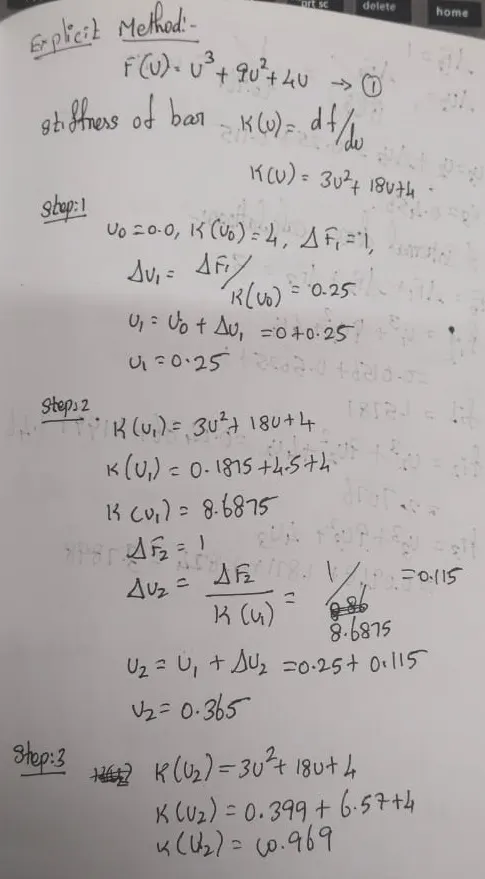 <!--[endif]-->
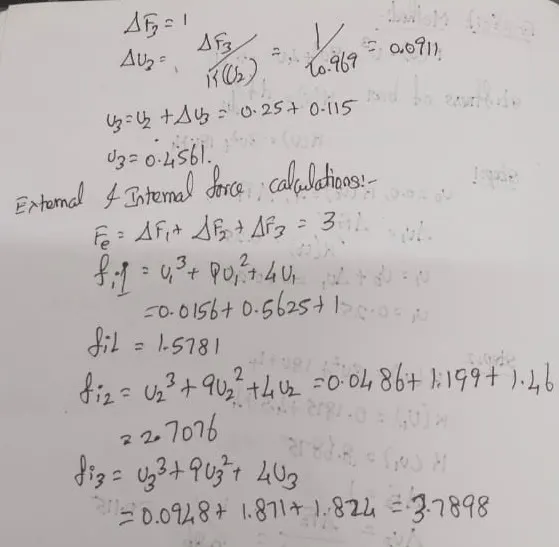
Summary of Explicit analysis results:
|
Step i |
▲ Fi |
▲ui |
ui |
(Fe)i |
(fi)i |
fi - Fe = R |
|
1 |
1 |
0.25 |
0.25 |
1 |
1.5781 |
0.5781 |
|
2 |
1 |
0.115 |
0.365 |
2 |
2.7076 |
0.7076 |
|
3 |
1 |
0.0911 |
0.4561 |
3 |
3.7898 |
0.7898 |
Implicit method: -
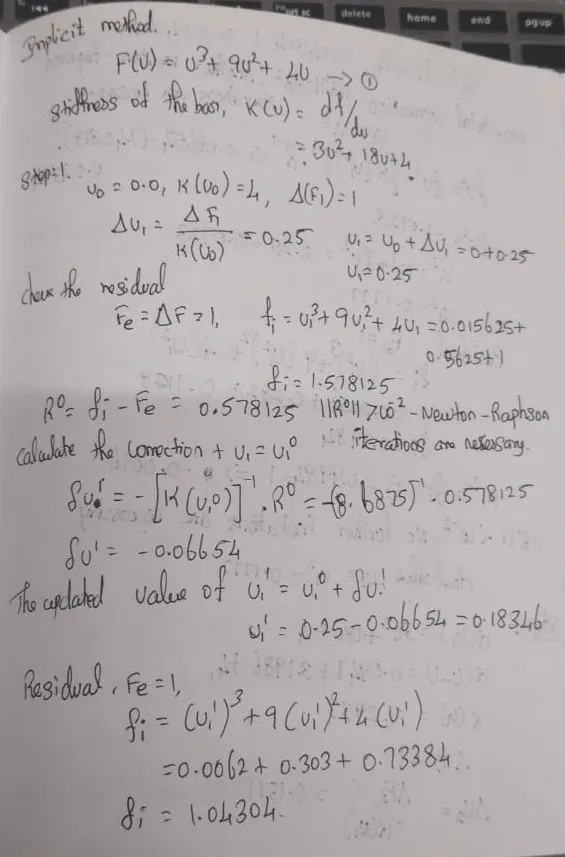
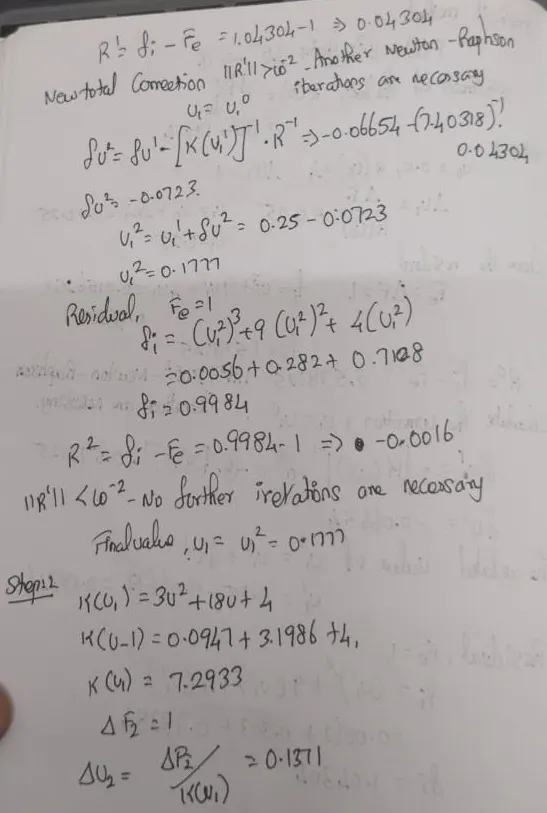
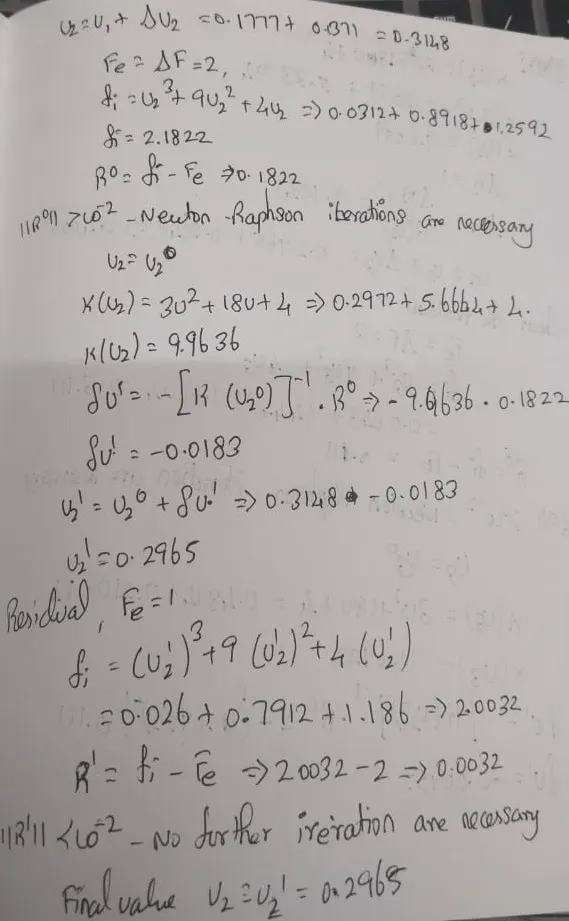
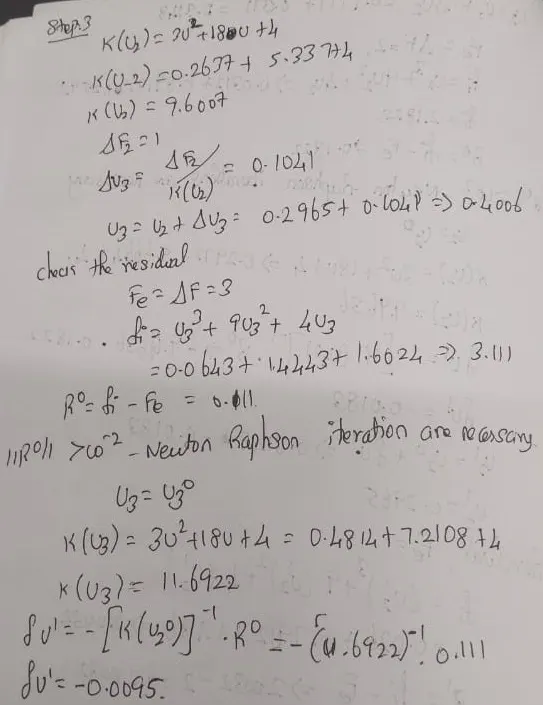
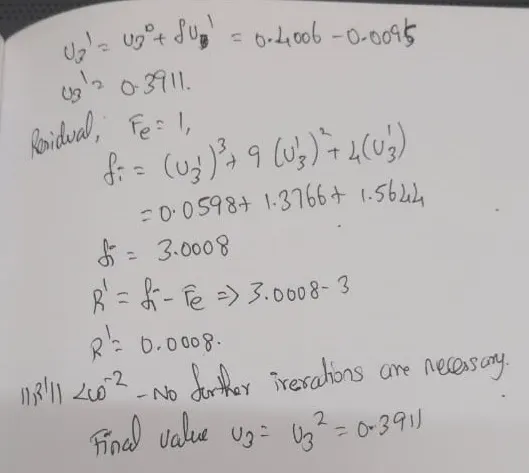
Summary of Explicit analysis results:
|
Step i |
▲ Fi |
ui |
(Fe)i |
(fi)i |
fi - Fe = R |
|
1 |
1 |
0.1777 |
1 |
0.9984 |
-0.0016 |
|
2 |
1 |
0.2965 |
2 |
2.0032 |
0.0032 |
|
3 |
1 |
0.3911 |
3 |
3.0008 |
0.0008 |
Exact Solution by solving third order polynominal:
F(u)=u3+9u2+4u
u3+9u2+4u−F(u)=0
|
Step i |
(Fe) i |
ui |
|
1 |
1 |
0.17762 |
|
2 |
2 |
0.29616 |
|
3 |
3 |
0.39103 |
Plot Results:
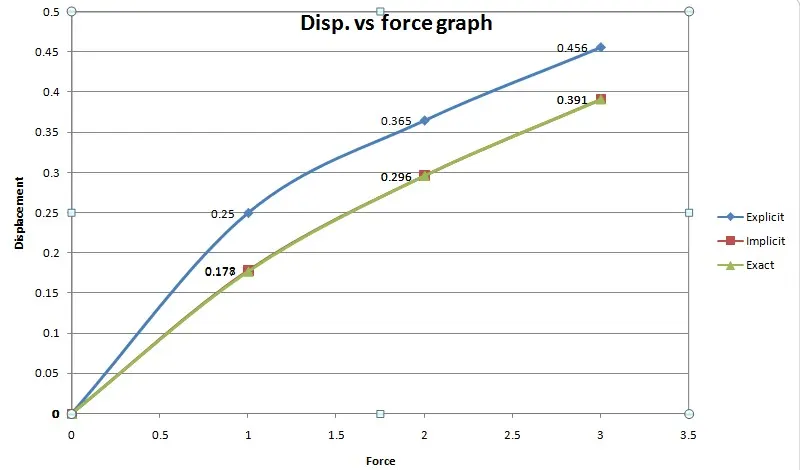
From the above plots, we obtained that the Implicit method gives a better solution comparing with the Explicit method. The implicit method will be equal to the exact solution due to Newton Raphson iterations used to enforce the equilibrium of external & internal forces.