Week - 2 - Explicit and Implicit Analysis
EXPLICIT AND IMPLICIT ANALYSIS
F(u) = u3+9u2+4u ---(1)
solve using both Explicit and Implicit Methods ( have a tolerance of 10-3).
Stiffness, k(U) = dF/du = 3u^2+18u+4 ---(2)
EXPLICIT ANALYSIS:-
- In explicit mostly dynamic analysis, nodal accelerations are solved directly (not iteratively) as the inverse of the diagonal mass matrix times the net nodal force vector where net nodal force includes contributions from exterior sources (body forces, applied
pressure, contact, etc.), element stress, damping, bulk viscosity, and hourglass control. - Once accelerations are known at time n, velocities are calculated at time n+1/2, and displacements at time n+1. From displacements comes strain. From strain comes to stress and the cycle is repeated.
- Explicit analysis handles nonlinearities with relative ease as compared to implicit analysis. This would include the treatment of contact
and material nonlinearities. With this method is that you do need many small increments for good accuracy and it is time-consuming.
where u= displacement , f= internal force in bar, F= external force in bar, ∆u = incremental displacements,
∆F = incremental external applied forces.
using relation, ∆F = k∆u,
Step 1:-
Take u=0.
K(u)=3(0)^2+18(0)+4 =4
∆u1= ∆F/ k(0)=1/4=0.25
u1=u0+ ∆u1=0+0.25=0.25.
Fint=u^3+9u^2+4u
=(0.25)^3+9(0.25)^2+4(0.25)
=1.5781
|R(0)|=Fint-Fext
=1.5781-1
=0.5781
Step2:-
Take u1=0.25.
K(u1)=3(0.25)^2+18(0.25)+4=8.6875.
∆u2= ∆F/K(u1)=1/8.6875=0.1151.
u2=u1+ ∆u2=0.25+0.1151=0.3651.
Fint=u^3+9u^2+4u
=(0.3651)^3+9(0.3651)^2+4(0.3651)
=2.70846.
|R(1)|=Fint-Fext.
=2.70846-2.
=0.70846.
Step3:-
Take u2=0.3651.
K(u2)=3(0.3651)^2+18(0.3651)+4=10.9716.
∆u3 = ∆F/K(u2)=1/10.9716.=0.09114.
u3=u2+ ∆u3=0.3651+0.09114.=0.4511.
Fint=u^3+9u^2+4u.
=(0.4511)^3+9(0.4511)^2+4(0.4511)
=3.7275.
|R(2)|=Fint-Fext.
=3.7275-3
=0.7275.
| S.NO | STEP | ∆F | ∆ui | ui | Fext | Fint | Fint-Fext | Actual (ux) |
| 1 | 1 | 1 | 0.25 | 0.25 | 1 | 1.5781 | 0.5781 | 0.1776 |
| 2 | 2 | 1 | 0.1151 | 0.3651 | 2 | 2.74846 | 0.70846 | 0.2961 |
| 3 | 3 | 1 | 0.09114 | 0.4511 | 3 | 3.7275 | 0.7275 | 0.3910 |
IMPLICIT ANALYSIS :
- Implicit analysis requires a numerical solver to invert the stiffness matrix once or even several times over the course of a load/time
step. This matrix inversion is an expensive operation, especially for large models. It is mostly used for static analysis. Implicit uses
Newton-Raphson iterations to enforce equilibrium. - If done correctly the Newton-Raphson iterations will have a quadratic rate of convergence which is very desirable. Implicit transient analysis has no inherent limit on the size of the time step.
- As such, implicit time steps are generally several orders of magnitude larger than explicit time steps.
where u= displacement , f= internal force in bar, F= external force in bar
∆u = incremental displacements, ∆F = incremental external applied forces.
using relation, ∆F = k∆u, Tolerance= 10^-3
Step1:-
Take u1=0.
k(U) = dF/du = 3u^2+18u+4.
=3(0)^2+18(0)+4 =4
∆u1= ∆F/ k(0)=1/4=0.25
u1=u0+ ∆u1=0+0.25=0.25.
Fint=u^3+9u^2+4u
=(0.25)^3+9(0.25)^2+4(0.25)
=1.5781
|R(0)|=Fint-Fext
=1.5781-1
=0.5781.
|R(0)|>10^-3 Newton Raphson iteration are necessary.
Calculate the correction to u1=u1(0)
δu(1)=-[K(u1(0))]^-1x R(0)
=-(8.6875)^-1(0.578)
=-0.06653.
The updated value of u1(1)=u1(0)+δu(1)
=0.18347.
Fint=u^3+9u^2+4u.
=(0.18347)^3+9(0.18347)^2+4(0.18347)
=1.04295.
|R(1)|=Fint-Fext
=0.04295.
|R(1)|>10^-3 Newton Raphson iteration are necessary.
Calculate the correction u1=u1(0)
δu(2)= δu(1)-[K(u1(0))]^-1x R(0)
=-0.0729.
u1(2)=u1(0)+δu(2)
=0.1771.
The updated value is u1(2)=0.1771.
The check residual
Fint=u^3+9u^2+4u.
=0.99616
|R(2)|=Fint-Fext
=-0.00384.
|R(2)|>10^-3 Newton Raphson iteration are necessary.
Calculate the correction u1=u1(0)
δu(3)= δu(2)-[K(u1(1))]^-1x R(0)
=-0.07237.
u1(3)=u1(0)+ δu(3)
=0.1776.
The updated value is u1(3)=0.1776.
Fint=u^3+9u^2+4u.
=1.000024.
|R(4)|=Fint-Fext
=0.000024.
|R(4)|<10^-3 no further iteration are necessary.
Final Value is u1=u1(3)=0.17763.
Step 2&3:-
similarly as step 1, we get u2=0.2961 , u3=0.3911
| S.No | STEP | ∆F | ∆ui | ui | Fext | Fint | Fint-Fext | Actual (ux) |
| 1 | 1 | 1 | 0.25 | 0.1776 | 1 | 1.00002 | 0.00002 | 0.1776 |
| 2 | 2 | 1 | 0.1371 | 0.2961 | 2 | 1.99936 | 0.00064 | 0.2961 |
| 3 | 3 | 1 | 0.1042 | 0.3911 | 3 | 3.00082 | 0.00082 | 0.3910 |
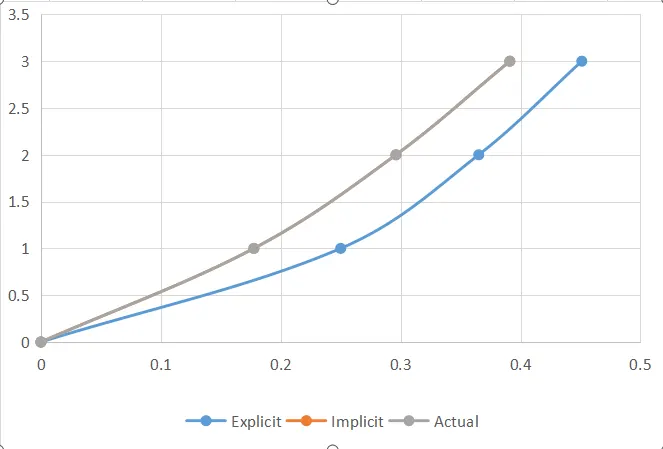
Comparison Graph Implicit and Explicit Force vs Displacement:-
CONCLUSION:-
- The explicit and implicit analysis is done for the given equation, an implicit method is more accurate than the explicit but the time
consumption is more in the implicit method.