Explicit Analysis Vs Implicit Analysis - Hand Calculation Method
IMPLICIT METHOD :
Implicit methods find a solution by solving an equation involving both the current state of the system and the later one. Implicit analysis requires a numerical solver to invert the stiffness matrix once or even several times over the course of a load/time step. Implicit methods attempt to find a solution to the nonlinear system of equations iteratively by considering the current state of the system as well as its subsequent (or previous) time state.
EXPLICIT METHOD :
An explicit analysis aims to solve for acceleration. The accelerations are solved for the nth time step, and then the velocity is solved for the n+1/2 step, and displacement at the n+1 step. The solutions are not always stable and much smaller time steps are required. The time step in an explicit analysis must be less than the time taken by a sound wave to travel across an element and is hence dependent on the mesh size and the material properties. This is known as the Courant time step.
| IMPLICIT METHOD VS EXPLICIT METHOD | ||
| CHARACTERISTICS | IMPLICIT METHOD | EXPLICIT METHOD |
| Time step | Large | Small |
| Strain Rate | small | Large |
| Strain Due to | Force | Velocity, acceleration with mass and inertia |
| K Matrix Inversion | yes | No |
| Advantages | Accuracy | Stability |
| Process Involved | Matrix inversion | Element process |
| Cost | large | Small |
F(u) = u³+9u²+4u , Lets solve this Equation with both Explicit and Implicit Function,
EXPLICIT ANALYSIS:
k(u) = df/du = 3u²+18u+4
Initial cartesian Co ordinates , u₀ = (0,0)
ΔF = F1 = 1, (F= Split along the axis)
k(u₀) = K(0) = 3(0)²+18(0)+4 = 4
ΔU₁= ΔF/k(u₀) = 1/4 = 0.25
U₁= U₀+ΔU₁ = 0+0.25 = 0.25
Fₑₓₜ= F1 = 1
Fᵢₙₜ= u³+9u²+4u = (0.25)³+9(0.25)²+4(0.25) = 1.5781
u₁ = 0.25
ΔF = F2 = 1,
k(u₁) = K(0) = 3(0.25)²+18(0.25)+4 = 8.68
ΔU₂= ΔF/k(u₁) = 1/8.68 = 0.1152
U₂= U₁+ΔU₂ = 0.25+0.1152 = 0.3652
Fₑₓₜ = ΔF₁+ΔF₂= 1+1 = 2
Fᵢₙₜ= u₂³+9u₂²+4u₂ = (0.36)³+9(0.36)²+4(0.36) = 2.65
u₂ = 0.36
ΔF = F3 = 1,
k(u₂) = K(0) = 3(0.36)²+18(0.36)+4 = 10.86
ΔU₃= ΔF/k(u₂) = 1/10.86 = 0.0920
U₃= U₂+ΔU₃ = 0.36+0.0920 = 0.4520
Fₑₓₜ = ΔF₁+ΔF₂+ΔF₃= 1+1+1= 3
Fᵢₙₜ= u₃³+9u₃²+4u₃ = (0.45)³+9(0.45)²+4(0.45) = 3.71
Summary of explicit analysis results,
| Steps | ∆Fi | ∆ui | ui | (Fext)i | (fint)i | fint − Fext = R |
| 1 | 1 | 0.25 | 0.25 | 1 | 1.57 | 0.57 |
| 2 | 1 | 0.1152 | 0.3652 | 2 | 2.65 | 0.65 |
| 3 | 1 | 0.092 | 0.452 | 3 | 3.71 | 0.71 |
IMPLICIT ANALYSIS : (Newton Raphson Method)
F(u) = u³+9u²+4u
k(u) = df/du = 3u²+18u+4
Initial cartesian Co ordinates , u₀ = (0,0)
ΔF = F1 = 1, (F= Split along the axis)
k(u₀) = K(0) = 3(0)²+18(0)+4 = 4
ΔU₁= ΔF/k(u₀) = 1/4 = 0.25
U₁= U₀+ΔU₁ = 0+0.25 = 0.25
Fₑₓₜ= F1 = 1
Fᵢₙₜ= u³+9u²+4u = (0.25)³+9(0.25)²+4(0.25) = 1.5781
Fᵢₙₜ-Fₑₓₜ =0.5781
|R⁽⁰⁾|>10⁻²
Calculate the correction to u₁=u₁⁰
Δu⁽¹⁾=-[K(u₁⁽¹⁾)]⁻¹.R⁽⁰⁾
=-(8.68)⁻¹*0.5781
=-0.0666
U₁⁽¹⁾=U₁⁽⁰⁾+Δu⁽¹⁾=0.25-0.0666=0.1834
Residual
Fₑₓₜ = ΔF = 1
Fᵢₙₜ = (U₁⁽¹⁾)³+9(U₁⁽¹⁾)²+4U₁⁽¹⁾=
=(0.1834)³+9(0.1834)²+4(0.1834)
=1.042
R⁽¹⁾=Fᵢₙₜ -Fₑₓₜ =0.042
|R⁽¹⁾|>10⁻²
U₁=U₁⁽⁰⁾
ΔU⁽²⁾=ΔU⁽¹⁾-[K(u₁⁽¹⁾)]⁻¹.R⁽¹⁾
=-0.0666-(7.404)⁻¹*0.042
=0.072
U₁⁽²⁾=U₁⁽⁰⁾+Δu⁽²⁾=0.25-0.072=0.178
Residual
Fₑₓₜ = ΔF = 1
Fᵢₙₜ = (U₁⁽²⁾)³+9(U₁⁽²⁾)²+4U₁⁽²⁾=
=(0.178)³+9(0.178)²+4(0.178)
=1.0027
R⁽¹⁾=Fᵢₙₜ -Fₑₓₜ =0.0027
STEP 2
U₁⁽²⁾=0.178
K(U₁)=7.29
ΔF = 1
Δu₂=ΔF /K(U₁)=1/0.178=0.1371
u₂=u₁+Δu₂=0.315
Fₑₓₜ =ΔF+ΔF = 2
Fᵢₙₜ=(U₂)³+9(U₂)²+4U₂
=2.18
R⁽⁰⁾=Fᵢₙₜ -Fₑₓₜ =0.18
|R⁽¹⁾|>10⁻²
U₁=U₁⁽⁰⁾
ΔU⁽¹⁾=-[K(u₂⁽⁰⁾)]⁻¹.R⁽⁰⁾
=-0.0666- (7.404)⁻¹*0.042
=-0.018
U₂⁽¹⁾=U₂⁽⁰⁾+Δu⁽¹⁾=0.315-0.018=0.297
Residual
Fₑₓₜ = ΔF+ΔF= 1+1=2
Fᵢₙₜ = (U₂⁽¹⁾)³+9(U₂⁽¹⁾)²+4U₂⁽¹⁾=
=(0.178)³+9(0.178)²+4(0.178)
=2.00
R⁽¹⁾=Fᵢₙₜ -Fₑₓₜ =0.004
|R⁽⁰⁾|>10⁻² -> No further iterations are necessary.
Therefore the final value is u₂=u₂⁽¹⁾=0.297
STEP - 3
U₂⁽¹⁾=0.297,
K(U₂⁽¹⁾)=9.610,
ΔF= 1,
ΔU₃=ΔF /K(U₂)=0.1040,
U₃=U₂+ΔU₃=0.401
Checking the residual |R|
Residual
Fₑₓₜ = ΔF+ΔF+ΔF= 1+1+1=3
Fᵢₙₜ = (U₃⁽³⁾)³+9(U₃⁽³⁾)²+4U₃⁽³⁾
=(0.178)³+9(0.178)²+4(0.178)
=3.1156
R⁽⁰⁾=Fᵢₙₜ -Fₑₓₜ =0.1156
|R⁽⁰⁾|>10⁻² -> Newton Raphson iterations are necessary.
Therefore the final value is u₂=u₂⁽¹⁾=0.297
k(u) = df/du = 3u²+18u+4
sub U₃=0.401 in the above Eqn we get, K(u₃⁽⁰⁾) = 11.698
ΔU⁽²⁾=-[K(u₃⁽⁰⁾)]⁻¹.R⁽⁰⁾ = -(11.698)⁻¹*0.1156= -0.00988203
U₃⁽¹⁾=U₃⁽⁰⁾+Δu⁽²⁾=0.401-0.00988203=0.3911
Residual,
Fₑₓₜ = ΔF+ΔF+ΔF= 1+1+1=3
Fᵢₙₜ = (U₃⁽¹⁾)³+9(U₃⁽¹⁾)²+4U₃⁽¹⁾=3.0008
R⁽¹⁾=Fᵢₙₜ -Fₑₓₜ =3-3.0008=0.0008
|R⁽¹⁾|>10⁻² , No further iterations are necessary
U₃= U₃⁽²⁾=0.3911
| Iterations | ΔF | Ui | Fₑₓₜ | (Fmt)i | R=Fᵢₙₜ -Fₑₓₜ |
| 1 | 1 | 0.178 | 1 | 1.0027 | 0.0027 |
| 2 | 1 | 0.297 | 2 | 2.004 | 0.004 |
| 3 | 1 | 0.3911 | 3 | 3.0008 | 0.0008 |
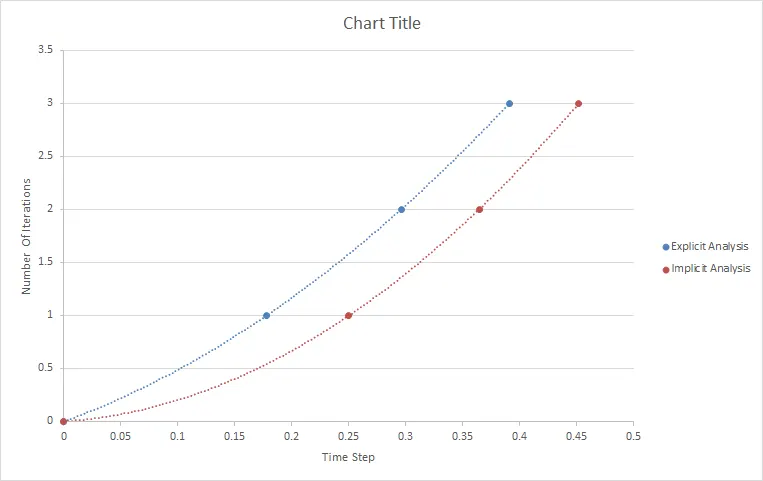
Implicit Vs Explicit Analysis Graph:
RESULT :
CONCLUSION:
- 3rd Order Polynomial, for a simple Bar under a tensile force, is analytically solved both in the Implicit and Explicit analysis is done and e plotted.
- Implicit is detailed and Time-consuming and more accurate and depends on element size and time steps
- The explicit analysis is faster but less accurate and needs more iterations to obtain good results.