Week - 2 - Explicit and Implicit Analysis
F(u)= U^3+9U^2+4U
F=K(U)
This is illustrated next. For this example, three equal load increments (or steps) of ∆F = 1 unit each are used to load the tension bar. The variables used are U for displacement, f for internal force in the bar, F for external force applied to the bar and k for stiffness. Incremental displacements or incremental externally applied forces are represented as ∆u or ∆F, respectively. Use is made of the relationship ∆F = k∆u. The analysis proceeds as follows:
K(U)= U^3+9U^2+4U
Differentiate the equation with respect to the U
K(U)=3U^2.dF/dU +18U.dF/dU +4.dF/dU
K(U)= dF/du(3U^2+18U+4)
Uo=0
K(Uo)=4, ΔF=1(External force)
ΔU1=ΔF/K(Uo)=1/4 =0.25
U1=Uo+ΔU1=0+0.25
U1=0.25
K(U1) = 3 (0.25^2) +18(0.25) +4
K(U1) =8.68
ΔU2=ΔF/K(U1)
ΔU2=1/8.68 =0.115
U2=U1+ ΔU2
=0.25+0.115
U2=0.365
K(U2)=3x(0.365)^2+18x(0.365)+4
K(U2) = 10.969
ΔU3=ΔF/K(U2)
=1/10.969
ΔU3 =0.091
Finally, from three steps following results.
Fext= ΔF+ΔF+ΔF=1+1+1=3
U3=U2+ΔU3
=0.365+0.091
U3=0.456
Fint =
=(0.456)^3+9(0.456)^2+4(0.456)
Fint =3.7898
Fext≠fint
|
Stepi |
ΔFi |
ΔUi |
Ui |
(Fext)i |
(fint)i |
Fint-Fext=R |
|
1. |
1 |
0.25 |
0.25 |
1 |
1.578 |
0.578 |
|
2. |
1 |
0.115 |
0.365 |
2 |
2.707 |
0.707 |
|
3. |
1 |
0.091 |
0.456 |
3 |
3.79 |
0.79 |
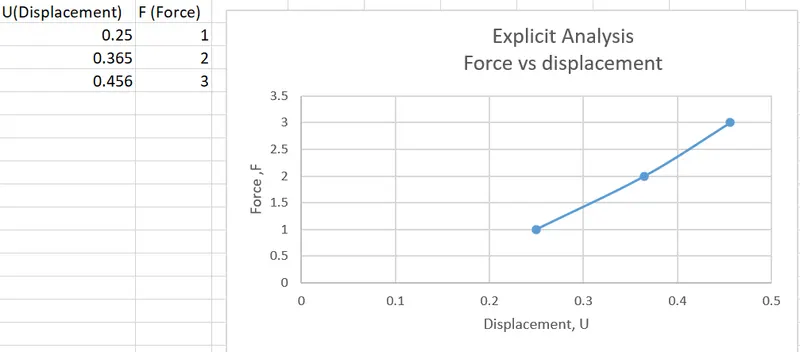
Table: Summary of the Explicit analysis Results
Implicit Analysis:
An implicit analysis is the same as the explicit analysis, except that at the end of each step Newton-Raphson iterations are used to enforce equilibrium before moving to the next step. This is accomplished by using Newton-Raphson iterations to minimize the residual, R(u) = fint − Fext. Expanding the residual as a Taylor series about the current displacement u j gives
R j+1 = R j (u j) + dR (u j) du δuj+1 + ... = R j + k (u j) δuj+1 +
By neglecting higher order terms in the series, setting Rj+1 = 0 and solving for δuj+1 the following correction is obtained
δuj+1 = −[k(u j )]^-1 R j
STEP-1:
Uo=0
K(U0)=4, ΔF=1, ΔU1= ΔF/K(Uo)=1/4=0.25
U1=Uo+ΔU1
=0+0.25
U1=0.25
Check Residual ,Fext=ΔF=1,fint=
= (0.25)^3+9(0.25)^2+4(0.25)
=0.0156+0.562+1
fint=1.577
| R^0| =fint-Fext
|R^0| =1.577-1
|R^0| =0.577
|R^0| >10^-2 →Newton Raphson iterations are necessary
Calculate the correction to U1=U1^0
where the first iteration j=0
δuj+1 = −[k(u1 ^j)]^-1 R j
substitute the K(U1) equation which is
K(U1)=3U^2 +18U+4
=3(0.25)^2+18 (0.25)+4
K(U1)=8.6875
δuj+1 = −[k(u1 ^j)]^-1 R ^j (where j=0)
=-(8.6875)^-1 x(0.577)
δU =-0.06641
The updated of the
U1^1 = U1^0 +δU^1
= 0.25-0.06641
U1^1 =0.184
Check the Residual again ,Fext =1,fint= U1^3 +9U1^2 +4U1
= (0.184)^3+9 (0.184)^2 +4 (0.184)
fint =1.046
R^1=fint -Fext
=1.046-1
R^1 =0.046> 10^-2 →Another Newton-Raphson iteration is necessary
Calculate the New total correction
j=1
U1^1=0.184
K(U1)=3xU^2 +18xU +4
=3x(0.184)^2 +18 x(0.184) +4
K(U1)=7.4135
δU^2= δU^1 -[K(U1)^1]^-1 .R^1
= -0.06641-5.294xE-3
=-0.0717
U1^2= U0+δU^2
=0.25-0.0717
U1^2 = 0.1783
finternal,
U2^2 =1.0049
= fint -Fext
= 1.0049-1
=0.0049 < 10^-2
Therefore the final value is U1^2 = 0.1783
Similarly U2=0.3535,U2=-0.209
U2^1 =0.2764
U3^1= U2^0 + δU3
U3^1 =0.3748
|
Stepi |
ΔFi |
Ui |
(Fext)i |
(fint)i |
Fint-Fext=R |
|
1. |
1 |
0.178 |
1 |
1.5776 |
0.5776 |
|
2. |
1 |
0.2764 |
2 |
2.582 |
0.582 |
|
3. |
1 |
0.378 |
3 |
3.406 |
0.406 |
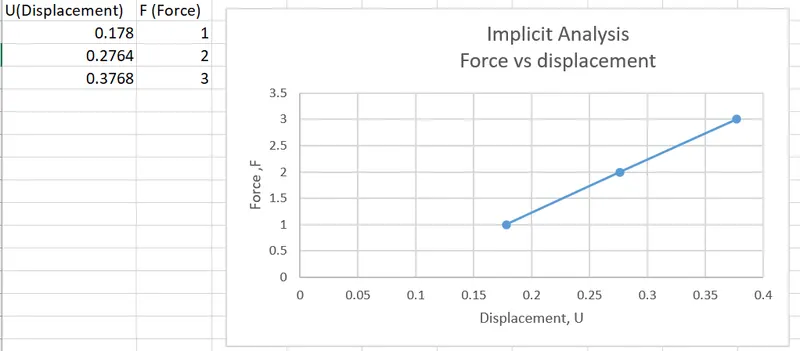
Table: Implicit Analysis Results
Exact solution:
The given equation in the form of
ax^3 +bx^2 +cx+d then
ax^3+bx^2 +cx=-d
i) Here in first case where F=-1,a=1,b=9,c=4
Then we will get values x1= -8.5165
x2= 0.1776
x3= -0.6610
ii)In second case where F=-2,a=1,b=9,c=4
Then we will get values x1= -8.5018
x2 = 0.2961
x3= -0.7943
iii)In third case where F=-3,a=1,b=9,c=4
Then we will get values x1= -8.4870
x2= 0.3910
x3 =-0.9039
F=K(U)
This is illustrated next. For this example, three equal load increments (or steps) of ∆F = 1 unit each are used to load the tension bar. The variables used are U for displacement, f for internal force in the bar, F for external force applied to the bar and k for stiffness. Incremental displacements or incremental externally applied forces are represented as ∆u or ∆F, respectively. Use is made of the relationship ∆F = k∆u. The analysis proceeds as follows:
K(U)=
Differentiate the equation with respect to the U
=
=
K(U)=
Uo=0
K(Uo)=4, ΔF=1(External force)
ΔU1=ΔF/K(Uo)=1/4 =0.25
U1=Uo+ΔU1=0+0.25
U1=0.25
K(U1) = 3 (0.25^2) +18(0.25) +4
K(U1) =8.68
ΔU2=ΔF/K(U1)
ΔU2=1/8.68 =0.115
U2=U1+ ΔU2
=0.25+0.115
U2=0.365
K(U2)=3x(0.365)^2+18x(0.365)+4
K(U2) = 10.969
ΔU3=ΔF/K(U2)
=1/10.969
ΔU3 =0.091
Finally, from three steps following results.
Fext= ΔF+ΔF+ΔF=1+1+1=3
U3=U2+ΔU3
=0.365+0.091
U3=0.456
Fint =
=(0.456)^3+9(0.456)^2+4(0.456)
Fint =3.7898
Fext≠fint
|
Stepi |
ΔFi |
ΔUi |
Ui |
(Fext)i |
(fint)i |
Fint-Fext=R |
|
1. |
1 |
0.25 |
0.25 |
1 |
1.578 |
0.578 |
|
2. |
1 |
0.115 |
0.365 |
2 |
2.707 |
0.707 |
|
3. |
1 |
0.091 |
0.456 |
3 |
3.79 |
0.79 |
Table: Summary of the Explicit analysis Results
Implicit Analysis:
An implicit analysis is the same as the explicit analysis, except that at the end of each step Newton-Raphson iterations are used to enforce equilibrium before moving to the next step. This is accomplished by using Newton-Raphson iterations to minimize the residual, R(u) = fint − Fext. Expanding the residual as a Taylor series about the current displacement u j gives
R j+1 = R j (u j) + dR (u j) du δuj+1 + ... = R j + k (u j) δuj+1 +
By neglecting higher order terms in the series, setting Rj+1 = 0 and solving for δuj+1 the following correction is obtained
δuj+1 = −[k(u j )]^-1 R j
STEP-1:
Uo=0
K(U0)=4, ΔF=1, ΔU1= ΔF/K(Uo)=1/4=0.25
U1=Uo+ΔU1
=0+0.25
U1=0.25
Check Residual ,Fext=ΔF=1,fint=U1^3 +9U1^2 +4U1
= (0.25)^3+9(0.25)^2+4(0.25)
=0.0156+0.562+1
fint=1.577
|R^0| =fint-Fext
=1.577-1
|R^0|=0.577
|R^0| > 10^-2 →Newton Raphson iterations are necessary
Calculate the correction to U1=U1^0
where the first iteration j=0
δuj+1 = −[k(u1 ^j)]^-1 R j
substitute the K(U1) equation which is
K(U1)=
=3(0.25)^2+18 (0.25)+4
K(U1)=8.6875
δuj+1 = −[k(u1 ^j)]^-1 R ^j (where j=0)
=-(8.6875)^-1 x(0.577)
δU =-0.06641
The updated of the
= 0.25-0.06641
=0.184
Check the Residual again ,Fext =1,fint= U1^3 +9U1^2 +4U1
= (0.184)^3+9 (0.184)^2 +4 (0.184)
fint =1.046
R^1 =fint -Fext
=1.046-1
R^1 =0.046> 10^-2 →Another Newton-Raphson iteration is necessary
Calculate the New total correction
j=1
U1^1 =0.184
K(U1)= 3 xU^2 +18U +4
=3x(0.184)^2 +18 x(0.184) +4
K(U1)=7.4135
= -0.06641-5.294xE-3
=-0.0717
=0.25-0.0717
U1^2 = 0.1783
finternal, U1^2 =U1^3 +9U1^2 +4U1
U1^2 =1.0049
R^2= fint -Fext
= 1.0049-1
=0.0049 < 10^-2
Therefore the final value is = 0.1783
Similarly U2=0.3535,U2=-0.209
U2^1 = U2^0 +δU2
U2^1 =0.2764
U3^1 =0.3748
|
Stepi |
ΔFi |
Ui |
(Fext)i |
(fint)i |
Fint-Fext=R |
|
1. |
1 |
0.178 |
1 |
1.5776 |
0.5776 |
|
2. |
1 |
0.2764 |
2 |
2.582 |
0.582 |
|
3. |
1 |
0.378 |
3 |
3.406 |
0.406 |
Table: Implicit Analysis Results
Exact solution:
The given equation in the form of
++cx=-d
F(u)=
i) Here in first case where F=-1,a=1,b=9,c=4
Then we will get values x1= -8.5165
x2= 0.1776
x3= -0.6610
ii)In second case where F=-2,a=1,b=9,c=4
Then we will get values x1= -8.5018
x2 = 0.2961
x3= -0.7943
iii)In third case where F=-3,a=1,b=9,c=4
Then we will get values x1= -8.4870
x2= 0.3910
x3 =-0.9039
Observation:
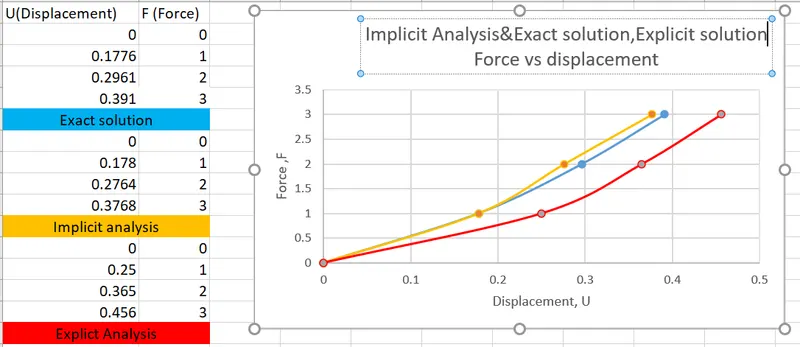
i) From the above plots explicit analysis is drift from the true solution or exact solution.
ii) If we use only explicit analysis from the graph mentioned above will not come to closer to exact solution (with three increments) to balance that implicit analysis is used , the explicit analysis to converge it require some more iterations to converge. And also mentioned that the tolerance value is 0.01 in this case we cannot consider the explicit analysis which is far.
iii) Then if an implicit analysis is employed, Newton-Raphson iterations are used to make corrections to the displacement in order to achieve equilibrium.