1) ans

 Fuel cells come in many varieties; however, they all work in the same general manner. They are made up of three adjacent segments: the anode, the electrolyte, and the cathode. Two chemical reactions occur at the interfaces of the three different segments. The net result of the two reactions is that fuel is consumed, water or carbon dioxide is created, and an electric current is created, which can be used to power electrical devices, normally referred to as the load.

Different types of fuel cell is classified based on the following changes in the making of fuel cells

The electrolyte substance, which usually defines the type of fuel cell, and can be made from a number of substances like potassium hydroxide, salt carbonates, and phosphoric acid.
The fuel that is used. The most common fuel is hydrogen.
The anode catalyst, usually fine platinum powder, breaks down the fuel into electrons and ions.
The cathode catalyst, often nickel, converts ions into waste chemicals, with water being the most common type of waste.
Gas diffusion layers that are designed to resist oxidization.
Based on the above, following 4 types of Fuel cell are taken for comparison.

1. Proton-exchange membrane fuel cell (PEMFC)

In the archetypical hydrogen–oxide proton-exchange membrane fuel cell (PEMFC) design, a proton-conducting polymer membrane (typically nafion) contains the electrolyte solution that separates the anode and cathode sides.

2. Solid Oxide Fuel Cell (SOFC)

A solid oxide fuel cell (or SOFC) is an electrochemical conversion device that produces electricity directly from oxidizing a fuel. Fuel cells are characterized by their electrolyte material; the SOFC has a solid oxide or ceramic electrolyte.

3. Alkaline Fuel cell (AFC)

The alkaline fuel cell (AFC), also known as the Bacon fuel cell, is one of the most developed fuel cell technologies. Alkaline fuel cells consume hydrogen and pure oxygen, to produce potable water, heat, and electricity. They are among the most efficient fuel cells, having the potential to reach 70%.

4. Direct-methanol fuel cells (DMFC)

Direct-methanol fuel cells or DMFCs are a subcategory of proton-exchange fuel cells in which methanol is used as the fuel. Their main advantage is the ease of transport of methanol, an energy-dense yet reasonably stable liquid at all environmental conditions.

Comparison

 	FUEL CELL
Parameter	PEM (Proton Exchange Membrane)	SOFC (Solid Oxide Fuel Cell)	AFC (Alkaline Fuel Cell)	DMFC (Direct Methonal Fuel Cell)
Fuel	Hydrogen and Oxygen	Hydrogen and Oxygen	Hydrogen and Oxygen	Methanol and Oxygen
Electrolyte	Solid polymer: PEM	Solid ceramic material	Liquid (aq. KOH/NaOH sol.)	Solid polymer: PEM
Power density	High (1570mWcm-2)	High (2000mWcm-2)	Low (150mWcm-2)	Low (100mWcm-2)
Operational temeperature	50-100 C	500-1000 C	upto 100 C	50-120 C
Start up time	Fast	Slow	Fast	Fast
Heat generation	Low	Moderate	Low	Low
Catalyst	Platinum	Platinum	Nickel	Bimetallic platinum-ruthenium (PtRu)
Efficiency	50-60%	60%	55-65%	30-40%
Sensitive to impurity	High	Low	High	Low
Lifetime	Moderate	Good	Moderate	Good (20000 operation hrs)
Stack size	1-100kW	 	1-100kW
By product	Water + Heat	Water + Heat	Water + Heat	CO2+Water+Heat
Application	Electric vehicle, Portable power generation	Transport, industrial equipment, Energy storage (using energy converts water back into hydrogen)	Portable power generation, low cost	Portable equipment, battery chargers, autonomous power equipment.
2) ans

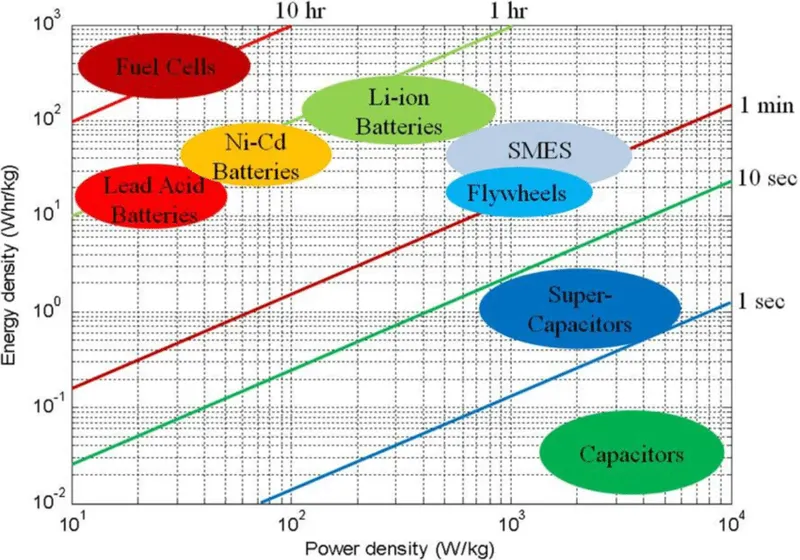
Power Density: Power density is a measure of power output per unit kilogram. Power density refers to how quickly a device can discharge its energy. Higher power density device can charge and discharge quickly. Its unit is W/kg.

Energy Density: Energy density is a measure of how much energy stored per unit kilogram. The higher energy density means it can supply more energy and indicates the working hour of source. Energy density helps in knowing the capacity of the source.


The energy density vs power density chara of different power sources are given below

OBSERVATION

Capacitor have the lowest energy density and highest power density, so the capacitor can supply or store power at higher rate. So it can be used where there requires instantaneous high power requirement.
Fuel cell have the lowest power density and higher energy density. FC can supply power at prolonged time and can use where there requires continous power for long duration.
Among batteries
Lead acid have lowest energy density and ower density, but due to its cost these batteries are used in most areas.
Li-ion batteries have highest energy and power density among batteries but there cost is high and used in areas where high secifications per kilogram are required like EVs, industrial equipments, etc.
Ni-Cd lies in between the Pb-acid and Li-ion, and used in most of the portable electrical equipment.