Week 2 Challenge
Week:2 (fuel cells)
Question:1
Compare four different types of fuel cells and state their applications
A fuel cell generates electricity via a chemical reaction by simply completing an electric circuit. The entire process is completed in a few steps which are as follows:
- At the anode, Hydrogen atoms are introduced. These atoms are known to carry a positive electric charge. However, these atoms are stripped of their electrons at this stage. These negatively charged electrons move and create a current through the wires.
- At the cathode, Oxygen atoms are introduced. These atoms combine with the leftover electrons of the hydrogen atoms. It can combine with it after it passes through the anode or at this stage itself. It all depends on the type of cell.
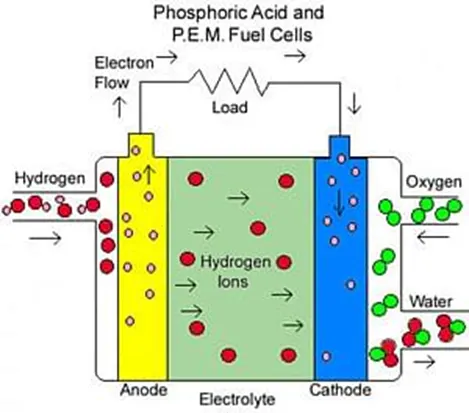
Working Process of Fuel Cells
The different reactions that take place involve:
- At Cathode: O2 + 2H2O + 4e- → 4OH-
- At Anode: 2H2 + 4OH- → 4H2O + 4e-
The net result of these two reactions is 2 H2 + O2 → 2H2O.
Sometimes, however, the reaction can be too slow and in such a situation a catalyst is used. Usually, platinum or palladium is used to expedite the reaction.
Types of Fuel Cells
- PEM or Polymer Electrolyte Membrane Fuel Cells, which are also known as Proton Exchange Membrane Fuel Cells, have an operating temperature of 50 to 100 degrees Centigrade while conducting protons. These cells consist of electrodes, bipolar plates, a polymer membrane, and a catalyst.
- Phosphoric Acid Fuel Cells contain phosphoric acid as their electrolyte. The operating temperature of these fuel cells is typically between 150 to 200 degrees Centigrade while they carry the positively charged Hydrogen ions. It is the non-conductive nature of this electrolyte that forces the electrons to pass through the cathode by completing an external circuit. However, the acidic nature corrodes the electrodes and oxidizes during the process.
- Solid Acid Fuel Cells work on either Cesium Hydrogen Sulfate, CsHSO4, or Cesium Dihydrogen Phosphate, CsH2PO4. The molecular structure of the solid acid material works in a specific order at a lower temperature. However, at a high temperature, conductivity can increase significantly due to the phase transition.
- Alkaline Fuel Cells use an aqueous alkaline solution. This solution helps to saturate the permeable milieu and helps in separating the electrodes. These cells operate at a temperature of 90 degrees Centigrade and are very efficient in producing heat and water apart from electric power.
- Solid Oxide Fuel Cells come with a solid oxide or a ceramic electrolyte like the Yttria-stabilized Zirconia. These low-cost cells are also very efficient. However, it operates at a very high temperature. The standard operating temperature of these cells can be 600°C and 1000°C at the two extremes of the temperature scale.
- Molten Carbonate Fuel Cells are powered by natural gas or biogas and use Lithium Potassium Carbonate salt as its electrolyte. It turns liquid at high temperatures to help the carbonate ions move. These cells also have a very high operating temperature of more than 650°C. However, the electrolyte corrodes the anode and cathode of the cells for its high operating temperature.
Question 2:
Using a plot with energy density and power density on the X and Y axis, arrange various battery types like lithium ion, lead acid, Nickel Cadmium, Ultracapacitor, fuel cell.
Battery energy density is the amount of energy a battery contains compared to its weight or size. We call this the specific energy density when comparing to weight and volumetric energy density when comparing size.
For example, we measure a battery’s energy in watt-hours (watts per hour, the equivalent of using one watt for one hour). We can then divide a battery’s watt hours (wh) by its kilograms (weight) or volume (liters).
Therefore, the length of time a battery can power a device compared to its weight or size equals the energy density.
Why Does Battery Energy Density Matter?
Battery energy density is crucial because the higher the energy density, the longer the battery can emit a charge in relation to its size. That being said, high energy density batteries can be useful when there isn’t much room for a battery but you need a lot of energy output. Smartphones and other handheld devices are great examples of this.
Let’s pose the benefits of energy density as a question: Would you rather have a small, lightweight battery that emits power for long periods or a heavy battery that takes up a lot of space and only provides a small amount of energy?
Almost everyone would say the former. This is why high energy density is vital in our world.
Energy Density vs. Power Density in Batteries
It’s easy to confuse energy density and power density because they’re similar in certain ways. They both measure an electrical characteristic of a battery in comparison to its weight.
Nevertheless, energy density and power density differ in one important way: while battery energy density measures the watt hours (wh) per kilogram (kg), power density measures the watt output per kilogram.
This is where power vs. energy comes into play. Power density measures how fast energy can be delivered, while energy density measures how much energy a battery holds.
What Are the Benefits of Using Batteries with High Energy Density?
Batteries with high energy density have transformed the mobile world. With more energy, we can fit useful batteries in smaller spaces. This enables long-lasting phones, laptops, earbuds, or medical devices.
They’re also very lightweight compared to past alternatives. Could you imagine carrying around a 5 lb iPhone? Or a 10 lb tablet?
More energy density also means we can pack a lot of energy into larger mobile devices like cars, planes, construction equipment, and robots.
What Are the Risks of High Energy Density?
When a battery packs more energy in it, it has more energy to release if something goes wrong.
The liquid electrolytes found in lithium-ion batteries are highly volatile and can lead to combustion, presenting a fire hazard. Because of this, there are safety features built into these batteries, limiting how lightweight and compact they can be.
Therefore, the higher the energy density of a battery, the more dangerous it can be, which poses limitations (and risks) to further advancement.
What Battery Currently Has the Highest Energy Density?
Hands down, lithium-ion batteries take the cake when it comes to high energy density. They’ve transformed our world with advancements in energy consumption and portability. In fact, lithium-ion batteries’ energy density ranges between 260-270 wh/kg, while lead-acid batteries range from 50-100 wh/kg.
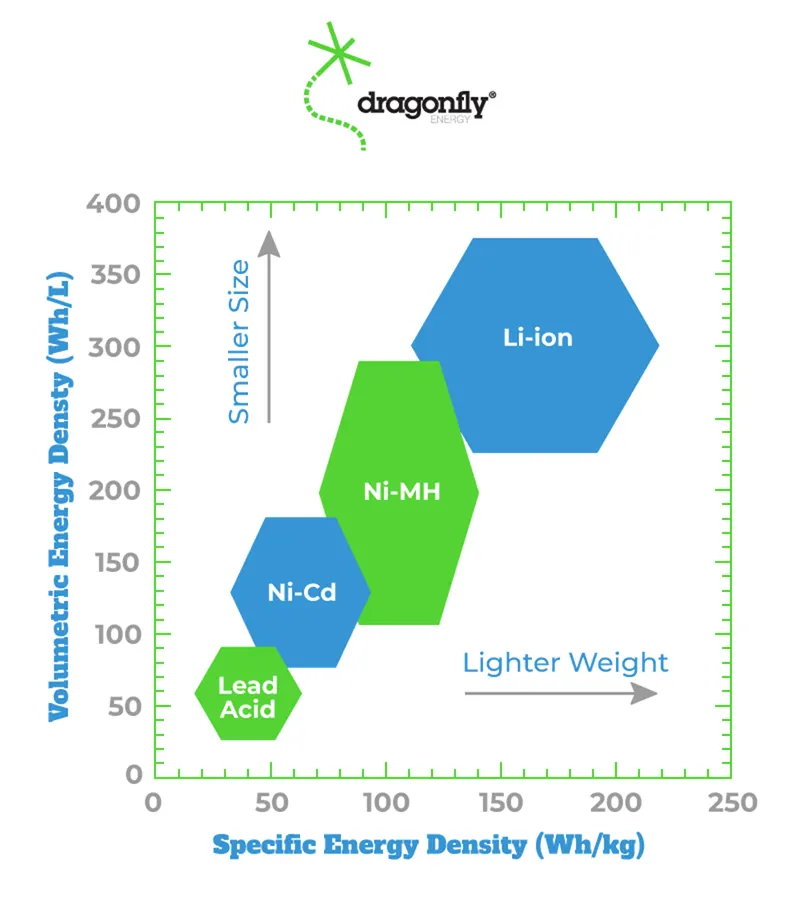
There have been many advancements in lithium-ion batteries over the last decade, specifically involving their chemistry. By using different materials for the anode and cathodes, engineers can experiment with electrochemistry and alter the energy density, power density, and more.
The lithium-ion battery with the highest energy density is the lithium cobalt-oxide battery. It uses cobalt oxide as the cathode and graphite carbon as the anode. Because of its high energy density, it’s popular for smartphones, laptops, watches, cars, and any compact device that needs to emit power over long periods.