Week 2 Challenge
Aim: - To describe all the loads acting on foundation, sub-structures & superstructures as per IRC-6-2019.
Explanation:-
- Dead Load:-The dead load carried by the structures (Bridge) is its own self-weight and is constant all along. The specific dead load for each and every material is mentioned in clause no. 203 of IRC-6-2016, some of them are mentioned below:- Materials Weight(t/m3)
1) Ashlar (granite) 2.7
2) Ashlar (sandstone) 2.4
3) Stone setts :
a) Granite 2.6
b) Basalt 2.7 4)Ballast (stone screened, broken, 2.5 cm to 7.5 cm gauge, loose):
a) Granite 1.4
b) Basalt 1.6
5) Brickwork (pressed) in cement mortar 2.2
6) Brickwork (common) in cement mortar 1.9
7) Brickwork (common) in lime mortar 1.8
8) Concrete (asphalt) 2.2
9) Concrete (breeze) 1.4
10) Concrete (cement-plain) 2.5
11) Concrete (cement – plain with plums) 2.5
12) Concrete (cement-reinforced) 2.5
13) Concrete (cement-prestressed) 2.5
14) Concrete (lime-brick aggregate) 1.9
15) Concrete (lime-stone aggregate) 2.1
16) Earth (compacted) 2.0
17) Gravel 1.8
18) Macadam (binder premix) 2.2
19) Macadam (rolled) 2.6
20) Sand (loose) 1.4
21) Sand (wet compressed) 1.9
22) Coursed rubble stone masonry (cement mortar) 2.6
23) Stonemasonry (lime mortar) 2.4
24) Water 1.0
25) Wood 0.8
26) Cast iron 7.2
27) Wrought iron 7.7
28) Steel (rolled or cast) 7.8 - Live load:- For the bridges classified under clause 201.1 of IRC-6 various types of tracked and wheeled vehicle loading are mentioned in IRC-6 in clause 204.
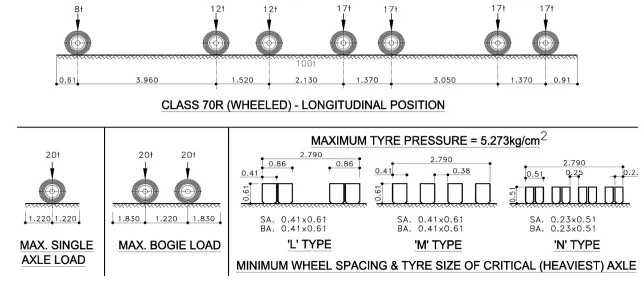
Fig.1 Class 70R wheeled vehicle arrangement.
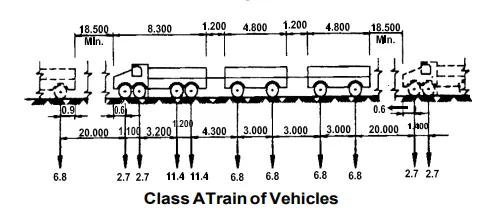
Fig.2 Class A wheeled vehicle loading
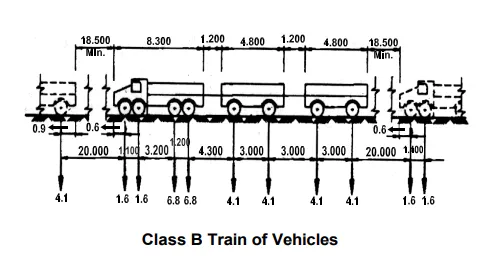
Fig.3 Class B wheeled vehicle loading
- Impact Loading:- Impact loading has to be considered while an accident and it is taken as some percentage of live load (wheel and track vehicle 70R, class A, B & AA) as according to clause 208.2 of IRC-6.
- Wind Loading:- Wind load is also one of the important types of loading in bridges with an individual span up to 150m and height up to 100m, for all other bridges (cable-stayed, suspensions, etc ) special literature should have to be used. Clause 209 of IRC-6 is used to do the wind calculations.
- Horizontal Force Due To Water Current:- Any bridge which is across the river, sea, or in some water bodies should be analyzed for horizontal force calculation as according to clause 210 of IRC-6.
- Earth pressure load:- These are the load mainly retained by abutments and foundations and analysis of this has to be done using clause 214 of IRC 6.
- Seismic Load:- As there are 4 seismic zones in India so according to the vicinity in which the bridge lies it has to be analyzed according to the IS 1893-2000.
- Centrifugal force:- It is the force exerted by the vehicle moving along the curve of the bridge and this definitely creat disturbance and needed to be calculated according to clause 212 of IRC-6.
- Braking Load:- When bracks are applied by the vehicle such types of load are applied and by using clause 211 of IRC-6 this load is calculated.
- Temperature load:- Due to variations in the temperature such loads are developed.
- Buoyancy Load:- This type of load is exerted on the bridge when they are located in deep water bodies.
OVERTURNING & SLIDING CALCULATION:-
Given data:-
- Abutment height= 4m
- Embedded depth= 2m
- Steam thickness= 0.8m
- SBC = 20Ton/m3
- coefficient of friction =0.5
- Eccentricity from bearing and abutment center is 0.3 m
- Soil density =18 kN/m3
Checking against sliding, overturning & deep-seated failure is all a matter of newtons 3rd law, which means for example the horizontal force exerted (Applied force) by the earthwork will tend to move the wall away from the backfill and the self-weight of the abutment (mainly vertical force and frictional force) will try to resist the movement. So the retaining structure which is designed should be able to withstand any pressure coming on it. The factor of safety against sliding and overturning is given in clause 703.6.4 of IRC-78.
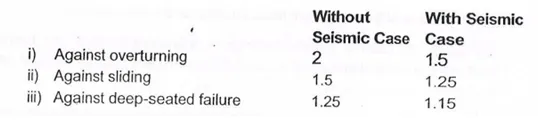
The factor of safety for sliding:-
Let us assume that the earth pressure exerts the lateral force on the abutment which will be given by:
Pa = Ka*γ*h---(1)
The force which resists the movement is given by:-
Fv = CaB+Rtanδ+Pp---(2)
δ= Angle of wall friction
so the factor of safety against sliding is given by
FOSs = Fv/Pa ≥ 1.5-----(3)
The factor of safety against overturning:-
Various load generating a moment should have to be considered for calculating the factor of safety against overturning which are as follow;
- The moment generated because of horizontal pressure = (area of pressure distribution diagram*H/3)
- The moment generated because of the vertical forces acting on the abutment
- The moment generated because of the load eccentricity
- The moment generated because of the upward ground pressure =
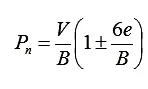
FOSo = Sum of the moment that resists overturning/sum of the overturning moment
FOSo = ∑Mr/∑Mo ≥ 2 -----(4)
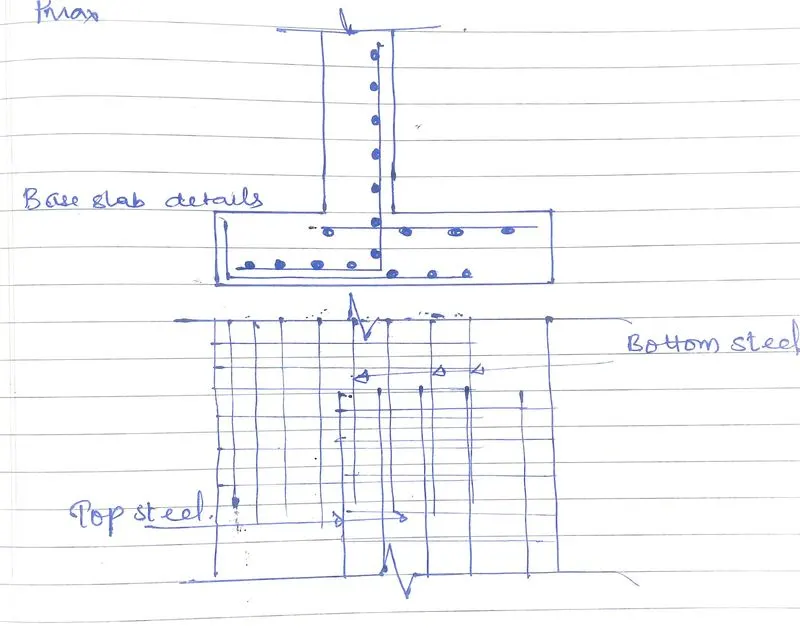
2. Locations of bore logs:-
What is a borehole???
A borehole is a deep vertical hole with a small diameter drilled into the ground to obtain soil samples for soil investigation required for the construction of the suitable foundation for the planned structure. It is required to carefully plan boreholes so as to obtain the required information with minimum possible cost.
Location of boreholes & uses:-
Mostly the location of the borehole will be near to the foundation which will give us an exact idea about the soil underneath, isn't suitable for the foundation or not. If not that what possible measure should be taken to make it stable or it is required to change the alignment of the bridge. Boreholes are used for finding the bearing capacity of the soil, nature of soil strata, liquefaction in the soil, and most importantly the depth of the foundation. The depth of the boreholes depends upon the width of the foundation means the depth will be 1.5 times the width of the foundation
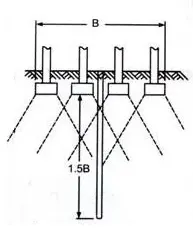
Credits:- https://theconstructor.org/geotechnical/setup-borehole-layout-site-investigation-foundations/18857/
In order to design the foundations the following things we need to get from the site:
- A reconnaissance survey involves the topography of the site, hydrological data, geographical location of the site, and most importantly the loads coming on the foundations.
- A sampling of the strata should be done both undisturbed and undisturbed.
- Data regarding fixing the alignment of the bridge and the location of the borehole
- Standard penetration test.
Different type of soil are as follow:-
Soil is classified in many ways. Broadly in civil engineering soil is a naturally occurring loose uncemented unconsolidated organic and inorganic in character. It may lay over the bed of rock which is ultimately formed because of weathering. Soils are formed by different particles such as gravel, rock, sand, silt, loam, clay & humas.
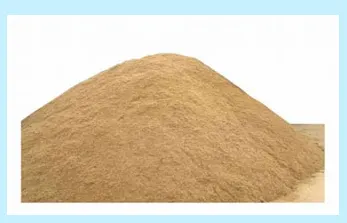

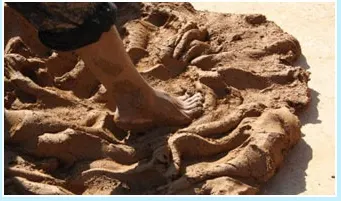
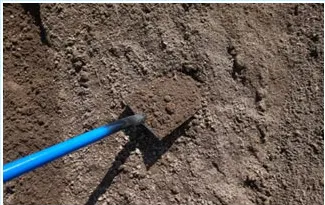
Sand wet silt clay loam
Different types of rock:-


Granit Diorite Sandstone Conglomerate Slate Gneiss Gabbro


Iron ore Rocksalt Phyllite Pumice Obsidian Coal Limestone Marble Quartzite


Basalt Hornfels