Week 2 Bevel Gear Challenge
BEVEL GEAR SIMULATION
OBJECTIVE:
To perform contact simulation and to perform a grid dependency test on two bevel gears to determine the Equivalent stress, Total deformation, and Stress intensity and to determine if any possible fracture could occur during its operation.
INTRODUCTION:
Grid dependency test
Grid dependency by its very nature implies that the solver results are dependent on the grid properties. Since it is obvious that the results generated by a coarse and fine mesh have a significant difference, however after a certain extent a mesh accuracy and density the variance in the output results are less significant.
This type of test where the mesh properties are refined at each stage such that the variance in the solver results are almost negligible is called a mesh convergence or grid dependency test.
PROCEDURE:
- Create a new static structural simulation
- Import the .igs file onto the spaceclaim window.
Since the model consists of two bevel gears with detailed geometry features, this would add up to our simulation time and mesh data. Hence it is advisable to trim out or extrude out the portions that are of no interest.
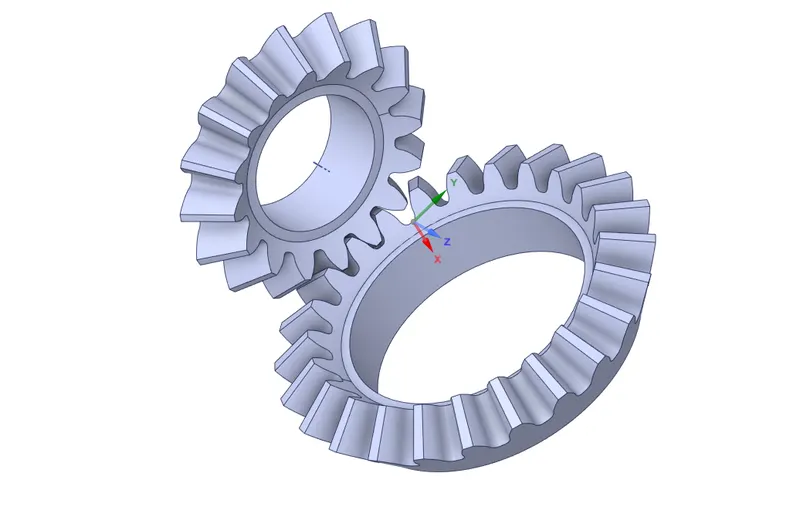
- Then the model module of static structural is again updated.
- Open the model in ansys mechanical module.
Material assignment
- Add structural steel as the desired material to both the geometries.
Contact sets
- Specify the faces that come in contact in both the model geometries
- Specify the faces in the pinion as the 'contact body' and that of the gear as the 'target bodies'
- Keep the type as a frictional contact with the formulation as Augmented lagrange
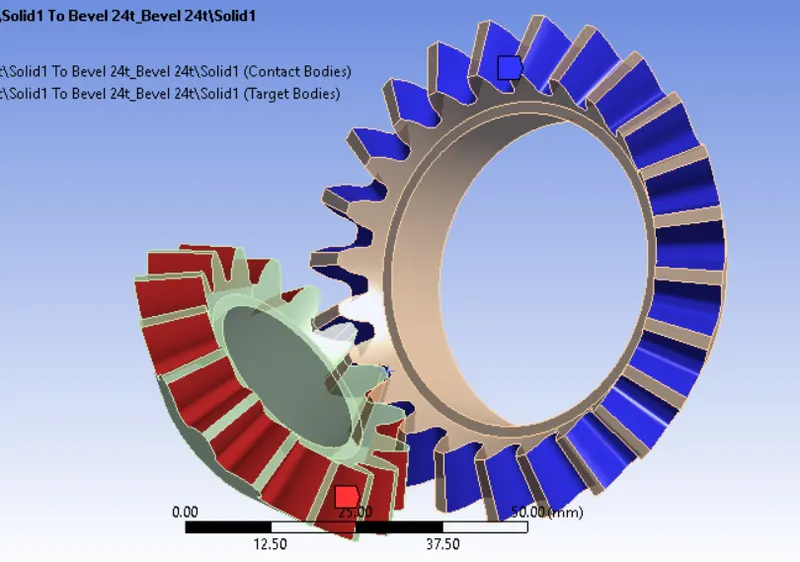
Revolute joint
- A revolute joint is created on the center point of both the components using the contact option.
Analysis settings
- Then the type of analysis and other simulation parameters like time step, no of steps etc are defined from the analysis settings.
Joint load
- A joint load of 100 N.mm is applied to the big gear and the pinion is made to rotate about the z axis at an angle of 20 deg at each time step. Hence with time step increments of 6, a total axis of 120 deg must be completed by the pinion at the end of the last iteration

NOTE: If the axis of rotation is misaligned in any of the gears, then it has to be reversed from the revolute joint CS
Mesh
- 3D tetra solid mesh is generated on both the model.
- The tooth contact regions are targeted for a dense mesh of 2mm while the rest of the non-contact regions are left to have a coarse mesh of 5mm target length
- The generated mesh is shown below
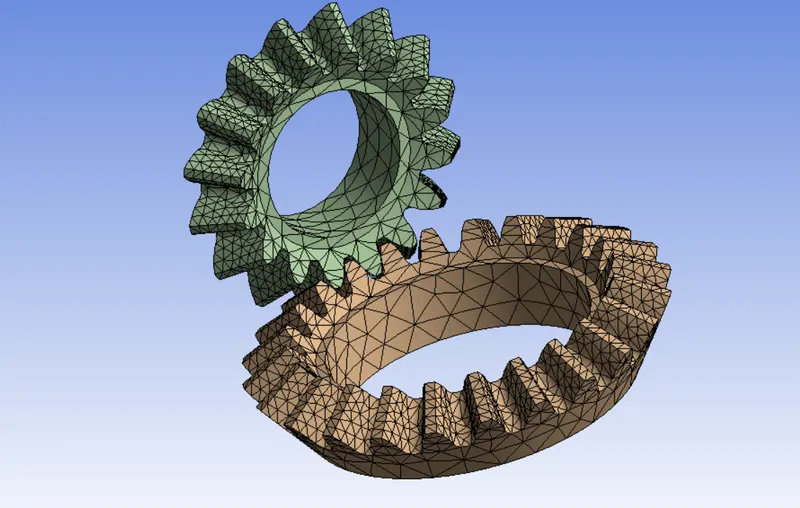
Output parameters
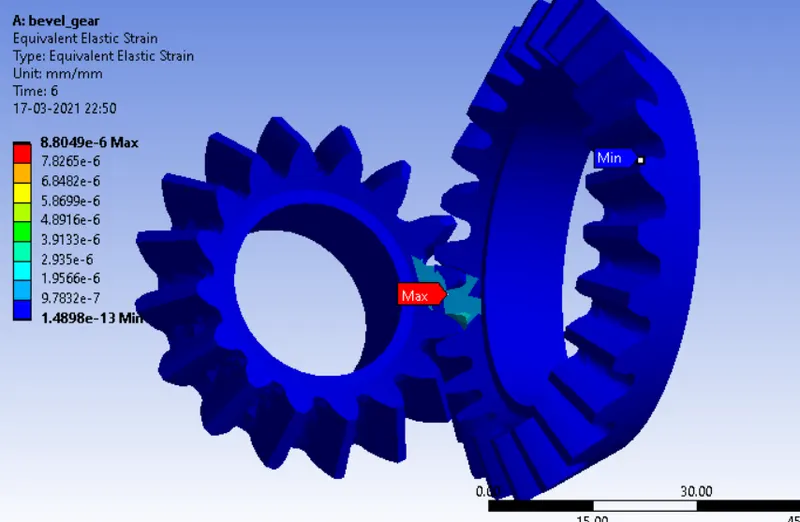
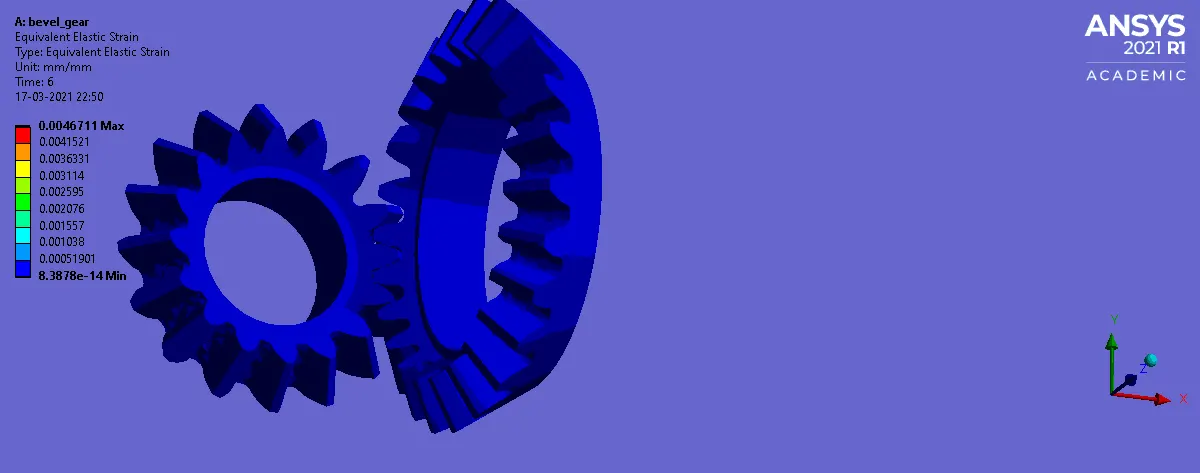
- The following results are requested: Equivalent (von-mises) stress, total deformation, Equivalent strain
- Factory of safety under stress tool
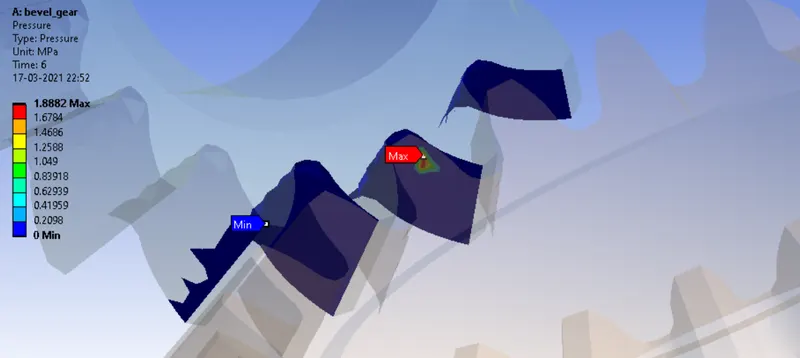
- Contact forces and pressure at contact regions
ERROR:
During the first time step, the solver failed to converge to the default criteria.
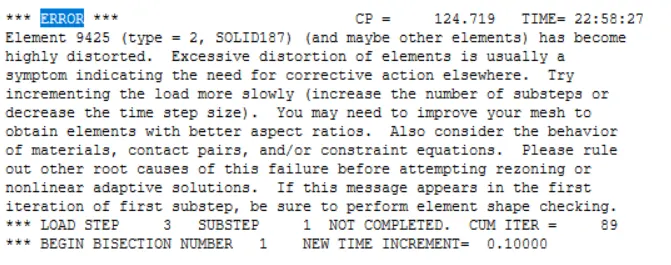
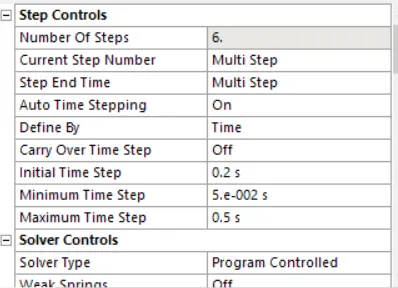
This is because the time step size is usually large. The current time increments are at a min and max value of 0.1s and 1s respectively.
This is quite large for the solver to converge hence it resulted in a in-accurate result.
The solution for this error is to decrease the time step increments to min and max value of 0.05 and 0.5 respectively (as shown below)
RESULTS:
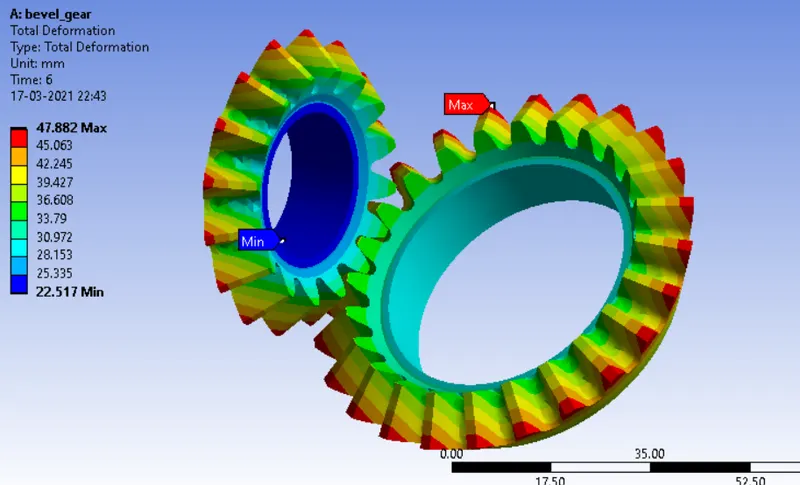
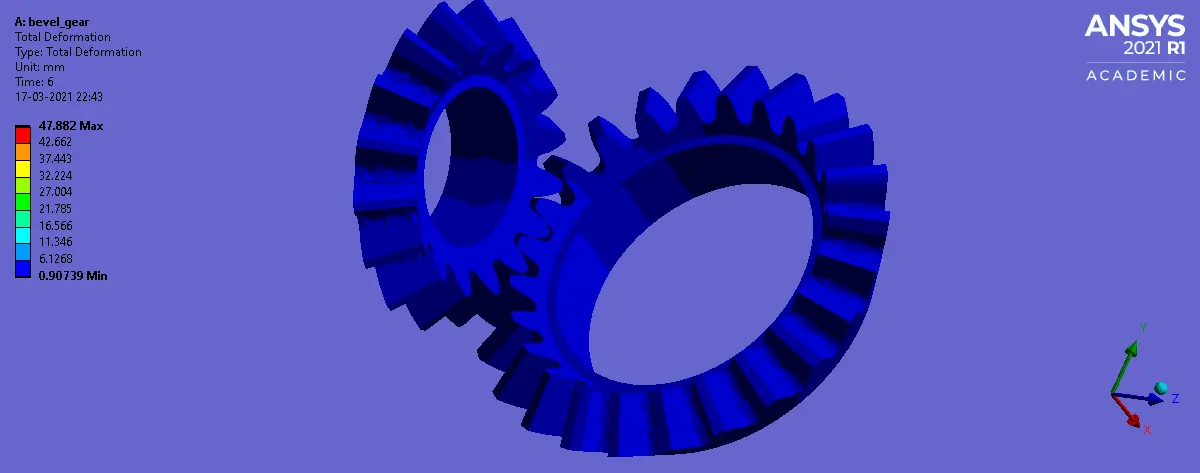
Total deformation
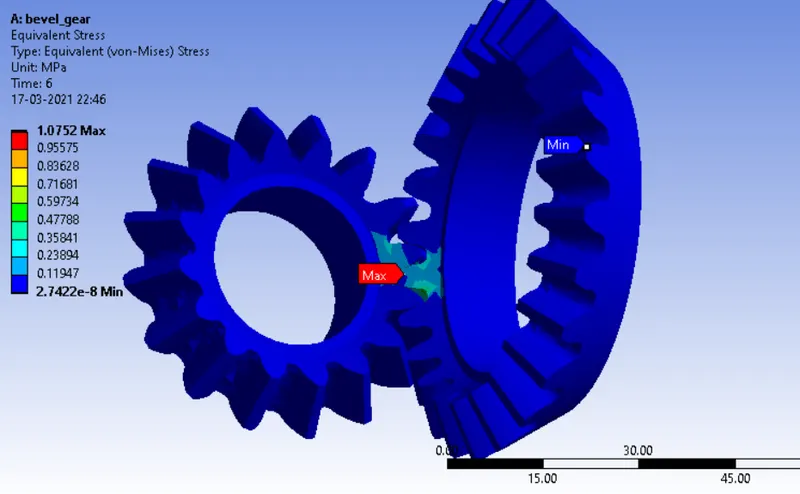
Equivalent stress
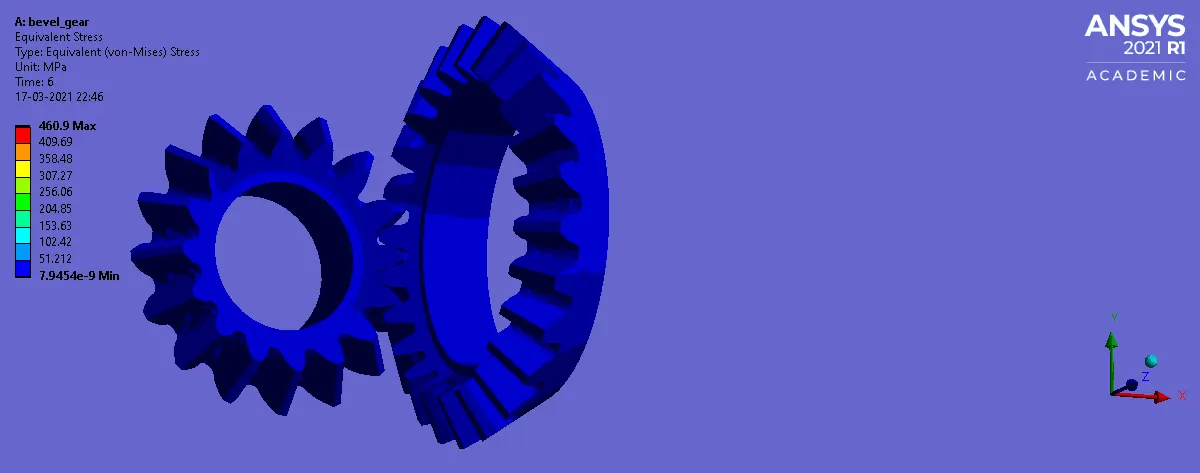
Equivalent strain
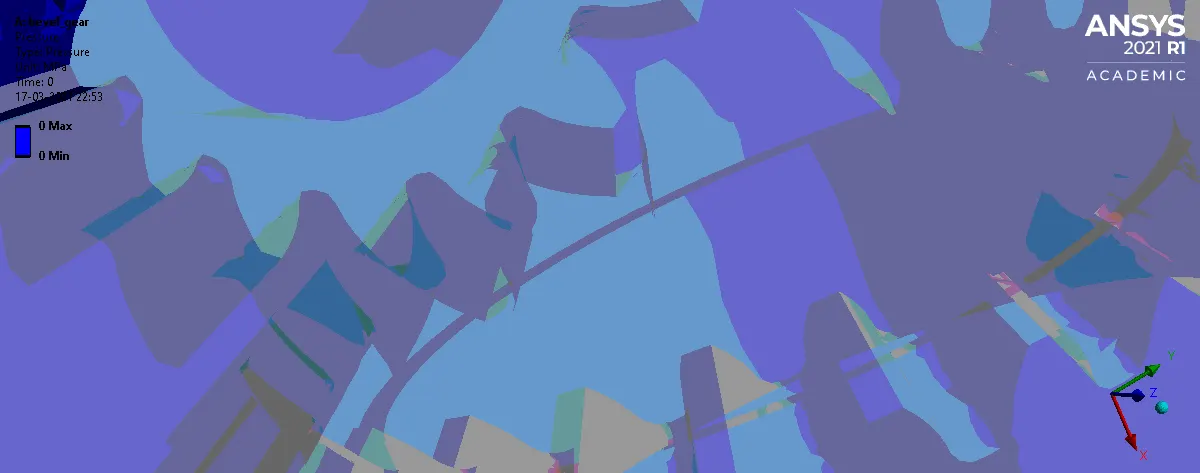
Contact pressure
GRID DEPENDENCY TEST
| Target length (mm) | Total deformation | Von mises stress | Equivalent strain |
| 6 | 47.88 | 1.116 | 7.05e-6 |
| 5 | 47.88 | 1.07 | 8.8e-6 |
| 4 | 47.88 | 1.159 | 8.7e-6 |
CONCLUSION
Hence the grid dependency test is done on the bevel gear component which resulted in a much similar result in either case even due to a large difference in mesh target length. Due to this less significant change in the results, a mesh length of 4mm and with other similar mesh parameters is preferred since it greatly reduces the solver time while not compromising on the solver accuracy.