Week 2 Bevel Gear Challenge
Grid dependency test: This is performed to check the effect of the mesh sizing in the obtained results. As we know that smaller mesh size gives more accurate results but it also leads to an increase in the computation time. So a grid dependency test is performed to see the variation of results with a mesh size. Now, when do a structural test then we reduce the mesh size to see the variation in the results. As mesh size is reduced the results are more accurate to the point where the results do not variate significantly.
Aim: To conduct a grid dependency test for a bevel gear system of mesh sizes 6,5 and 4mm. The material of the bevel gear is structural steel. Von mises stress, equivalent elastic strain, and total deformation are obtained for the different mesh sizes.
Procedure:
Geometry: Drag the geometry in space claim and use the pull feature to remove the material from the center of the gears. This is done because we need to increase the number of nodes around the point of the study.
Setup:
Connections:
- Contact: Set the contact type as Frictional (coeff. of friction as 0). The formulation will be Augmented Lagrange, along with that set the interface to adjust to touch.
- Joint: We create two revolute joints by selecting the inner circular surface of either of the gears. The type will be Body-ground.
Mesh:
- As we are interested in the mesh size in the teeth grooves, add a face sizing to these grooves, which is 1.75mm.
- Then add a mesh size of 4mm (and click the parameter setting on. This will help us to obtain the results of 5mm and 6mm element size.
Analysis Settings:
- Number of steps: 6 (select all the steps to add the following settings).
- Auto Time step: On
- Define by: Time
- Carryover time step: Off
- Initial time step: 0.1s
- Large Deflection: On
Load Settings:
- Add a moment joint load of -100 Nmm to the larger gear.
- Add a rotating joint load with 20 degrees increment at every second to the smaller gear.
Solution: Create three solution which is Von mises Stress, Elastic strain, and deformation. When the solution set is created make the min, max, and average as a parameter.
Results and Discussion:
Mesh Size: 4mm
Max Deformation: 47.88 mm
Min Deformation: 37.16 mm
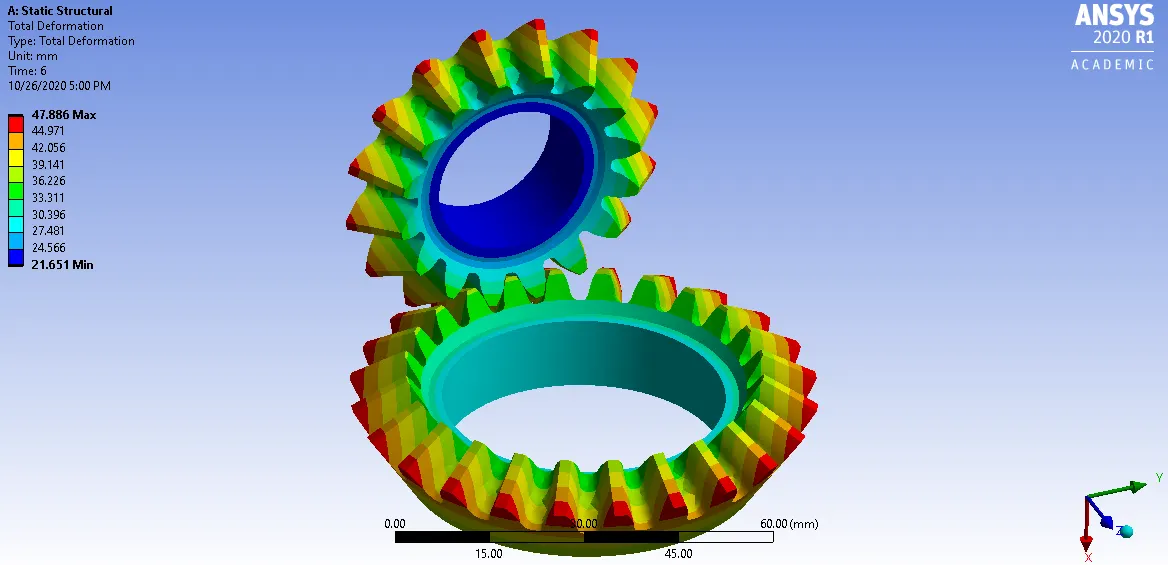
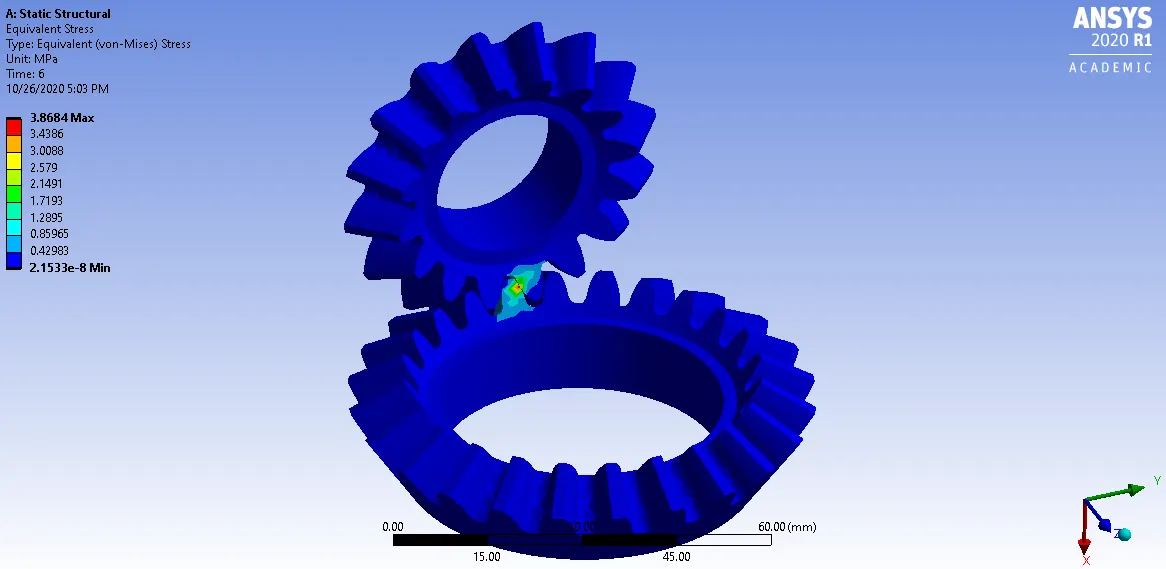
Max Von misses stress: 3.868 MPa
Min Von misses stress: 2.15e-08 MPa
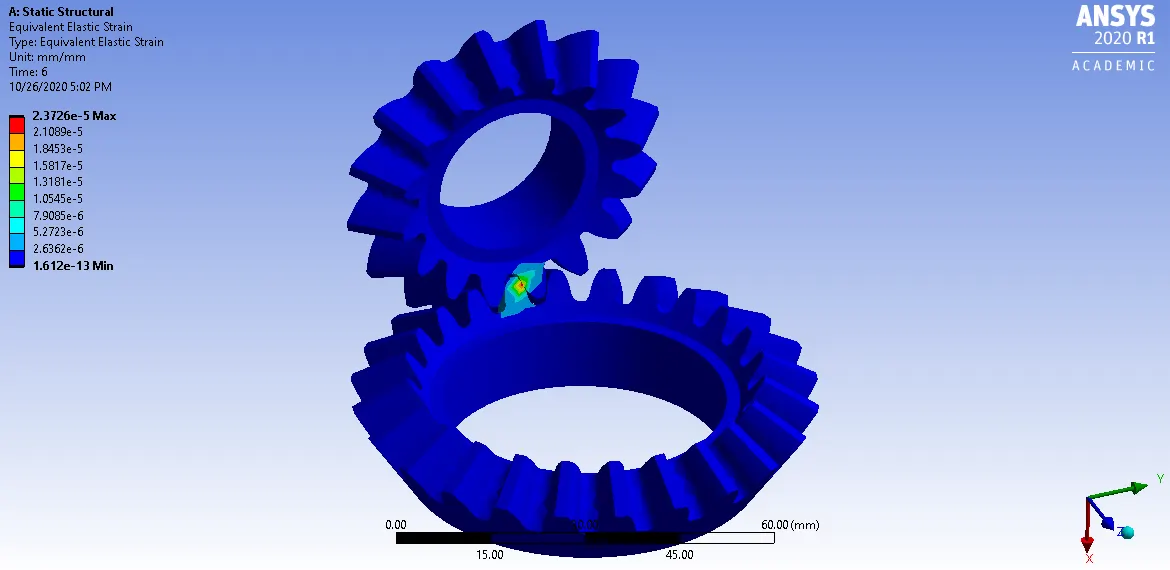
Max Elastic Strain: 2.37e-05 mm/mm
Min Elastic Strain: 1.61e-13 mm/mm
Mesh Size: 5mm
The total deformation remains the same as it is associated with the motion of the gear.
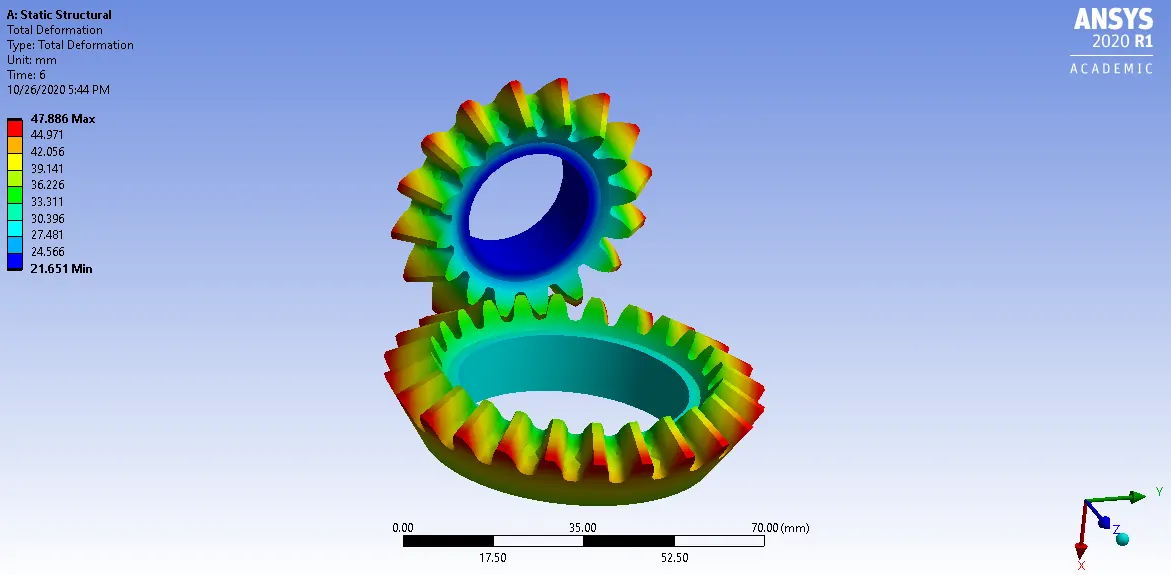
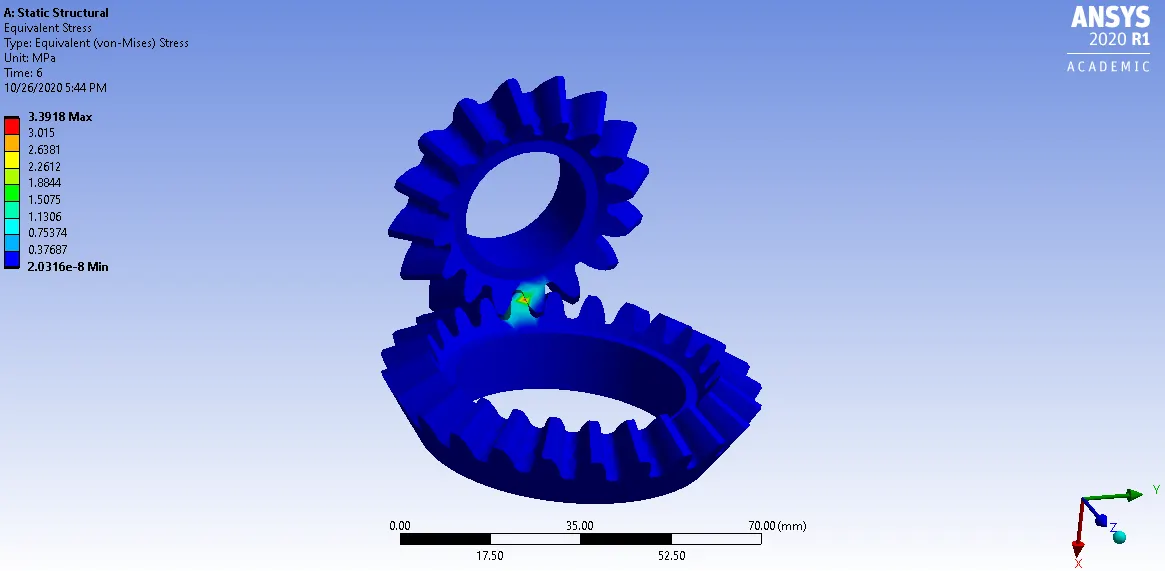
Max Von misses stress: 3.3918 MPa
Min Von misses stress: 2.03e-08 MPa
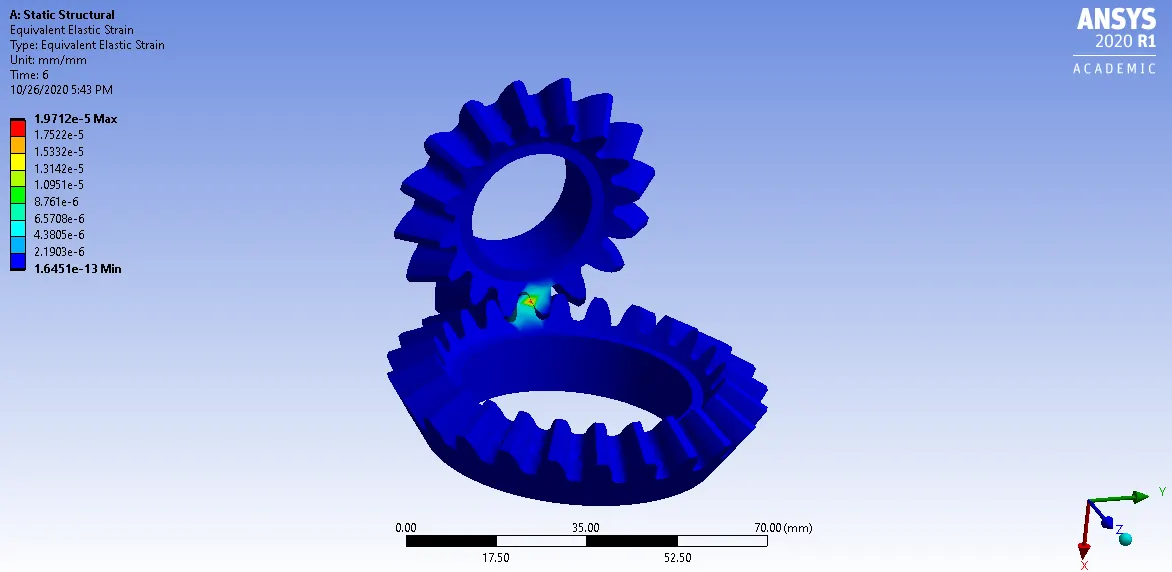
Max Elastic Strain: 1.97e-05 mm/mm
Min Elastic Strain: 1.64e-13 mm/mm
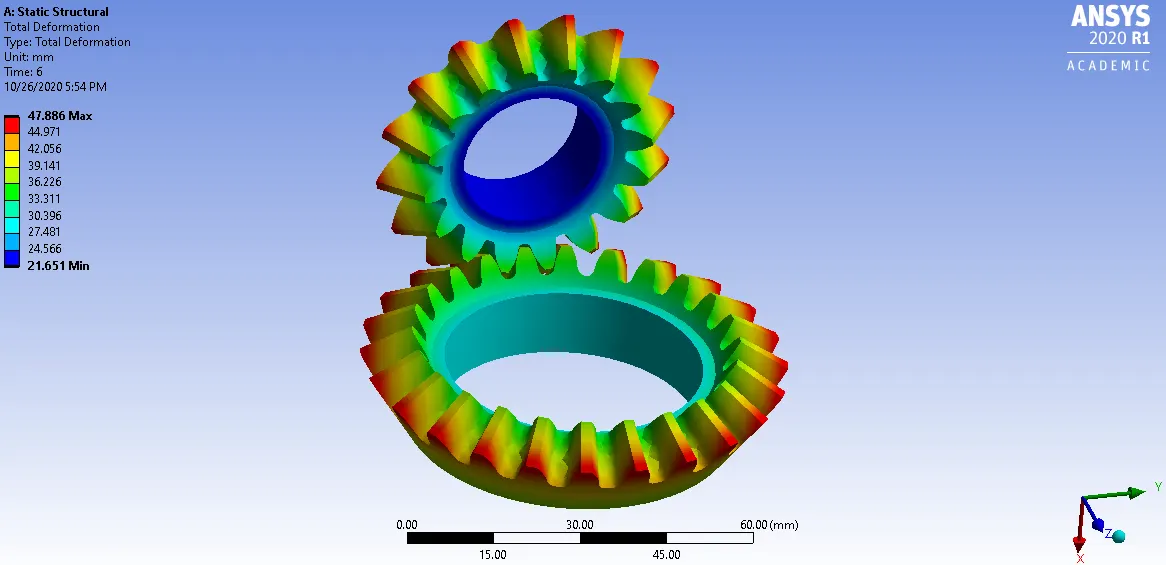
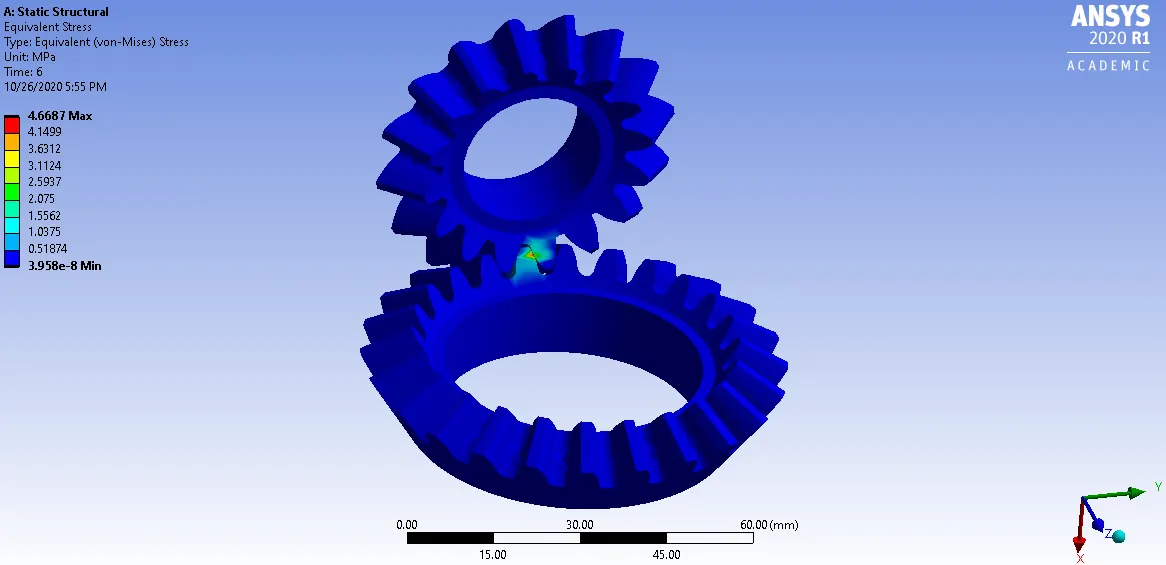
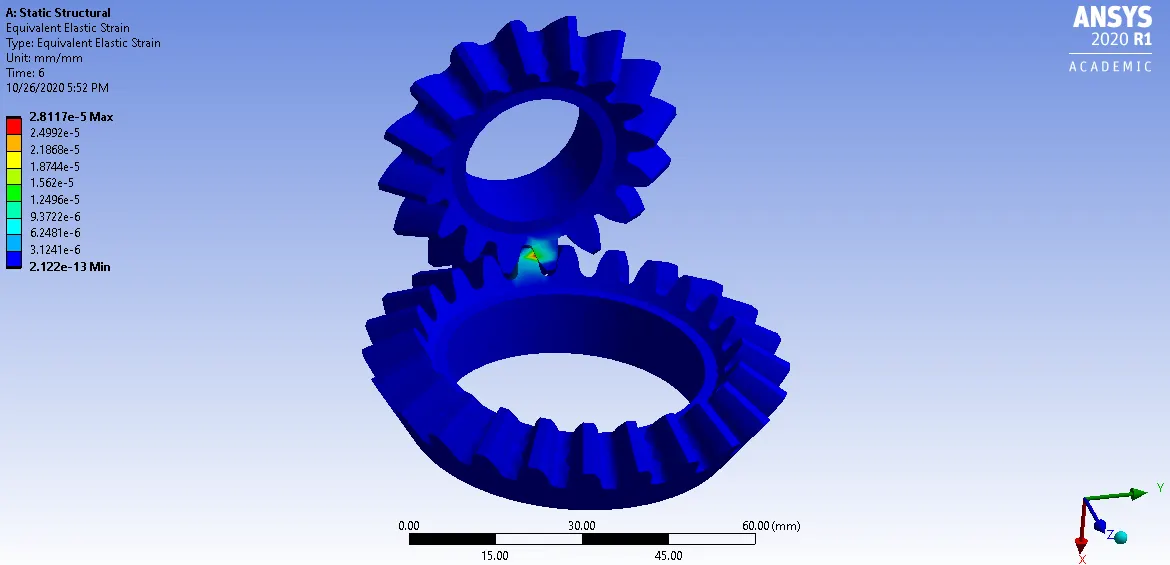
Mesh Size: 6mm
The total deformation remains the same as it is associated with the motion of the gear.
Max Von misses stress: 4.6687 MPa
Min Von misses stress: 3.958e-08 MPa
Max Elastic Strain: 2.811e-05 mm/mm
Min Elastic Strain: 2.122e-13 mm/mm
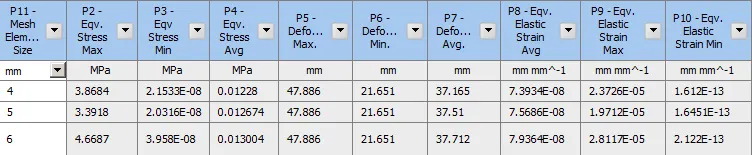
Comparison: