Week 2 Air standard Cycle
Aim:
To perform the program for the air standard cycle i.e., for otto cycle and plot the graph.
Procedure:
Otto cycle:
An Otto cycle is an idealized thermodynamic cycle that describes the functioning of a typical spark ignition piston engine. It is the thermodynamic cycle most commonly found in automobile engines.
Four stages of otto cycle:
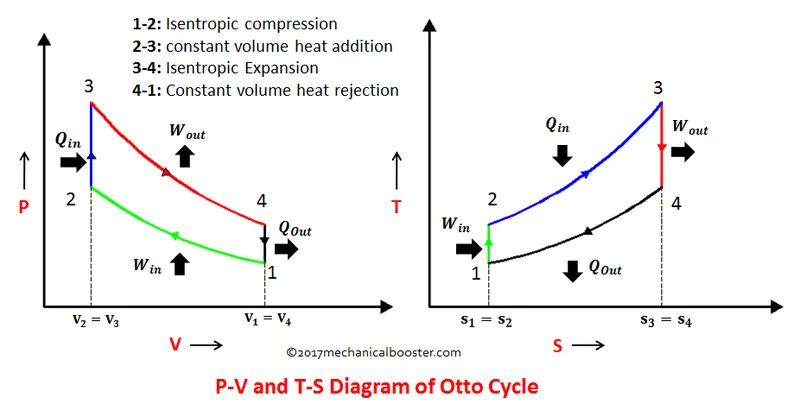
The Otto cycle consists of isentropic compression, heat addition at constant volume, isentropic expansion, and rejection of heat at constant volume.
Process of otto cycle:
The four-stroke Otto cycle is made up of the following four internally reversible processes:
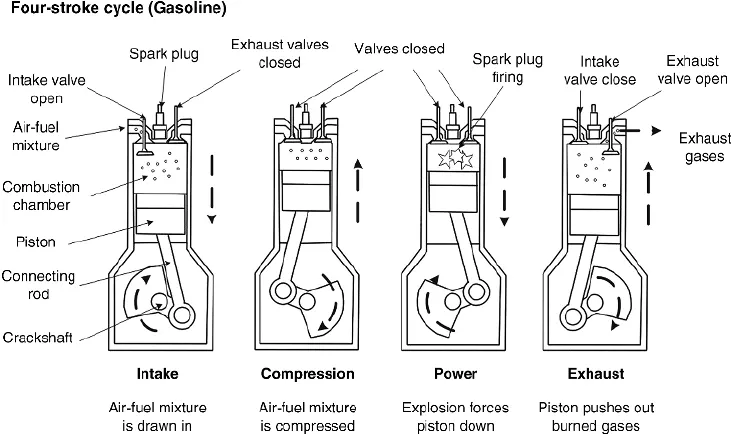
Process 0–1, a mass of air is drawn into piston/cylinder arrangement at constant pressure.
Process 1–2, isentropic compression is an adiabatic (isentropic) compression of the charge as the piston moves from bottom dead center (BDC) to top dead center (TDC).
Process 2–3, constant-volume heat addition is a constant-volume heat transfer to the working gas from an external source while the piston is at top dead center. This process is intended to represent the ignition of the fuel-air mixture and the subsequent rapid burning.;
Process 3–4, isentropic expansion is an adiabatic (isentropic) expansion (power stroke).; and
Process 4–1, constant-volume heat rejection completes the cycle by a constant-volume process in which heat is rejected from the air while the piston is at bottom dead center.
Process 1–0, the mass of air is released to the atmosphere in a constant pressure process.
P-v diagram:
Program done in python for otto cycle:
import math
import matplotlib.pyplot as plt


def engine_kinematics(bore,stroke,con_rod,cr,start_crank,end_crank):

	# Engine_kinematic


	# Geometric parameters
	a = stroke/2
	R = con_rod/a

	#Volume parameter
	V_s = math.pi*(1/4)*pow(bore,2)*stroke
	V_c = V_s/(cr-1)

	sc= math.radians(start_crank)
	ec= math.radians(end_crank)

	num_values = 50

	dtheta = (ec-sc)/(num_values-1)

	V=[]

	for i in range(0,num_values):
		theta = sc + i* dtheta
		term1= 0.5*(cr-1)
		term2= R + 1 - math.cos(theta)
		term3= pow(R,2)-pow(math.sin(theta),2)
		term3= pow(term3,0.5)
		V.append((1+term1*(term2-term3))*V_c)

	return V


# Inputs
p1= 101325
t1= 500
gamma= 1.4
t3= 2300

# Geometric parameter
bore= 0.1
stroke= 0.1
con_rod= 0.15
cr= 8

# Volume computation
V_s= (math.pi/4)*pow(bore,2)*stroke
V_c= V_s/(cr-1)
v1= V_s + V_c

#State point 2
v2= V_c

#p2v2/t2^gamma=p1v1^gamma
p2= p1*pow(v1,gamma)/pow(v2,gamma)

#p2v2/t2 = p1v1/t1 | rhs = p1v1/t1 | p2v2/t2 = rhs| t2 = p2v2/rhs
rhs= p1*v1/t1
t2= p2*v2/rhs
V_compression = engine_kinematics(bore,stroke,con_rod,cr,180,0)
constant = p1*pow(v1,gamma)
P_compression = []
for v in V_compression:
	P_compression.append(constant/pow(v,gamma))

#state point 3
v3=v2

#p3v3/t3 = p2v2/t2 | rhs = p2v2/t2 | p3=rhs*t3/v3
rhs= p2*v2/t2
p3= rhs*t3/v3

V_expansion = engine_kinematics(bore,stroke,con_rod,cr,0,180)
constant = p3*pow(v3,gamma)
P_expansion = []
for v in V_expansion:
	P_expansion.append(constant/pow(v,gamma))

#state point 4
v4=v1

#p4v4^gamma=p3v3^gamma
p4=p3*pow(v3,gamma)/pow(v4,gamma)

#p4v4/t4=[p3v3/t3]
t4=p4*v4/rhs

plt.plot([v2,v3],[p2,p3])
plt.plot(V_compression,P_compression)
plt.plot([v4,v1],[p4,p1])
plt.plot(V_expansion,P_expansion)
plt.show()

# Thermal efficiency
n= 1 - (pow(cr,(1-gamma)))
print(n)
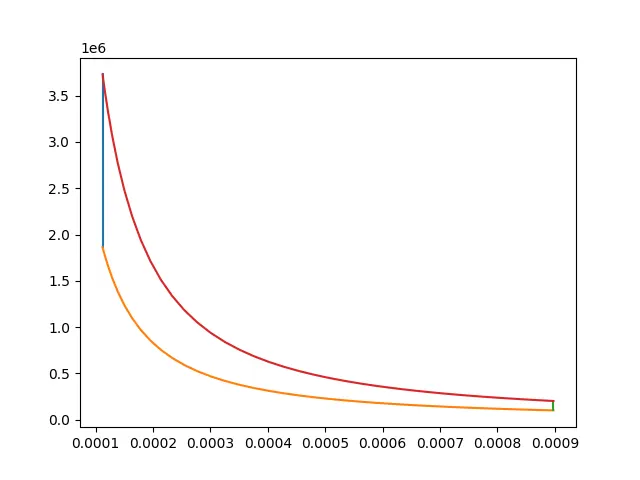
The graph according to the program:
Thermal Efficiency of the engine:
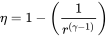
The efficiency increase with increase in compression ratio (r) and specific heat ratio (`gamma`) and is independent of load,amount of heat added and initial conditions.
The thermal efficiency of the engine obtained is 0.5647.
Result:
Hence the programm for air standard cycle is scripted along the graph plotted. The thermal efficiency of the engine is also obtained.