Week 2 Air standard Cycle
Program to generate P-V diagram for Otto cycle or Air Standard Cycle
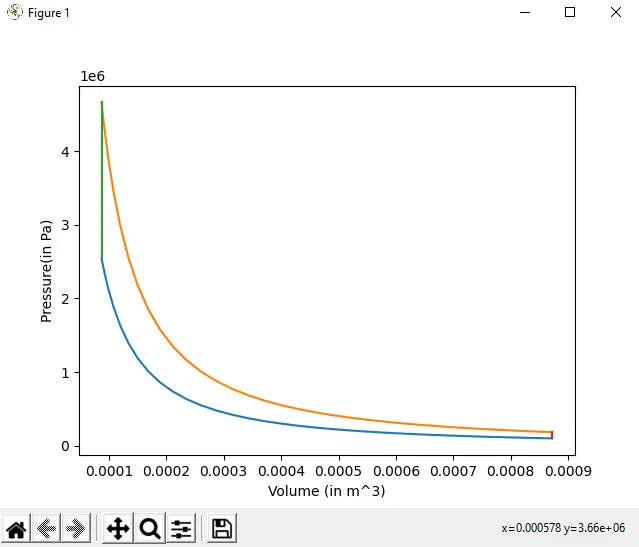
Aim:-To create python program to generate P-V diagram for Otto cycle and calculate the thermal efficiency.
Equation used:-
- The volume of cylinder for given crank angle is given by,
V = `(1 +frac{1}{2}(r_c-1)[R+1-cos(theta)-(R^2-sin^2(theta))^frac{1}{2}])*V_c`
`r_c`:Compression ratio `theta`: Crank Angle
R = 2*connecting rod length/stroke length
- The equation for isentropic process,`P*V^gamma`= constant
P: Pressure inside the cylinder `gamma`: Ratio of specific heats
V: Volume inside the cylinder
- The equation for temperature at any point ,
- Thermal Efficiency, η = 1 -`frac{1}{r_c^(gamma-1)`
Objectives:-
* To create python program which computes pressure and volumes for different conditions based on given inputs.
* To plot the P-V diagram of Otto cycle and hence analyze the different conditions.
Procedure:-
The working principle of a 4stroke petrol engine is based on theoretical Otto cycle. Hence it is called as Otto cycle engine. The four strokes include suction stroke, compression stroke, expansion stroke or power stroke and exhaust stroke. Each stroke is completed by the rotation of crankshaft by 180°.Hence in 4stroke engines, four different strokes are completed through 2 revolutions of the crankshaft. It is easy to analyze the process taking place inside the engine with the help of P-V diagram . P-V diagram represents the plot of pressure bs volume for different conditions or strokes. So to generate a P-V diagram, we require different values of pressures and volumes. During the suction stroke the pressure inside the cylinder remains constant . At the end of suction stroke the volume occupied by the gas is nothing but the total volume of the cylinder . That is, sum of swept volume and the clearance volume. The swept volume and clearance volume are calculated by the formula as given above.
The pressure inside the cylinder in this condition is the atmospheric pressure . At the beginning of the program necessary modules are imported. The variables for different parameters such as cylinder radius, stroke, bore, compression ratio are declared and assigned with proper values. The lists for compression pressures, expansion pressures are declared. The volume of cylinder during the compression or expansion can be computed using the formula . So, a function is created for generating different values for volumes based on the crank angle, which can be then returned to the main function .The volume_expansion and volume_compression lists hold the values of volumes generated by the called function. The compression stroke and expansion stroke represent the isentropic process. The variables of pressure, volume, temperature at the end of suction stroke are assigned with the initial conditions. At the state 2 , i. e during compression stroke the pressure of the cylinder increases which can be calculated using for loop using formula for different values of volumes .When the ignition is done the pressure increases but the volume remains constant. So the volume occupied is nothing but the clearance volume. The temperature at this point will be about 1200K . The increased in the pressure lead to the expansion stroke during which the volume increases but the pressure decreases. The pressure can be calculated using formula as we calculated for compression process. At the end of the expansion stroke the volume, temperature, pressure are calculated using the formula. When one complete cycle is over the Pressure vs Volume plot is created using plot function of matplotlib.pyplot module.
Conclusion:-
* A good analyzation of working of petrol engine can be done with the help of this P-V diagram.
* The unknown pressure or temperature can found using the plot.

#######  Program to create P-V diagram of Otto Cycle  or Air Standard Cycle #########


import math  #importing math module for mathematical calculations.
import matplotlib.pyplot as plt # for plotting graph.


def volumes_generator(min_angle,max_angle,total_num_angles,compression_ratio,clearence_volume,R):#The function which calculates the volume of the cylinder for different values of angle

	angles = []  # List to hold different values of angle
	volumes = []  # List to hold different values of volumes
	angle_diff = (max_angle - min_angle)/(total_num_angles-1) #calculates change in angle
#Foor loop generates volumes corresponding to the each angle
	for i in range(0,total_num_angles):

		angle = min_angle + i*angle_diff #Logic to generate different values of angle
		angles.append(angle) #Append function appends each generated value to the angles list.

		#The formula to calculate the volume of cylinder for different values of crankangle.
		#The formula is givven by V = [1 + (0.5*compression_ratio-1)*(R + 1 + cos(crank_angle))]*clearence_volume

		trm1 = 0.5 * (compression_ratio-1)#Splitting equation into number of parts
		trm2 = (R+1) + math.cos(angle)
		trm3 = pow(pow(R,2)-pow(math.sin(angle),2),0.5)

		volume = (1 + trm1*(trm2 - trm3))*clearence_volume # Calculating the volume for corresponding value of crank angle
		volumes.append(volume) #Append function appends each generated value to the volumes list.


	return volumes # Returning volumes list to the main function


bore = 0.1 #Assigning the value of bore diameter
stroke = 0.1  #Assigning the value of stroke length
connecting_rod_len = 0.15 #Assigning the length of connecting rod
compression_ratio = 10 #Assigning the value of compression ratio
a = stroke/2 #Crank radius which is given by stroke length/2.
R = connecting_rod_len/a

min_angle = math.radians(0) #Minimum angle is taken as 0 (in radians) for generating the values for crank angle
max_angle = math.radians(180) #Maxmimum angle is taken as 180 (in radians) for generating the values for crank angle
total_num_angles =45 #Total number of angles to be generated
gamma = 1.4 #Taking value of gamma as 1.4


p_compression = [] #Declaring empty list for accomadation of pressures during compression

p_expansion = [] #Declaring empty list for accomadation of pressures during expansion


swept_volume = (math.pi/4)*pow(bore,2)*stroke #Formula to calculate the swept volume (pi*bore^2*stroke/4)
clearence_volume = swept_volume/(compression_ratio-1) #Formula to calculate the clearence volume( swept volume / (compression ratio - 1)

v1 = swept_volume + clearence_volume #Volume after the suction stroke
p1 = 101325 #Pressure at the end of suction stroke
t1 =500 #Temperature at the end of suction stroke

#State 2 i.e Compression Stroke

v2 = clearence_volume #Volume after the compression stroke
p2 = p1*pow(v1/v2 , gamma) #Volume after the compression stroke
rhs = (p1*v1)/t1
t2 = (p2*v2)/rhs

#Calling volume generator function to generate different volumes during compression
v_compression= volumes_generator(min_angle,max_angle,total_num_angles,compression_ratio,clearence_volume,R)


#Foor loop to calculate compression pressure for the corresponding volume at that time
for v in v_compression :
	#Formula to calculate the pressure during the compression is given by p = p1(v1/v)^gamma
	constant = p1*pow(v1,gamma)
	p_compression.append(constant/pow(v,gamma))#Append function appends each generated value to the p_compression list.

#State 3 i.e Expansion Stroke

v3 =v2 #Volume at begining of expansion stroke
t3 = 2300#Temperature of the gas at the begining of the expansion stroke
#Formula to calculate the pressure at this ponit is given by ideal gas equation i.e P3 = p2*v2*t3/(v3*t2)
rhs = p2*v2/t2
p3 = rhs*t3/v3
#Calling volumes generator function to generate the volumes during expansion stroke
v_expansion = volumes_generator(min_angle,max_angle,total_num_angles,compression_ratio,clearence_volume,R)


#Foor loop to calculate compression pressure for the corresponding volume at that time

for v in v_expansion :
	#Formula to calculate the pressures during the expansion is given by p = p3(v3/v)^gamma
	constant = p3*pow(v3,gamma)
	p_expansion.append(constant/pow(v,gamma))#Append function appends each generated value to the p_expansion list.


#State 4
v4 = v1#volume at the begining of exhaust stroke
p4 = p3 * pow(v3, gamma)/pow(v4,gamma) #Pressue at end of the expansion stroke
t4 = p4*v4/rhs


#Finding thermal efficiency.
#Formula to find the thermaln efficiency is ,n = 1-(1/((compression ratio)^(k-1))

Thermal_efficiency = 1-(1/(pow(compression_ratio , gamma-1)))
print(f"Thermal Efficiency = {Thermal_efficiency}")


plt.plot(v_compression,p_compression)#Plots the compression volumes against compression pressures.
plt.plot(v_expansion,p_expansion)#Plots the expansion volumes volumes against expansion pressures.
plt.plot([v2,v3],[p2,p3])#Plots the volume against pressure at end of compression stroke
plt.plot([v4,v1],[p4,p1])#Plots the volume against pressure at end of expansion stroke
plt.ylabel("Pressure(in Pa)") #Gives title to the Y-axis
plt.xlabel("Volume (in m^3)") #Gives title to the X-axis
plt.show()#Brings the plot from the backend t the frontend.


####################################    END  #########################################