Week 12:- Documentation Challenge
AIM
Create a BOM and Hardware list (BOP) for the complete Fixture assembly from challenge 8.
WHAT IS BOM
- A Bill of Materials (BOM) is a list of all the components and parts needed to manufacture a product or assembly.
- In a drawing sheet, the BOM is typically included as a table or list of items, with information such as the part number, description, quantity required, and other relevant details.
- The BOM serves as a reference for designers, engineers, and manufacturers to ensure that all the necessary components are accounted for and that the correct quantities are ordered or produced.
- It is also used to track changes and revisions to the design, as well as to estimate the cost of manufacturing.
- In summary, a Bill of Materials is a critical component of a drawing sheet that provides a detailed inventory of the parts and components required to build or assemble a product.
USES OF BOM
The Bill of Materials (BOM) list is a vital document that is used throughout the product development cycle and is an essential component of the drawing sheet.
Here are some of the key uses of a BOM list:
Assembly and Manufacturing:
- The BOM list provides a complete inventory of all the parts and components required to assemble a product.
- This ensures that manufacturers and production teams have all the necessary components on hand to build the product and that the correct quantities are produced.
Cost Estimation:
- The BOM list is used to estimate the cost of manufacturing a product by tracking the cost of each component.
- This information is critical in making decisions about pricing and profitability.
Quality Control:
- The BOM list helps ensure the quality of the finished product by ensuring that all components are accounted for and that they meet the required specifications.
Design and Engineering:
- The BOM list is an essential tool for designers and engineers as it ensures that all the necessary components are considered during the design process.
- It also allows for tracking design changes and revisions, and provides a comprehensive reference document for future product development.
Inventory Management:
- The BOM list is used to track inventory levels and ensure that there are enough components on hand to meet production demands.
Regulatory Compliance:
- The BOM list is used to ensure that all components used in the product meet regulatory requirements, such as safety standards, environmental regulations, and material restrictions.
- Each part listed in the BOM should have a unique part number to help with identification and tracking.
- This number is often used to cross-reference the part in inventory management and procurement systems.
- The BOM should include the material type of each part or component.
- This helps ensure that the correct materials are ordered and used in the manufacturing process.
- The BOM should list the quantity of each part needed to produce the product.
- This helps ensure that the correct number of parts are ordered and that the correct number of parts are used during assembly.
- The BOM should also include the revision level of each part.
- This helps ensure that the correct version of each part is used during assembly.
- A reference designator is a code that identifies where each part or component should be placed in the product.
- The BOM should include the reference designator for each part to ensure that it is placed in the correct location during assembly.
- The BOM may also include vendor information, such as the name and contact information of the supplier for each part.
- This can be helpful in procurement and inventory management.
BILL OF MATERIAL OF FIXTURE DESIGN
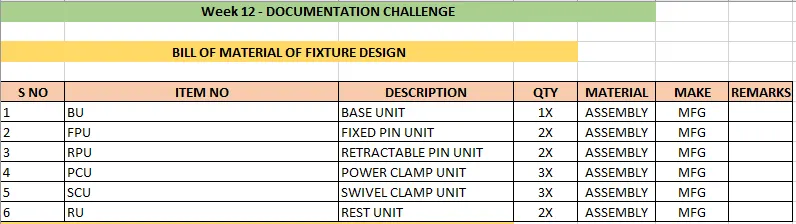
BILL OF MATERIAL OF BASE UNIT
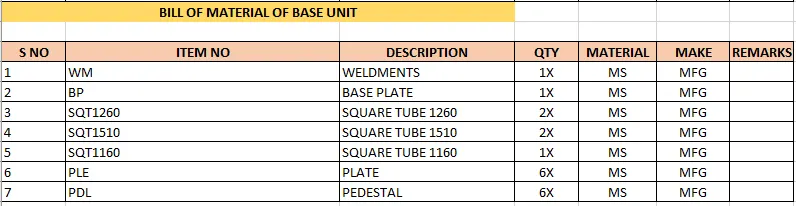
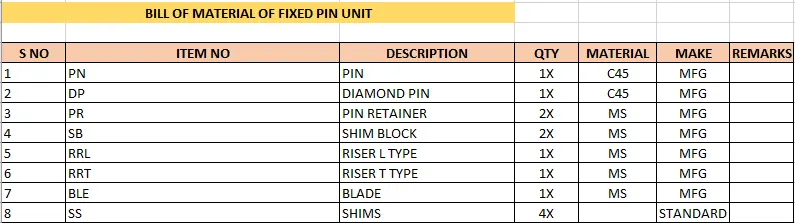
BILL OF MATERIAL OF FIXED PIN UNIT
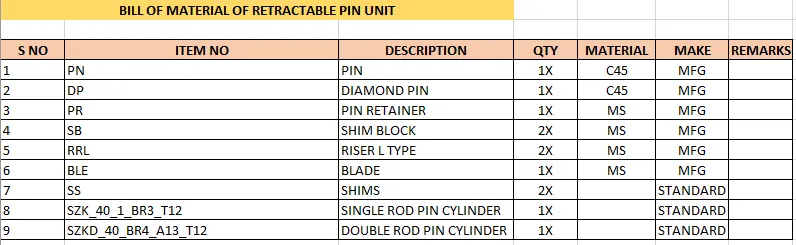
BILL OF MATERIAL OF RETRACTABLE PIN UNIT
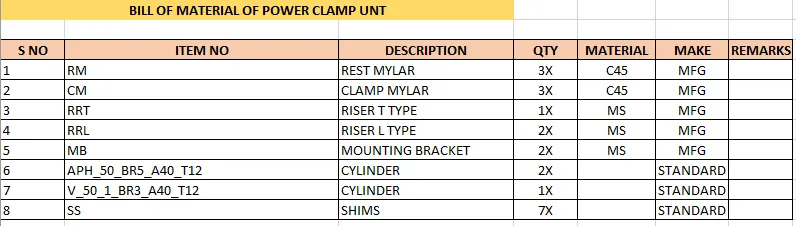
BILL OF MATERIAL OF POWER CLAMP UNT
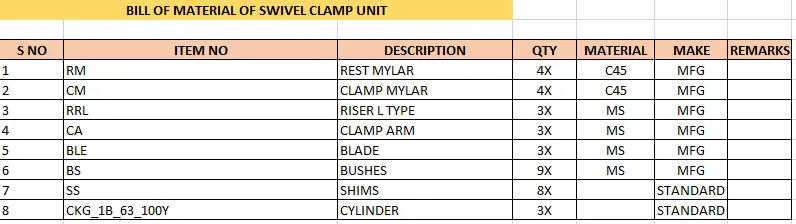
BILL OF MATERIAL OF SWIVEL CLAMP UNIT
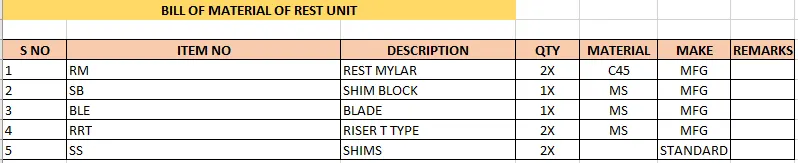
BILL OF MATERIAL OF REST UNIT
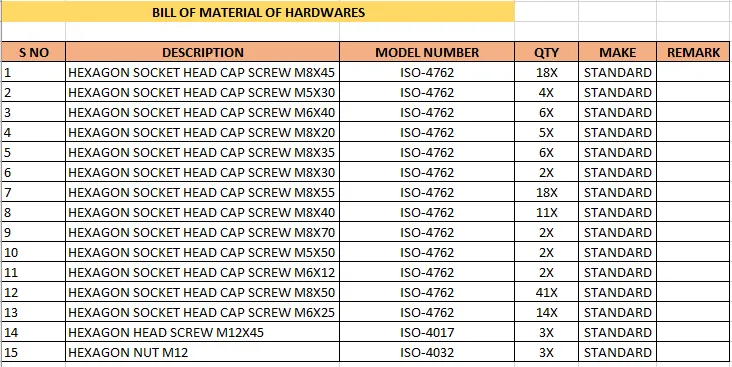
BILL OF MATERIAL OF HARDWARES
CONCLUSION:
BOM and hardware list (BOP) for the complete fixture assembly from challenge 8 has been done.