Week 11: Project 2 - Emission characterization on a CAT3410 engine
Emission characterization on a CAT3410 engine using Converge Studio
Objectives:
- Setup an engine simulation of CAT3410 using a 60 deg. sector geometry of piston bowl profiles, Omega and Open W.
- Analyze the emissions such as Soot, NOx, and unsaturated hydrocarbons.
- Compare the Indicated Mean Effective Pressure(IMEP) and Power values graphically.
Piston Bowl profile:
A piston bowl is a recess in the piston crown primarily used in (direct injection) Diesel engines, where it basically forms the combustion chamber. The design and shape of the piston bowl influences the movement of air and fuel during the compression stroke, thereby affecting the air/fuel mixture. A good mixture leads to a more efficient combustion, resulting in more power or better fuel economy. Additionally, using an effective piston bowl shape can reduce the in-cylinder emissions (like NOx and soot) and the cost for after-treatment.
CAT 3410
CAT 3410 is a diesel-powered heavy-duty engine. In this study, a closed cycle simulation technique is used. In this technique, the geometry of valves, intake and exhaust ports, injectors, etc are defined in terms of numerical values into the GUI. Only the profile of the combustion chamber influenced by the bowl of the piston is imported. Piston bowl profiles have a direct influence on combustion quality.
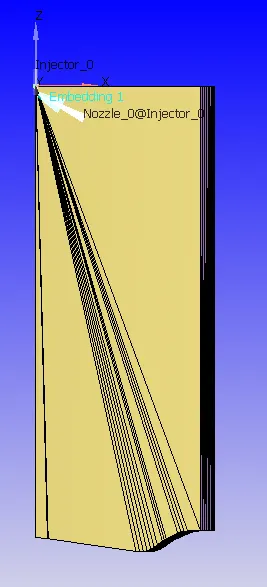
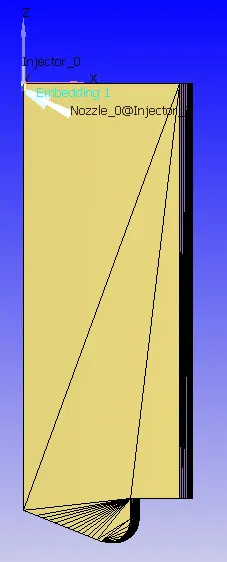
Fig. Open W Piston (Left) and Omega Piston (Right)
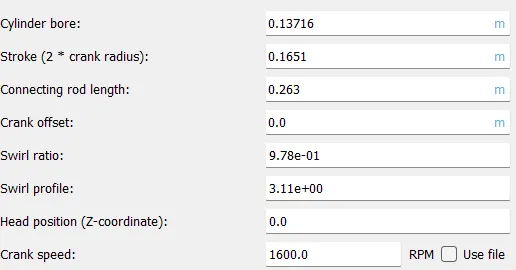
Engine Physical Parameters:
Materials:
Gas Simulation - ON
Species - ON (NOx and HIROY Soot)
Parcels:
- A parcel is defined as a group of monologues particles with similar properties such as diameter, velocity, position, shape, etc. The parcel’s properties are considered the same as particles.
In another view, each parcel represents a fraction of the total mass flow rate. - Here, Diesel is assigned as a parcel species with a molecular weight of 178.6 kg/kmole
Reaction Mechanism:
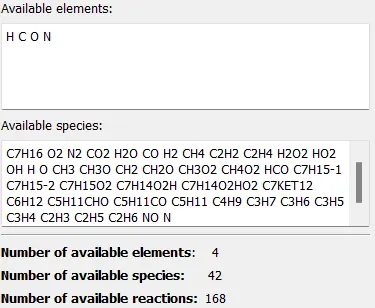
Four commonly known elements such as Hydrogen, Carbon, Oxygen and Nitrogen are present which enables 42 possible species leading to 168 reactions. All these datum and respective properties are present in thermo.dat file.
Simulation Setup:
Simulation type: Transient (Crank angle based)
Solver type: PISO (Density based)
Turbulence Model: RNG k-epsilon
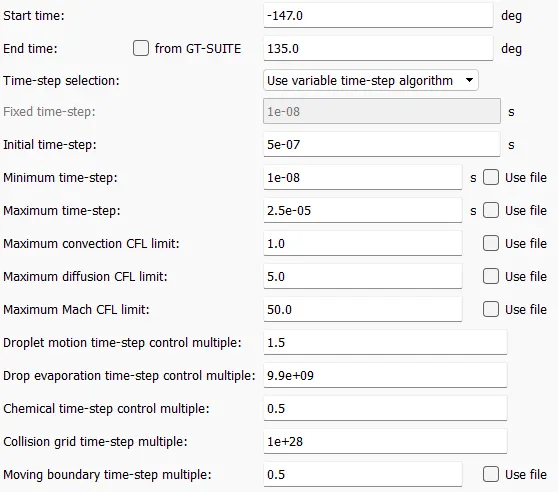
Simulation time parameters:
Boundary conditions:
(Open W piston geometry is shown for representation, however the same conditions are applied to equivalent boundaries of Omega Piston)
| Piston | Translating wall, T= 553K | 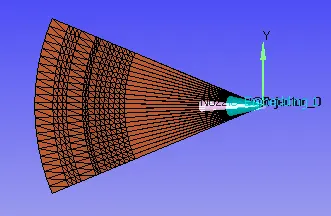 |
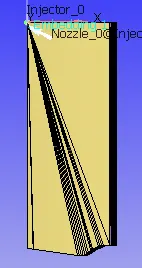
| Front face |
Periodic, type- stationary, shape- rotating, matching boundary-back face, Angle - 60deg. |
 |
| Backface | Periodic with matching boundary as the front face | 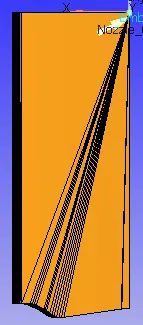 |
| Cylinder wall | Stationary wall, T = 433K | 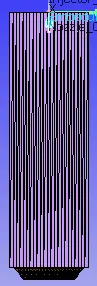 |
| Cylinder head | Stationary wall, T = 533K | 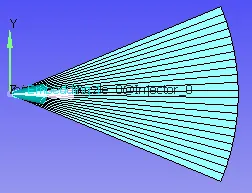 |
Initial conditions:
In cylinder region - T=355K, Pressure=197000.0 Pa
Active Species:
O2-0.23029 N2-0.76765, CO2-0.0014304, H2O-0.0006296 (in terms of mass fractions)
Passive Species:
HIROY SOOT-0, NOx-0
Spray Modeling:
Converge uses Eulerian solver to solve gaseous sprays and Lagrangian solver to solve liquid sprays.
A concept of parcels is used in converge. A parcel is a collection of drops having same radius, velocity, temperature etc. Equations are solved on a per parcel basis rather than a per drop basis as the properties of drop inside the parcel are identical.
These parcels undergo several physical processes such as
- Primary breakup
- Secondary breakup
- Drop drag
- Collision and Coalescence
- Turbulent dispersion
- Evaporation
Below figure shows various physical processes during spray breakup.
Spray Modeling setup:
General - Drop Evaporation:
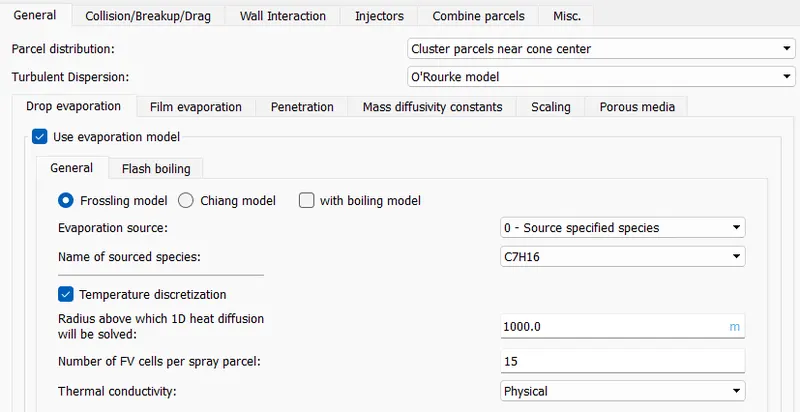
- In the above section, parcel distribution is specified to be cluster parcels near cone center which would align the parcels along the axis of the cone. There is an another option which would distribute parcels evenly throughout cone.
- Turbulent dispersion is enabled using O'Rourke model which is a LES based Turbulent kinetic energy preserving model. Turbulent dispersion is a phenomena which the spray parcels undergo due to fluctuations of turbulence.
- Evaporation model is enabled using Frossling model which computes at what rate does the drop evaporates.
- Evaporation source is set to Source specified species which evaporates to specified species (Here, C7H16 - Heptane). There is also an option to source to all composite parcel species which will aid in case of multi component liquid species and also an option to source all base parcel species which will evaporate to its base species itself.
- Temperature based discretization is turned on with 1000m as threshold radius of a parcel above which 1D heat diffusion equation will be solved. If the drop radius exceeds the max value (here, 1000m), converge will assume a radially varying temperature distribution else it will assume an uniform termperature distribution.
General - Film Evaporation: OFF
General - Spray penetration:

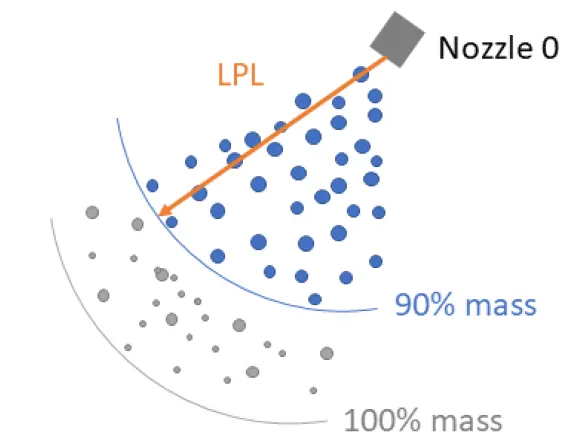
- Spray penetration length is calculated using the mass fraction. Here, 0.97 of mass fraction is set as the threshold for estimating spray penetration which means that first the total mass of the liquid parcel is calculated from the nozzle and then this mass is multiplied by the liquid penetration fraction to yield the penetrated spray mass. Starting from the center of the nozzle hole, CONVERGE sums the
mass of the liquid parcels until it reaches the penetrated spray mass. This distance is the LPL.
- For calculating Vapor penetration length, two parameters are considered. (a) Fuel vapor mass fraction exceeds the user specified fuel vapor mass fraction. (b) The cell size does not exceed the user specified bin size. It is recommended to have a bin size at least twice the size of the cells in the spray cone. Here, bin size is set to 0.001m and minimum fuel vapor mass for considering into VPL calculation is 0.001. Below figure illustrates the calculation of VPL.
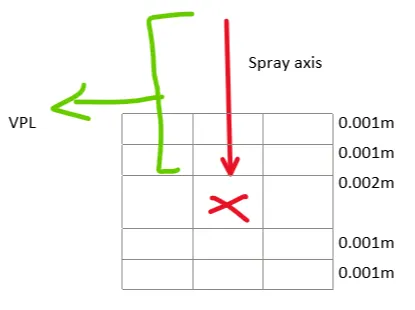
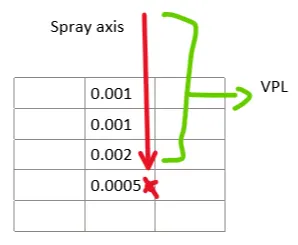
Fig. Cell size condition (a-Left), Fuel vapor mass fraction (b-right)
General - Mass diffusivity constants: Set as defaults for DIESEL2, Kerosene.
General - Scaling: All set to 1 (zero scaling)
General - Porous Media: OFF
Collision/Breakup/Drag:
Whenever two spray drops comes into contact with each other, they pass though or breakup or coalesce. Such phenomena are modeled under this section.
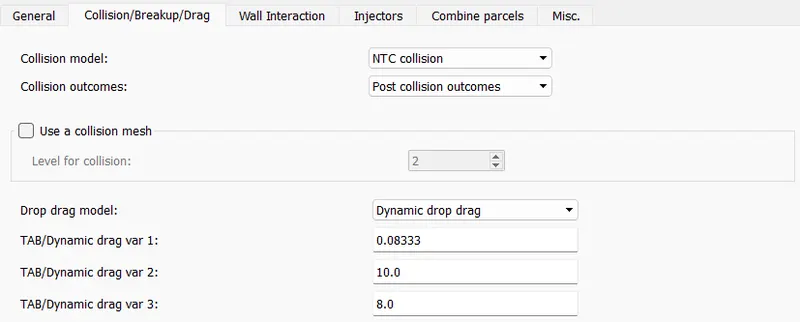
- Collision of spray drops is modelled using NTC collision and post collision outcomes are chosen.
- Collision mesh is turned off. It creates a separate adaptive collision mesh which reduces grid sensitivity when two parcels collides in the same cell. Turning this on, enables collision of parcels across grid cells.
- Drop Drag is the drag effect experienced by a drop. Converge provides options to eliminate drag consideration using No Drag Drop model, to assume the drops are perfect sphere, to account for variations in drop shape which brings in a TAB model to determine distortion.
Wall Interaction: Rebound/Slide
Available interactions are Rebound/Slide after impingement, Wall film approach where drop actions are calculated with hybrid approach based on particle/film based quantities, vanishing of drop after interaction which is not advisable as it leads to mass loss.
Wall film model is set to O'Rourke which models splash criteria based on Weber number and film thickness.
Combustion Modeling Setup:
- Converge offers two types of solvers such as SAGE (detailed) and simplified models for combustion modeling. SAGE model is accurate but slow whereas simplified model works in an opposite manner. SAGE uses local conditions in each cell to calculate reaction rates based on principle of chemical kinetics.
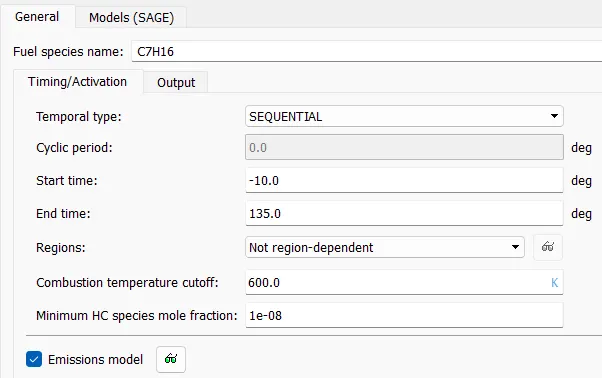
- Fuel species is set to heptene which resembles properties similar to diesel. Start and End time in terms of degrees are defined with sequential cycle time.
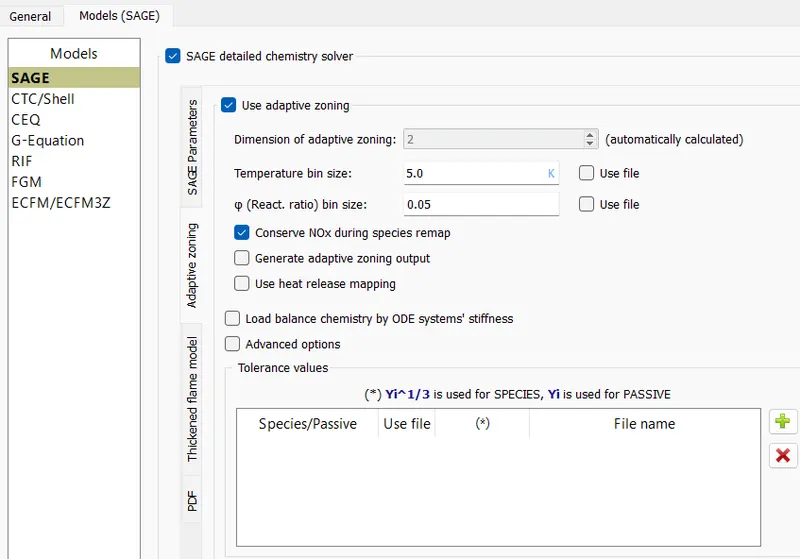
- Multi zone model (adaptive zoning) is enabled which is a technique in CONVERGE which reduces the number of SAGE calculations by grouping cells into bins. Number of bins vary dynamically with the stratification of flow field parameters. Bins are created based on two or more variables such as Equivalence ratio, Temp, Pressure etc.
- This technique enables calculation of average quantities and SAGE solver solves once per bin instead of each cell.
- Conserve NOx is enabled to remap species after solving which improves N2 prediction.
Grid control:
- Base grid size is set to 0.004m which estimates to be 5052 cells without AMR or fixed embedding.
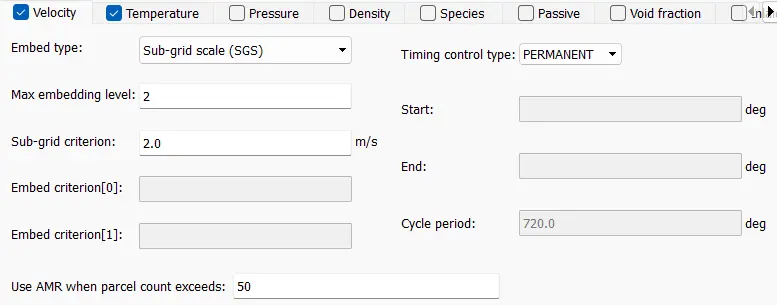
- Adaptive mesh refinement: (Velocity based - In-cylinder region)
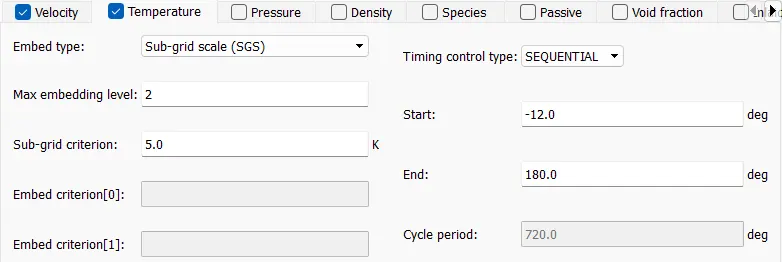
- Adaptive mesh refinement: (Temperature based - In cylinder region)
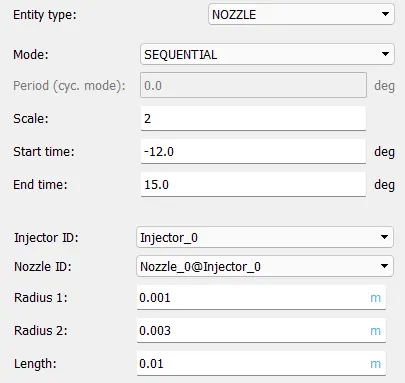
- Fixed Embedding - Nozzle:
- Fixed Embedding - Piston face boundary
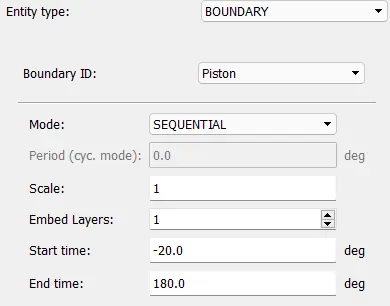
- Fixed embedding - cylinder head face boundary
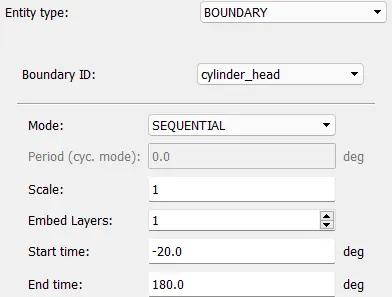
Results: (Click here for contour plots)
Pressure:
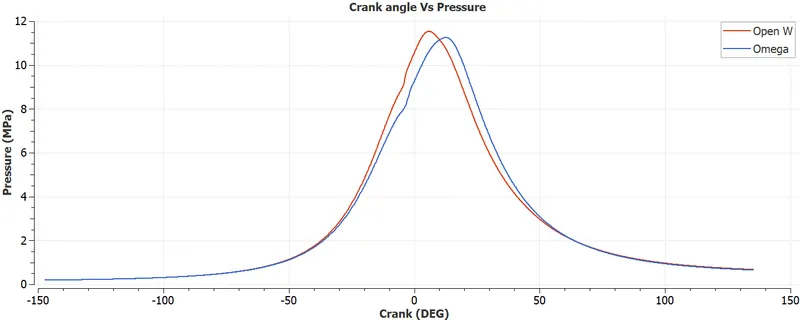
The pressure generated by the Open W piston is marginally higher than the Omega piston. This is due to the fact that the surface area of the piston face is lower in Open W measuring about 1.93e-03 m2 whereas Omega piston measures about 2.37e-03 m2.
Temperature:
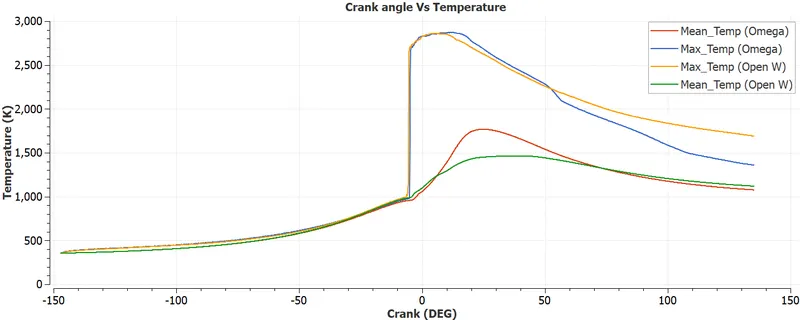
Max Temperature curves of both pistons are on par whereas the mean temperature shows a drastic variation among which Omega piston is higher. Despite having higher surface area, Omega piston has reached high temperature. It is visible that the high temperatures were achieved only after combustion and exhaust which indicates that majority of the fuel is burnt leading to less HC.
Integrated heat release:
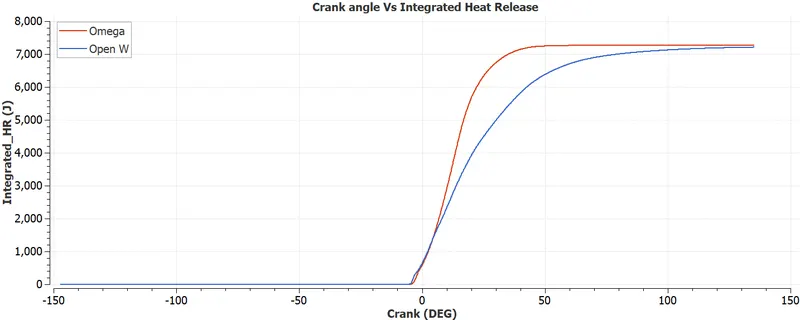
The above heat release profile is well in line with the temperature plot where the temperature of Omega piston was higher leading to a much higher heat release.
HC:
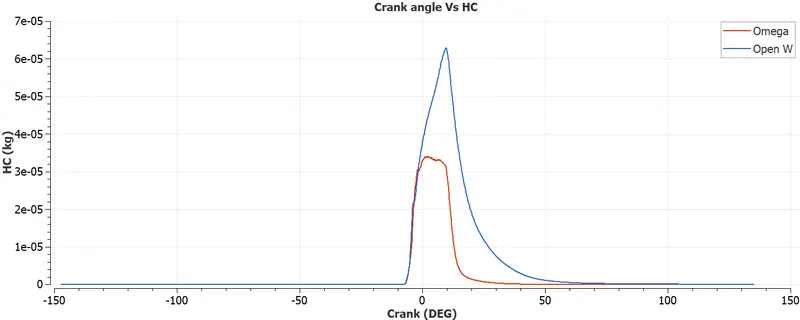
In the above plot, Omega piston has produced less unburnt HC. This ensures that the fuel is burnt completely and this is the cause for temperature raise in Omega Piston.
Hiroy Soot:
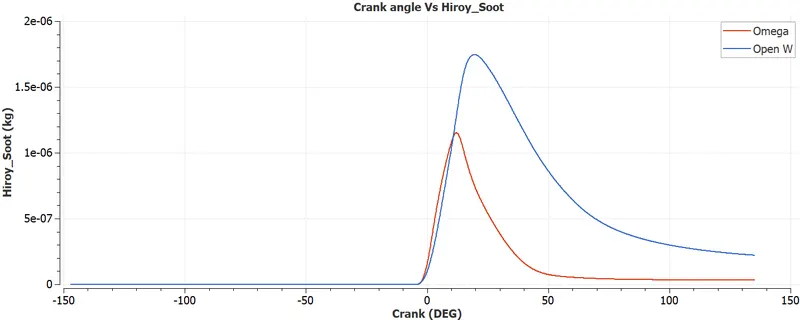
The major advantage of the high temperature, less HC produced by Omega piston is that the fuel is burnt well than the Open W piston. This leads to less soot formation.
NOx:
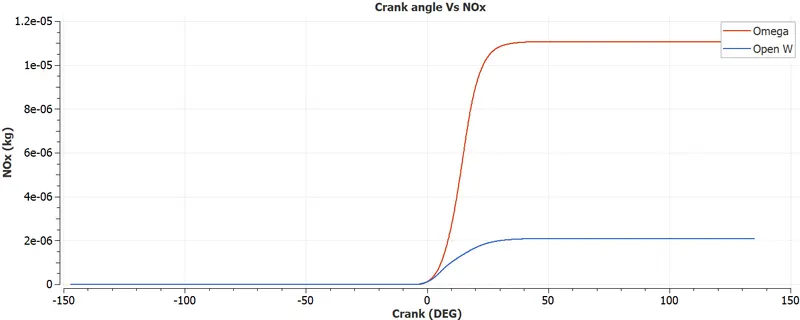
NOx formation plot shows the downside of high temperature, less HC and Soot produced by Omega Piston. As the temperature gradient between both the pistons are significant, NOx formation has also become significant. Here, Open W piston performs well with less NOx formation.
CO and CO2:
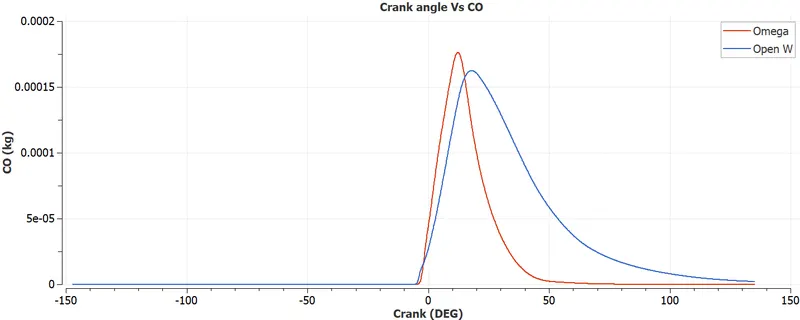
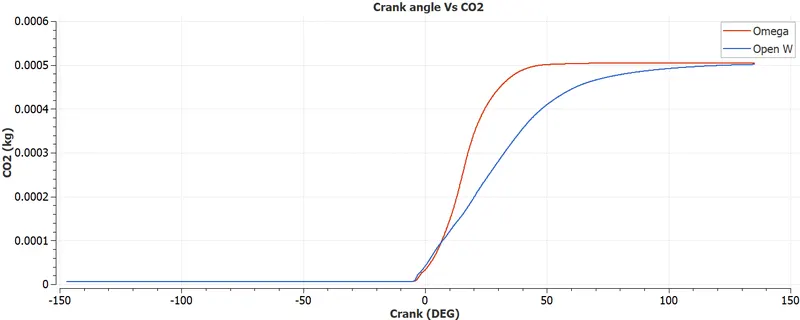
Both the above plots of CO and CO2 and in line with NOx formation with higher amount of pollutant formation in Omega piston than in Open W piston.
Open-W Vs Omega Piston:
Open-W Piston

- Power = Workdone/Time
- Workdone = 3028.53 Nm
- RPM = 1600
- Time = 270.156* (60/360*RPM) = 0.02814125 deg/sec
- Power = 3028.53/0.02814125 = 107.618 kW
- Power = (2*pi*N*T)/60
- Torque= (107.618*1000*60) / (2*pi*N) = 642.3 Nm
Omega Piston

- Power = Workdone/Time
- Workdone = 3409.28 Nm
- RPM = 1600
- Time = 270.171* (60/360*RPM) = 0.0281428125 deg/sec
- Power = 3409.28/0.0281428125 = 121.142 kW
- Power = (2*pi*N*T)/60
- Torque= (121.142*1000*60) / (2*pi*N) = 723.01 Nm
Power Vs IMEP:
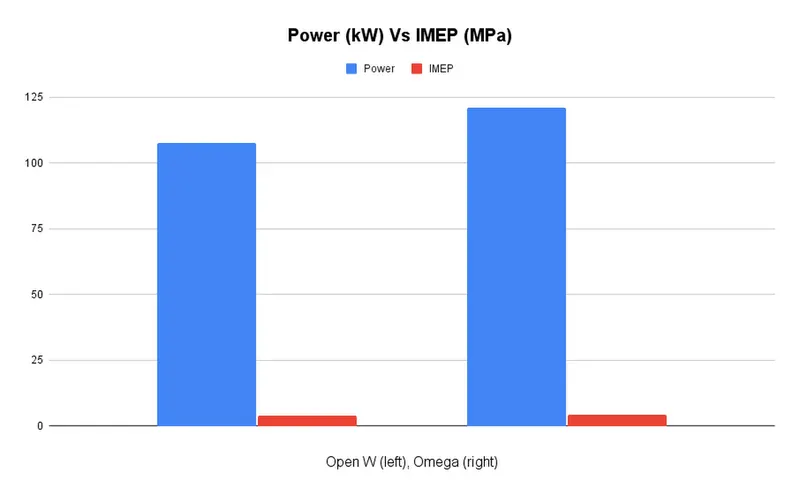
Based on the above graph, it is evident that the Omega Piston has high performance than the Open W piston as it produces more power at more or less similar IMEP.
Inferences:
- Omega piston has high performance due to the fact that the unburnt HC is less indicating that the fuel is burnt almost to a complete level. This has increased the temperature and reduced the soot formation. The performance spike is evident with a power of 121 kW as against 107 kW of Open W piston.
- Open W is better in terms of eco-friendliness as it produces less NOx and CO when compared to Omega Piston. This comes at the cost of less performance leaving more amount of HC unburnt and higher soot formation.