Week-11 Challenge: Braking
AIM:
To learn about braking in the EVs using Matlab.
THEORY:
REGENERATIVE BRAKING:
Regenerative braking is an energy recovery mechanism that slows down a moving vehicle or object by converting its kinetic energy into a form that can be either used immediately or stored until needed. In this mechanism, the electric traction motor uses the vehicle's momentum to recover energy that would otherwise be lost to the brake discs as heat. This contrasts with conventional braking systems, where the excess kinetic energy is converted to unwanted and wasted heat due to friction in the brakes, or with dynamic brakes, where the energy is recovered by using electric motors as generators but is immediately dissipated as heat in resistors. In addition to improving the overall efficiency of the vehicle, regeneration can significantly extend the life of the braking system as the mechanical parts will not wear out very quickly.
GOVERNING EQUATIONS:
For Brakiing Energy,
`E=1/2*m*(V_f-V_i)^2`
where,
`E=text(Braking Energy`
`m= text(mass of the vehicle`
`V_f=text(Final Velocity`
`V_i= text(Initial Velocity`
For Motor Efficiency
`eta=P_(out)/P_(text(in)`
`P_(out= T*omega`
`P_(text(in) ) = P_(out)+Cu_(text(loss))+Fe_(text(loss))+ text(Win)_(text(loss))+text(Cond)_(text(loss))`
`Cu_(text(loss))= k_(cu)*omega^2`
`Fe_(text(loss))= k_(Fe)*T^2`
`text(Win)_(text(loss))=k_w*T^3`
where,
`P_(text(in))= text(Input Power to Motor)`
`P_(out)= text(Output Power of Motor)`
`Cu_(text(loss))= text(Copper Losses`
`Fe_(text(loss))=text(Iron Losses)`
`text(Win)_(text(loss))=text(Winding Loss)`
`text(Cond)_(text(loss))=text(Conduction Loss)`
`T = text(Torque of motor)`
`omega=text(Speed)`
OBJECTIVES:
- To calculate the energy required for braking, for a defined driving cycle.
- To understand why electric motor can’t develop braking torque at high speed similar to starting and how electric and mechanical brakes are coordinated?
- To make a MATLAB program which plots contour of given motor speed, torque and efficiency values.
SOLUTION:
TO CALCULATE THE ENERGY REQUIRED FOR BRAKING:
clear all
close all
clc

%Loading data file
load('matlab.mat');

% Defining Time and Speed
time=nyc(:,1);
speed=nyc(:,2);
m=1000;

% Braking Energy
for i=1:598
    if speed(i+1)< speed(i);
        BE(i)= 0.5*m*(speed(i+1)-speed(i))^2 ;
    end
end
E=BE';

%Total Braking energy
TE=sum(E)/1000
fprintf("The Total Braking Energy Required is %f",TE)

% Plotting
figure(1)
subplot(2,1,1)
plot(time,speed)
xlabel('Time')
ylabel('Velocity')
title('Drivecycle')
subplot(2,1,2)
plot(E)
xlabel('Time')
ylabel('Braking Energy')
- To calculate the braking energy, we have used Matlab program.
- Here first we have imported a New York City Cycle (NYCC) excel sheet into our program.
- Then using the load command, we have loaded it into the code.
- Then we have defined that 1st column of excel sheet is Time of the drive cycle and 2nd column of excel sheet is Speed of the drive cycle.
- Then we have defined the mass of the vehicle and we have applied a logic that when the speed in the drive cycle is less than the previous data point speed, this means there is a brake applied and we calculate brake energy at this point using the above mentioned kinetic energy formula and then after calculated all such braking energies we will add all of them and get total brake energy.
- To implement the about logic we have used for loop and if condition, then since we will get a row matrix, we have change it into column matrix using transpose operation.
- Now we have used plot command to plot the graphs. Once we run the code we get the following result.
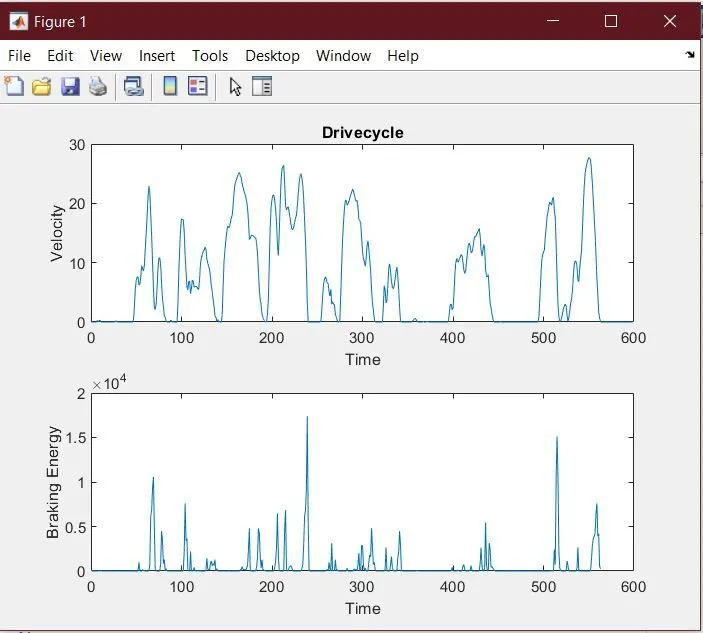
FIGURE.1
- We can see that where ever the speed is being reduced the brake energy is more.
BRAKING TORQUE OF ELECTRIC MOTOR:
|
FIGURE.2 |
FIGURE.3 |
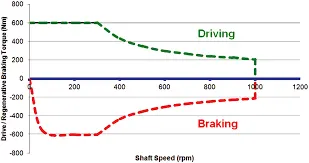
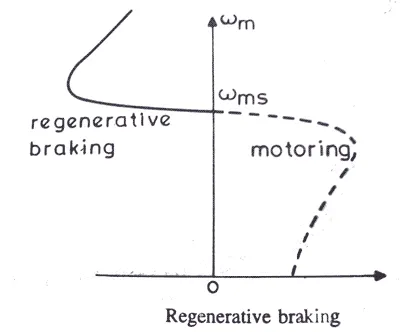
- In above figure we can see that the motoring and regenerative graphs are mirror image to each other.
- We know that at high speed to apply braking, we need high braking torque. But as per the above characteristics graph at high speed high braking torque is not possible.
- The peak value in motoring is also not same as braking torque.
- Also, the rated of discharging is more than the rate of charging for a battery due its chemical properties.
- Electric motors are designed mainly for more starting torque. So definitely, motor will not produce more braking torque at high speeds than starting.
- These are the reasons electric motor can’t develop braking torque at high speed similar to starting
ELECTRIC AND MECHANICAL BRAKES CO-ORDINATION:
In general, EVs are equipped with the regenerative-hydraulic hybrid braking system. Whenever the regenerative braking torque is insufficient to offer the same deceleration rate as available in conventional vehicles, the hydraulic braking torque is applied.
The control of their distribution is depicted in following figure, which aims to provide the driver with the same braking feel as that experienced in conventional vehicles while maintaining maximum regenerative braking. During low brake pedal force, only the regenerative braking torque is applied on the driving wheels, and is proportional to the pedal pressing force. The braking torque on the non-driving wheels is always due to the hydraulic braking which is also proportional to the pedal pressing force. When the pedal force is beyond a certain limit, the maximum regenerative braking torque is applied on the driving wheels, and the hydraulic braking torque is simultaneously applied on the driving wheels to top up the desired braking torque. Meanwhile, the maximum regenerative braking torque is kept constant to fully recover the kinetic energy.
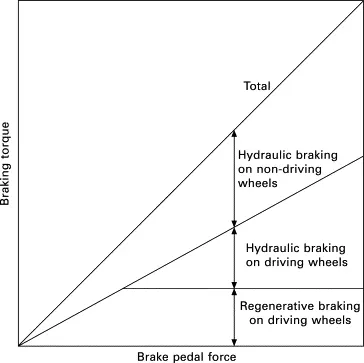
FIGURE.4
There are two types of electric and mechanical braking co-ordination strategies:
- Serial Braking:
Serial regenerative braking is basically based on the combination of friction-based adjustable braking system that transfers energy to the electric motors and batteries under an integrated control strategy. The overall design of serial regenerative braking is to estimate the deceleration required and distribute the required braking force between the regenerative braking system and mechanical braking system. Serial braking system requires brake by wire system and has more consistent pedal feel due to good torque blending capability. It can increase the efficiency by 15-30%.
Depending upon the level of depression of brake, a brake torque is sent and passed into the brake control strategy block and checked if state of charge is below the maximum permissible level of charge. Then the brake torque requested is compared to the maximum regenerative torque limit of the motor generator. If the brake torque requested is less than or equal to the maximum regenerative torque, then the vehicle brakes purely on regenerative torque and the battery is charged, and if the requested brake torque is greater than the maximum regenerative torque, friction brakes contributes and is checked if the total brake torque requested from front(70% of requested brake torque) is less than or equal to maximum regenerative torque. If the condition is satisfied, front braking is provided by regenerative braking and rear by friction. If not, then the front friction brakes contribute along with rear friction brakes and front regenerative braking, to satisfy the overall brake torque demand.
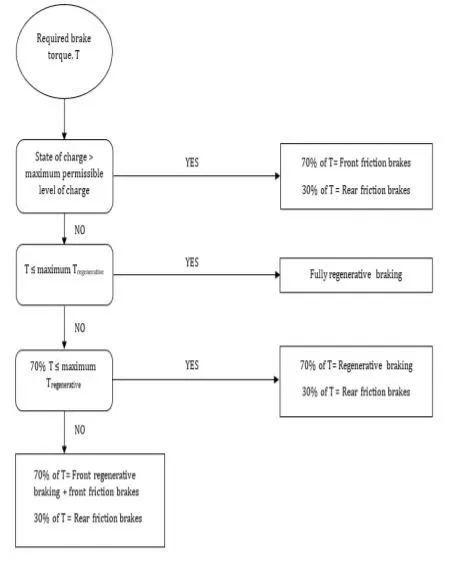
FIGURE.5
- Parallel Braking:
Parallel braking system is basically based on the combination of friction-based system and the regenerative braking system, operated in tandem without an integrated control. The regenerative braking force is calculated from the brake control unit by comparing the requested brake torque and the motor torque available. Parallel regenerative braking system requires more work in achieving good torque blending. This system can increase the efficiency by 9-18%.
When the brake pedal is pressed and a brake torque is requested, it is passed through the brake control strategy block to check if state of charge is less than the maximum permissible level of charge. Then the requested brake torque is compared with the maximum regenerative torque limit of the motor generator. If the brake torque requested is less than or equal to the maximum regenerative torque, then the vehicle brakes purely by friction, and if the requested brake torque is greater than the maximum regenerative torque, it is checked if the total brake torque requested from front(70% of requested brake torque) is less than or equal to maximum regenerative torque. If the condition is satisfied then the vehicle brakes purely by friction. If not, then the vehicle brakes by front friction and regenerative braking and rear friction braking.
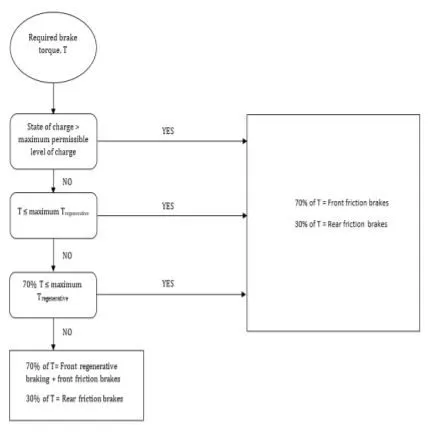
FIGURE.6
MATLAB PROGRAM WHICH PLOTS CONTOUR OF GIVEN MOTOR SPEED, TORQUE & EFFICIENCY VALUES:
clear all
close all
clc
omega = linspace(0,1000);
torque= linspace(0,250);

%Motor Loss constants
%for copper loss
k_c = 0.2;
%for iron loss
k_i = 0.008;
%for winding loss
k_w = 0.00001;
% for conduction  loss
cl = 20;

% Making 2d matrix
[T,W] = meshgrid(omega,torque);

%  Output power = torque*Speed
Out_power = (T.*W);

% Copper Loss
b = (W.^2)*k_c;

% Winding Loss
c = (T.^3)*k_w;

% Iron Loss
d = T*k_i;

% Therefore for Input Power
In_power = Out_power +b +c +d +cl;

% Efficiency
E= Out_power./In_power;

%Efiiciency levels for contour
e=[0.70,0.75,0.80,0.82,0.87,0.89,0.90,0.92];

%Creating Contour
contourf(T,W,E,e);
xlabel('Speed');
ylabel('Torque');
title('Contour for Motor speed,Torque and Efficiencies')
- In the above code speed and torques of the motor are defined using linspace command.
- Then all loss constant as mentioned above are entered in the code and named accordingly.
- Then a 2d matrix is created for speed and torque using mesh grid command to help to create a contour.
- Then all the losses, input power and input power are calculated according to the above-mentioned formulas.
- We created another efficiency matrix so that we can define levels for the contour.
- Then we plotted contour using contourf command and once the program is run we get the following result.
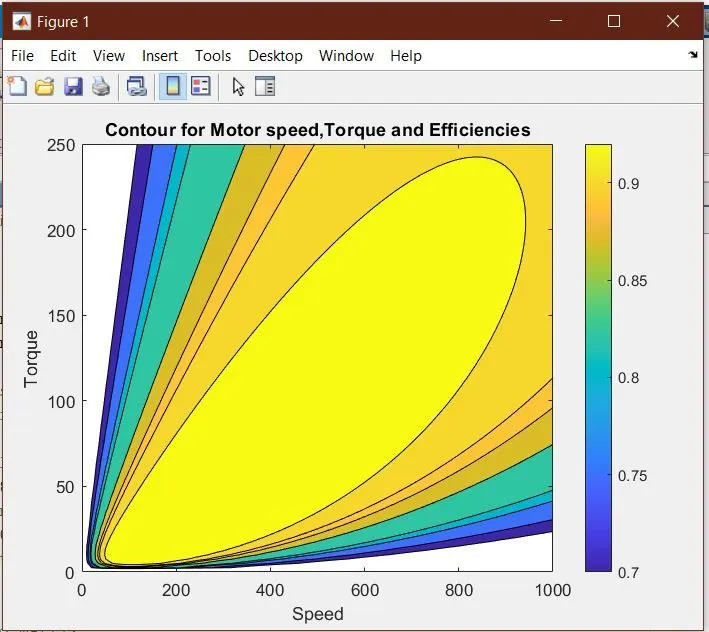
FIGURE.7
- Here we can see that the inner most contour has highest efficiency, i.e. for all the values in thic contour the value of efficiency is same. As the efficiency decreases the contours keep going outside.
CONCLUSIONS:
- Thus, all the objectives were achieved successfully.
- Similar kind of approach can be followed for similar kind of problems and concepts.