Week-11 Challenge: Braking
1. For a defined driving cycle, calculate the energy required for braking.
Solution:
Mass of vehicle: 1000kg
Energy = 0.5*Mass*(Vf - Vi)^2
https://docs.google.com/spreadsheets/d/1dIqV6h0xpYPS5ehyZRTgTQbqvK9EXI6PNt14Nb4XLXg/edit?usp=sharing
There are two braking conditions in the following drive cycle;
For 0-25 secs;
`E1 = 0.5*1000*(40- 0)^2`
`E1 = 500*1600`
`E1 = 800KJ`
For 26-50 secs;
`E2 = 0.5*1000*(38-2)^2`
E2 = 648KJ
Total energy required for braking = E1 + E2
= 1448 KJ
2.Why electric motor can’t develop braking torque at high speed similar to starting? How electric and mechanical brakes are coordinated?
Sometimes after accelerating you can't reach the maximum torque. The reason is that no matter how much the current loop wants to increase current (proportional to torque) by increasing the PWM duty cycle of the power stage, the Vmotor is too close to Vbemf and therefore current can't increase more.
Whenever Friction torque + Additional loads = Motor Torque, the load remain in equilibrium (does not move, or moves under constant speed). Whenever Friction torque + Additional loads < Motor Torque, the load accelerates (Motor torque - Friction torque - Additional loads = Acceleration torque > 0). Al high speeds, the BEMF is so close to Vbus that the applicable Motor torque gets limited. Then, the bigger the Friction torque + Additional load is, the smaller the Acceleration torque becomes.
This can also occur if acceleration or speed is limited by some reason.
This situation does not occur at the beginning of an acceleration because most of the torque is used to increase the kinetical energy of the load (and motor). But when the speed is already high and no extra load is applied it is not possible to increase the torque.
Coordination of electrical and mechanical brakes of EV/HEV:
The braking system in EV can be divided into two types ;
- SERIES - Here,regenerative braking and mechanical braking are applied one after the other.
- PARALLEL - Here, regenerative and mechanical braking is applied simultaniously.
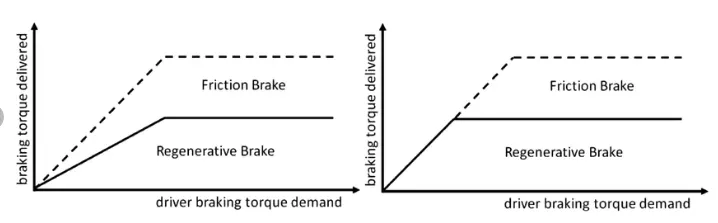
PARALLEL SERIES
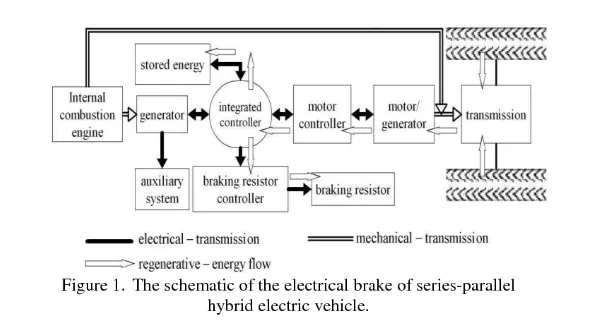
Hybrid vehicles usually have several braking systems, and braking mode switches are significant events during braking. It is difficult to coordinate torque fluctuations caused by mode switches because the dynamic characteristics of braking systems are different. In this study, a new type of plug-in hybrid vehicle is taken as the research object, and braking mode switches are divided into two types. The control strategy of type one is achieved by controlling the change rates of clutch hold-down and motor braking forces. The control strategy of type two is achieved by simultaneously changing the target braking torque during different mode switch stages and controlling the motor to participate in active coordination control. Finally, the torque coordination control strategy is modeled in MATLAB/Simulink, and the results show that the proposed control strategy has a good effect in reducing the braking torque fluctuation and vehicle shocks during braking mode switches.
3.Make a MATLAB program which plots contour of given motor speed, torque and efficiency values. Attach the code as a .m file attach a screenshot of all the plots.
Matlab code:
clear all
close all
clc
%INPUT ARRAY
V=linspace(1,1000); %speed
T=linspace(1,250); %torque
%ALLOCATING MOTOR LOSSES
kc=0.2; %copper losses
ki=0.008; %iron losses
kw=0.00001; %windage losses
ConL=20; %constant motor losses

%2d array for torque and velocity
[W,T]=meshgrid(V,T);
outputpower = (W.*T);

%claculating the losses
B=(T.^2)*kc;
C=(W).*ki;
D=(W.^3)*kw;

%power calculations
inputpower = outputpower + B + C + D + ConL;
Z =(outputpower./inputpower);

%SETTING EFFICIENCIES TO PLOT CONTOUR
V1 =[0.70,0.75,0.80,0.85,0.90,0.95];
box off
grid off

%Contour plot
contourf(W,T,Z,V1)
xlabel=('Speed')
ylabel=('Torque/N.m')
zlabel('Efficiency')
hold on
Explanation:
- At first, the input arrays along with the loss coff. are determined in the code.
- Next we create a 2D array and also calculate the motor losses
- Then we calculate the power losses for the given motor speed,torque and efficiency.
- Next, we create a contour plot for motor speed,torque and efficiency.
PLOT:
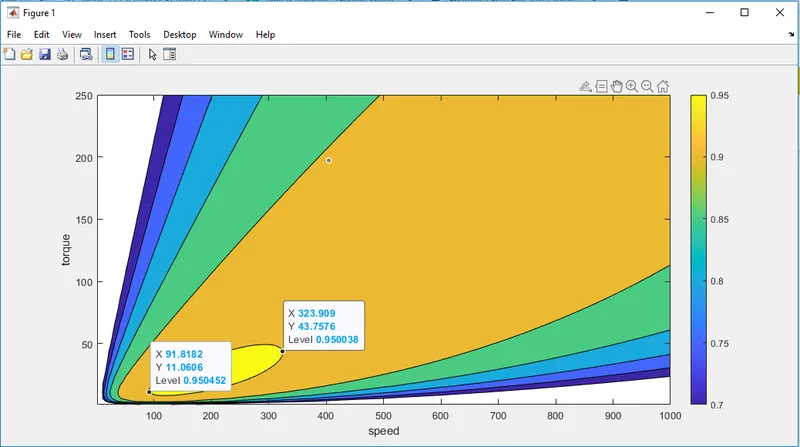
Thus, we can say that as the speed and torque of the motor increases, the efficiency of the system is compramised.