Week-11 Challenge: Braking
Objective 1: For a defined driving cycle, calculate the energy required for braking.
Answer:
A brake system is designed to slow and halt the motion of a vehicle. To do this, various components within the brake system must convert the vehicle's moving energy into heat. This is done by using friction. Friction is the resistance to movement exerted by two objects on each other.
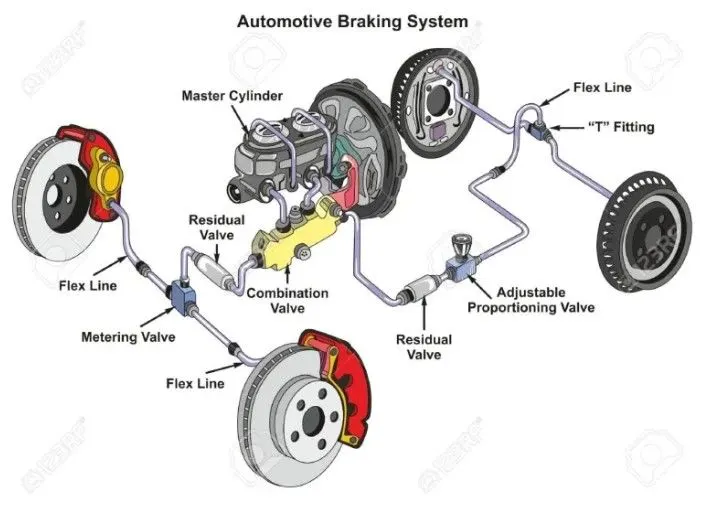
Below are the functions braking system used in the automotive engine:
- A brake system helps to stop vehicles within the smallest possible distance. This is achieved by converting the kinetic energy of the vehicle into heat energy.
- It also functions on a mechanical device where motion occurs, the brake is applied to stop it within a short period of time.
The brakes must be capable of decelerating a vehicle at a faster rate then the engine is able to accelerate it. Normally brakes have to absorb three times the amount of engine horsepower energy in its equivalent form.
Kinetic energy is the force that keeps the vehicle moving. This energy is provided by the engine in order to accelerate the vehicle from standstill to desired speed.
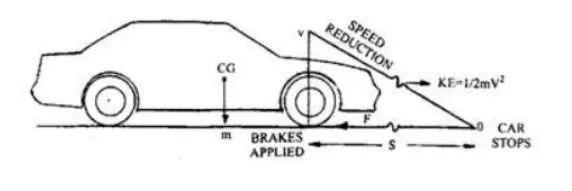
Kinetic energy of vehicle during braking is given by:
KE= (½)(w/g)(U^2-V^2)=(½)M(U^2-V^2)
W= Vehicle gross weight, N
U= Initial Velocity
V= Final Velocity
M= Mass of the Vehicle
g= Acceleration due to gravity
Thus Kinetic Energy doubles as the weight doubles, but it increases four times as speed doubles.
Types of braking system
Below are the various types of braking used to automotive devices:
Electromagnetic brake system
This is one of the rising designs of the brake system, it uses an electric motor that is contained in the automobile. The motor aided the stopping of the vehicle. Electromagnetic braking system types are used in most hybrid vehicles where electric motors charge the batteries and power the brakes.
Frictional brake system
The frictional types of braking systems are common in automobiles. Their design is complex but serviceable and is typically available in two forms; pads and shoes. Just as it’s named, friction is used in the braking system to stop the vehicle from or device from moving. In its components, a rotating device with a stationary pad and a rotating weather surface.
Hydraulic brake system
The hydraulic braking system types are composed of master cylinders that receive hydraulic braking fluid from a reservoir. Through connections of an assortment of metal pipes and rubber fittings, the system is attached to the cylinders of the wheel. The wheel features two opposite pistons, located on the band or drum brakes. The pressure pushes the piston apart, forcing the brake pads into the cylinders, which cause the wheel to stop moving.
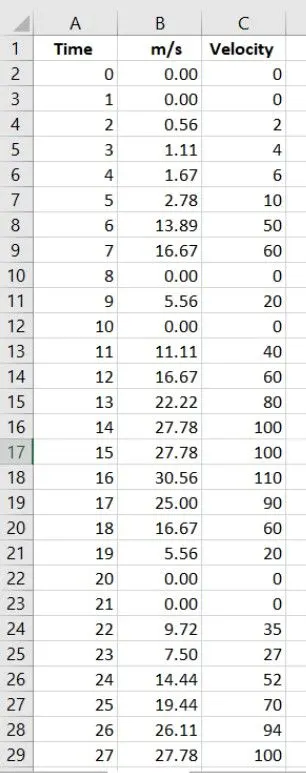
Excel Sheet for the Drive System:
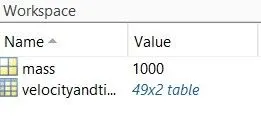
Workspace:
MATLAB Program:
mass= 1000; % mass of the vehicle in kg
t= velocityandtime(:,1); %time period
v= velocityandtime(:,2); %velocity data in m/s
for i= 1:(length(velocityandtime)-1)
if v(i)>v(i+1)
BE(i)= 0.5*mass*(v(i)-v(i+1))^2; %BE stands for brake energy
end
end
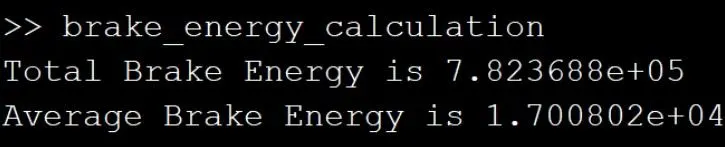
fprintf ('Total Brake Energy is %d', sum(BE))
fprintf ('Average Brake Energy is %d',mean(BE))
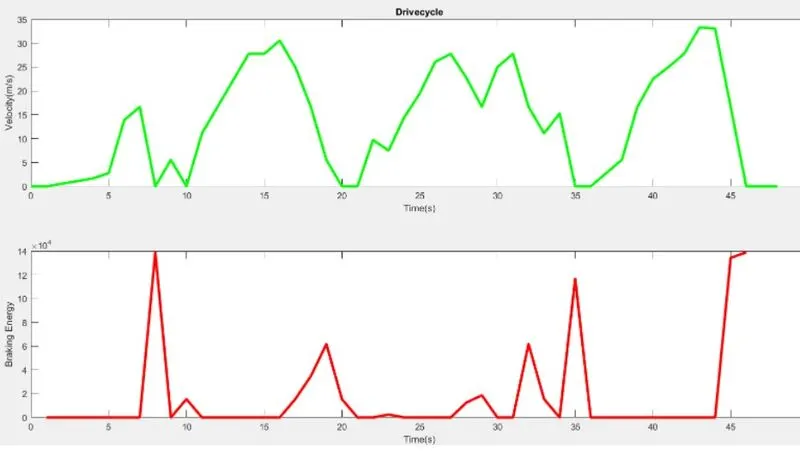
% plotting the results
figue(1)
subplot(2,1,1)
plot(t,v,'linewidth',3,'Color',g)
xlabel('Time(s)')
ylabel('Velocity(m/s)')
title('Drivecycle')
subplot(2,1,2)
plot(BE,'Linewidth',3,'Color','r')
xlabel('Time(s)')
ylabel('Braking Energy')
Command window:
Plot:
Objective: 2
Why can't electric motors develop braking torque at high speed similar to starting? How are electric and mechanical brakes coordinated?
Answer: The electric motor can’t develop braking torque at high speed similar to starting because once the electric supply is pulled off from the motor, it acts as generator and due to the flux weakening effect of the electric generator , the generator produces low torque as expected.
The most common form of regenerative brake involves an electric motor functioning as an electric generator.
Regenerative Braking:
Regenerative braking is an energy recovery mechanism that slows down a moving vehicle or object by converting its kinetic energy into a form that can be either used immediately or stored until needed. In this mechanism, the electric traction motor uses the vehicle's momentum to recover energy that would otherwise be lost to the brake discs as heat. This contrasts with conventional braking systems, where the excess kinetic energy is converted to unwanted and wasted heat due to friction in the brakes, or with rheostatic brakes, where the energy is recovered by using electric motors as generators but is immediately dissipated as heat in resistors. In addition to improving the overall efficiency of the vehicle, regeneration can significantly extend the life of the braking system as the mechanical parts will not wear out very quickly.
Speed Torque Characteristics of Regenerative Braking:
When the supply frequency is fixed, regenerative braking is possible only for speeds greater than synchronous speed. With a variable frequency speed, it cannot be obtained for speed below synchronous speed.
Coordination of Electric and Mechanical brakes:
In a Electric motor the total brake distribution is in two aspects which are Electrical brakes called as Regenerative brake and Mechanical brake or Classical brake with hydraulic cylindrical system, if the Regenerative braking power requirement is more than the charging limit of the battery or more than than regenerative capacity of the machine we must apply Mechanical brakes as well.
In practical cases the combination of these two is applied. So usually it is a combined response of Mechanical brake or Electrical brake.The reason for how these brake forces are combined that particular phenomena is called Brake control Strategies.
Objective:3
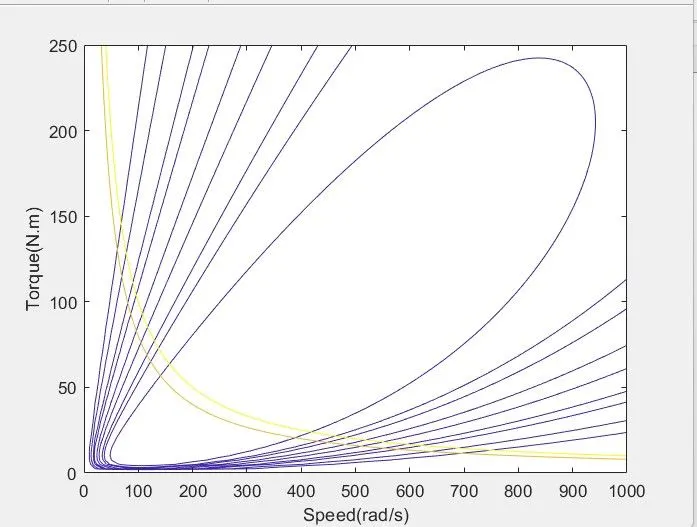
Make a MATLAB program which plots contours of given motor speed, torque and efficiency values. Attach the code as a .m file attach a screenshot of all the plots.
Answer:
To plot a contour line for a given motor. A motor has various types of losses happening inside . The various types of losses are:
Copper losses:These losses occur in armature and field copper windings. Copper losses consist of Armature copper loss, Field copper loss and loss due to brush contact resistance.
Copper losses = Kc.T^2
Iron Losses:
As the armature core is made of iron and it rotates in a magnetic field, a small current gets induced in the core itself too. Due to this current, eddy current loss and hysteresis loss occur in the armature iron core. Iron losses are also called Core losses or magnetic losses.
Iron losses = Ki.w
Windage losses:
Windage loss is the reduction in efficiency due to windage forces. For example, electric motors are affected by friction between the rotor and air. Large alternators have significant losses due to windage. To reduce losses, hydrogen gas may be used, since it is less dense.
Windage losses= Kw.w^3
Constant losses: This is denoted by C.
Total losses = Kc.T^2 + Ki.w + Kw.w^3 + C
All motors are modeled as per the above equation of losses. This above equation is not only applicable for permanent magnet DC motors , but other motors as well like induction motors.
MATLAB Program:
clear all
close all
clc

w = linspace(0,1000);
T = linspace(0,250);

%motor constants
kc = 0.2; % for copper loss
ki = 0.008; % for iron loss
kw = 0.00001 ; %for windage loss
conL = 20; %for constant motor losses

%making mesh
[X,Y] = meshgrid(w,T);
OutputPower = (X.*Y); % Torque * Speed = Power
B = (Y.^2)*kc; %copper loss
C = (X.^3)*kw; % winding loss
D = X*ki; % iron loss
Inputpower = OutputPower + B + C + D + conL;
Z = OutputPower./Inputpower;

% Set the efficiencies for which the contours will be plotted
V = [0.70 , 0.75 , 0.80 , 0.82 , 0.85, 0.87 , 0.89 , 0.90 , 0.92];
box off
grid off
contour(X,Y,Z,V);
xlabel('Speed(rad/s)')
ylabel('Torque(N.m)')
hold on
V = [8000,10000];
contour(X,Y,OutputPower,V);
Result: