Week-11 Challenge: Braking
- For a defined driving cycle, calculate the energy required for braking.
Q1.ans}BRAKING
Braking can be defined a the process by which the velocity and kinectic enrgy of a vehicle is reduced gradually to a negligible value by applying brakes on the wheels of the vehicle.Braking primarily uses the concept of friction to stop the vehicle.When brakes are applied the brake discs attach themselves to the rotating element(tire) and prevent its rotation motion.This process genrates heat.We can say that the kinectic energy devloped by the vehicle during acceleration is dissipated in the form of heat while braking.
Automobiles are attached with two brakes ,The service brakes and the Hand brake.The service brake/brake at the foot is used to reduce the speed of vehicle and stop it as desired by applying force on the brake pedal.Hnd brakes are emergency brakes used when the service brakes are not functional/when needed to stop for elongated time on slopes/hills etc.Hnd brake only needs to be engaged,does not require constant force to hold it.
Brakes are of two types.
1. Mechanical brakes 2.Electrical brakes.
We know K.E is developed when vehicle moves.It is due to the power supplied by engine making the wheels rotate.Therefore to calculate energy required for braking we can understand that the kinectic enrgy has to ovecomed.So at some point we see K.E=B.E, Because a K.E has to be overcome first to achieve braking and that energy is nothing but energy require for braking (.B.E)
Kinetic energy = 1/2*m*(Vi-Vf)^2
m= mass of vehicle(KG)
Vi= Initial velocity(m/s)
Vf= Final velocity(m/s)
MATLAB CODE
close all
clc

m= 1000;
t=DrivecycleforChallenge11(:,1);
v=DrivecycleforChallenge11(:,2);
for i=1:(length(DrivecycleforChallenge11)-1)
    if v(i)>v(i+1)
        breaking_energy(i)=0.5*m*(v(i)-v(i+1))^2;
    end
end
fprintf('total breaking energy = %d',sum(breaking_energy));

figure(1)
subplot(2,1,1);
plot(t,v,'LineWidth',3,'color','g');
xlabel('time(s)');
ylabel('velocity');
title('Drivecycle graph');

subplot(2,1,2);
plot(breaking_energy,'LineWidth',3,'color','b');
xlabel('time');
ylabel('breaking energy');
Step-explanation for code
- Its established to calculate the KE of this condition to actually find out braking power.
- In code,We dont put 'clear all' (since upon 'run' excel sheet becomes cleared)since we will be importing a drive cycle form excel in the form ofa numerical matrix.
- We assign an assumed value for mass(m).Then assign time and velocity values to variable't' and 'v' from the excel sheet as a matrix.
- Now we open a loop to complete the entireity of the excel sheet length,in which breaking energy is calculated using the formuls if existing velocity value is greater than nxt velocity value in the sheet.else move to comparison of nxt velocity value pairs.After length of sheet is done loop ends.
- Then we calculate the total breaking enrgy needed.
- Lter we plot the velocity and time graph of the drive cycle and also the Braking energy over the timeperiod of the drive cycle in seperate sub plots.
Results
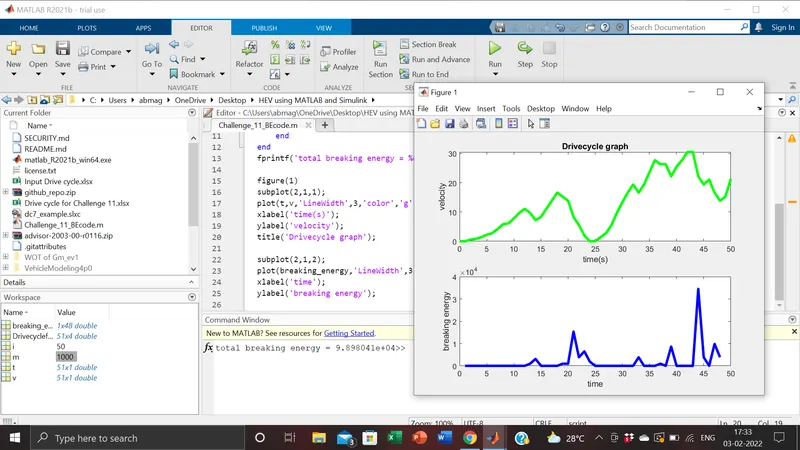
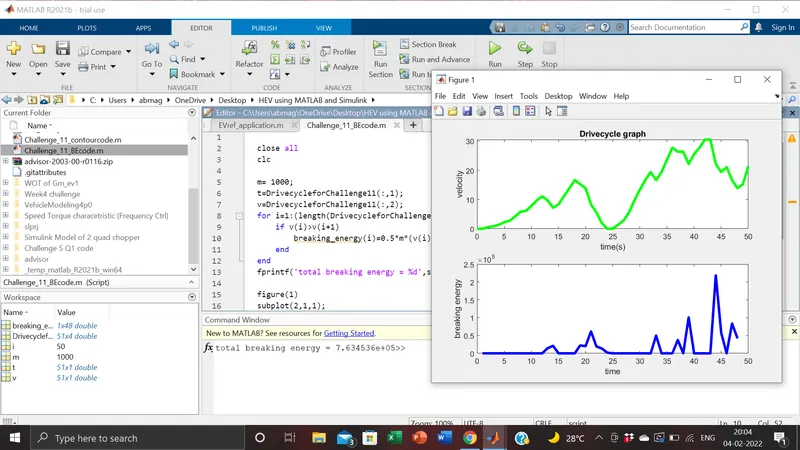
The above second result is after varying the formula of braking energy by changing 0.5*m*(Vi-V(i+1))^2 to 0.5*m*(Vi^2-V(i+1)^2)....since i was not sure about the power change when two velocity values are involved.
Q2.Why electric motor can’t develop braking torque at high speed similar to starting? How electric and mechanical brakes are coordinated?
ans}Electric motor can’t develop braking torque at high speed similar to starting because once the motor is cutt off from the supply it acts as a generator and the resulting change in magnetic flux that is the weakened flux the generator produces low torque.
Co-ordination of mechanical and electric brakes
We know that there are two types of brake systems the Electric/Regenerative braking and the mechanicak braking.In an EV there is an option to use both these braking systems.The way its decided to use either of these systems is known as Brake control strategy.
There are primarily two such strategies :SERIES and PARALEL.A EV has both these braking mechanisms in it.They are used at various times one after the other or simultaneously depending on need and speed.In series brake control strategy, mechanical and regenrative brakes are applied one after the other. The Series brake control strategy has a further classification depending on the performance of the brakes and comfort of the driver.In parallel brake control strategy both the types of brakes are pressed/engaged simultaneously.EDIB is a combination of hydraulic and regenrative braking happeneing simultaneously.It is a further classification of parralel braking stategy.The control criteria is such that low speed uses regenrative braking and as the speed goes higher and higher the combination of both is used.
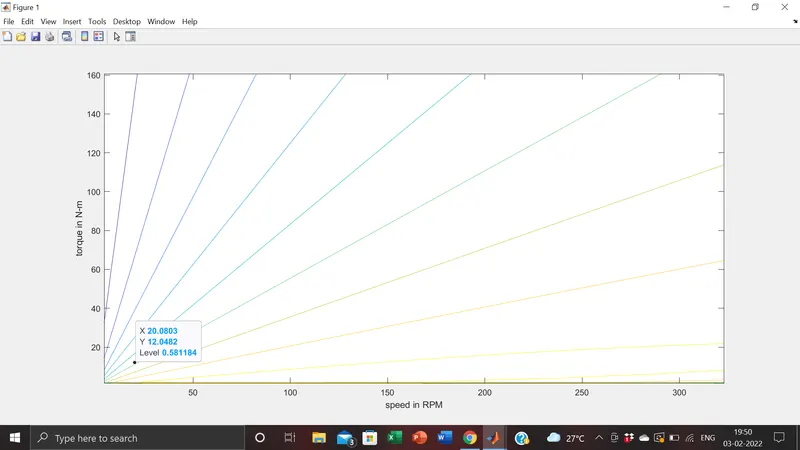
3.Make a MATLAB program which plots contour of given motor speed, torque and efficiency values. Attach the code as a .m file attach a screenshot of all the plots.
Q3.ans}MATLAB CODE
clear all
close all
clc

%to plot contour for given motor spped,torque,eff
torque=linspace(0,500,250);
speed=linspace(0,1000,250);
[X,Y]=meshgrid(torque,speed);

%loss constants
kc=0.3;     %copper constant
kw=0.00005; %windage constant
ki=0.010;   %iron constant
C=30;
%loss calculation
cu_loss=kc*(Y.^2);
wind_loss=kw*(X.^3);
iron_loss=ki*X;
p_output=X.*Y;
p_input=p_output+cu_loss+wind_loss+iron_loss;

eff=p_output./p_input;

contour(speed,torque,eff);
xlabel('speed in RPM');
ylabel('torque in N-m');
Code explanation
- Initially values of speed and torque are generated using linspace.
- to create a 2d array meshgrid command is used ontorque and speed.as it is necessary for the contour plot.
- Later losses are evaluated using formula and constants are assumed .Output and input power is calculated.The main reason we do this is to calculate efficiency.,since formula is output / input AND factoring in the losses makes it more accurate.
- Then we plot the contour using command and label axes.
Result