Week-11 Challenge: Braking
1. Energy required for braking.
clear all
clc
load highwaytest.txt
time =highwaytest(:,1);
velocity = highwaytest(:,2);
M = 1200 % load of the vehicle
Energy = 0.5*M*(velocity).^2/1000;
plot(time, Energy)
title('Brakng energy vs time')
xlabel('Time')
ylabel('Braking energy in kJ')
legend('Highway driving cycle')
2.
What is regenerative braking?
Moving vehicles have a lot of kinetic energy, and when brakes are applied to slow a vehicle, all of that kinetic energy has to go somewhere. Back in the Neanderthal days of internal combustion engine cars, brakes were solely friction based and converted the kinetic energy of the vehicle into wasted heat in order to decelerate a car. All of that energy was simply lost to the environment.
Fortunately, we have evolved as a species and developed a better way. Regenerative braking uses an electric vehicle’s motor as a generator to convert much of the kinetic energy lost when decelerating back into stored energy in the vehicle’s battery. Then, the next time the car accelerates, it uses much of the energy previously stored from regenerative braking instead of tapping in further to its own energy reserves.
It is important to realize that on its own, regenerative braking isn’t a magical range booster for electric vehicles. It doesn’t make electric vehicles more efficient per se, it just makes them less inefficient. Basically, the most efficient way to drive any vehicle would be to accelerate to a constant speed and then never touch the brake pedal. Since braking is going to remove energy and require you to input extra energy to get back up to speed, you’d get your best range by simply never slowing down in the first place.
But that obviously isn’t practical. Since we need to brake often, regenerative braking is the next best thing. It takes the inefficiency of braking and simply makes the process less wasteful.
How well does regenerative braking work?
To evaluate regenerative braking, we really need to look at two different parameters, efficiency and effectiveness. Despite sounding similar, the two are quite different. Efficiency refers to how well regenerative braking captures ‘lost’ energy from braking. Does it waste a lot of energy as heat, or does it turn all of that kinetic energy back into stored energy? Effectiveness, on the other hand, refers to how large of an impact regenerative braking really makes. Does it measurably increase your range, or will you not notice much of a difference?
Efficiency
No machine can be 100% efficient (without breaking the laws of physics), as any transfer of energy will inevitably incur some loss as heat, light, noise, etc. Efficiency of the regenerative braking process varies across many vehicles, motors, batteries and controllers, but is often somewhere in the neighborhood of 60-70% efficient. Regen usually loses around 10-20% of the energy being captured, and then the car loses another 10-20% or so when converting that energy back into acceleration, according to Tesla. This is fairly standard across most electric vehicles including cars, trucks, electric bicycles, electric scooters, etc.
Keep in mind that this 70% does not mean that regenerative braking will give an 70% range increase. This isn’t going to bump your range from 100 miles to 170 miles. This simply means that 70% of the kinetic energy lost during the act of braking can be turned back into acceleration later.
This is why only reporting the efficiency of the system doesn’t really mean much. Someone could be very efficient when they work, but if they only work an hour a day, they probably aren’t accomplishing a lot. What should interest us more is the effectiveness of regenerative braking.
Effectiveness
This is where things get really interesting. The effectiveness of regenerative braking is a measure of how much it can increase your range. Does it make your theoretical range 5% further? 50% further? Even more?
As you’ve probably already guessed, the effectiveness of regenerative braking varies significantly based on factors including driving conditions, terrain and vehicle size.
Driving conditions have a large impact. You’ll see much better effectiveness for regenerative braking in stop-and-go city traffic than in highway commuting. This should make sense, as if you’re repeatedly braking, you’ll recapture a lot more energy than if you simply drive for hours without touching the brake pedal. Terrain also plays a large role here too, as uphill driving doesn’t give you much chance for braking, but downhill driving will regenerate a much larger amount of energy due to the long braking periods. On long downhills, regenerative braking can be used nearly constantly to regulate speed while continuously charging the battery.
Vehicle size may be the largest factor in the effectiveness of regenerative braking for the simple reason that heavier vehicles have much more momentum and kinetic energy. Just like a big flywheel is more effective than a small flywheel, a four-wheel electric car has a lot more kinetic energy when in motion than an electric bicycle or scooter.
Data for comparison can be somewhat hard to come by. Tesla vehicles show you the regenerative braking power, such as 60 kW during hard braking, but that doesn’t answer the more interesting question. We want to know how much energy we are recapturing over a trip, not how strong our brakes are each time we mash the pedal.
Fortunately, a number of Tesla drivers have reported back energy contribution data using different data tracking apps. Model S drivers have reported recapturing as much as 32% of their total energy use while driving up and then back downhill. This would effectively increase a 100 mile car’s range to 132 miles, for example. A Model S P85D owner reported approximately 28% energy recapture (forum in Danish) and still others have reported recapturing between 15-20% of their total kWh usage on average during normal trips.
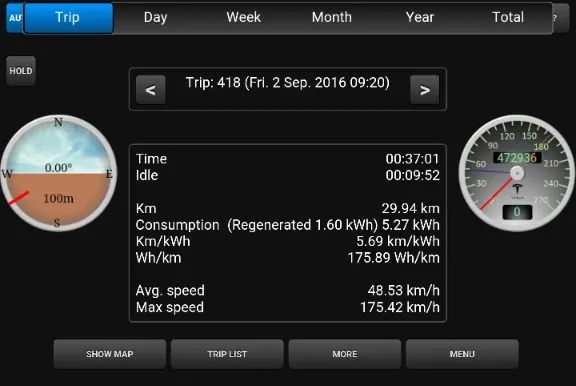
A Tesla driver’s LinkMyTesla App data showing approximately 30% of battery energy usage recaptured using regenerative braking.
For smaller EVs such as personal electric vehicles, the numbers aren’t quite as optimistic. On multiple electric bicycles with regenerative braking options, I’ve generally averaged around 4-5% regeneration, with a maximum of around 8% in hilly areas. Other personal electric vehicles including electric scooters and skateboards have similar results, usually in the lower single digits. Again, keep in mind this isn’t the raw efficiency of the system (as in how much braking energy is lost in the energy transfer), it’s the effectiveness (as in how much further your range increases due to the use of regenerative braking).
As I mentioned above, this is largely due to the lower weight of personal electric vehicles. They simply don’t carry much momentum and thus have less kinetic energy to convert back into the battery.
HEV Structure
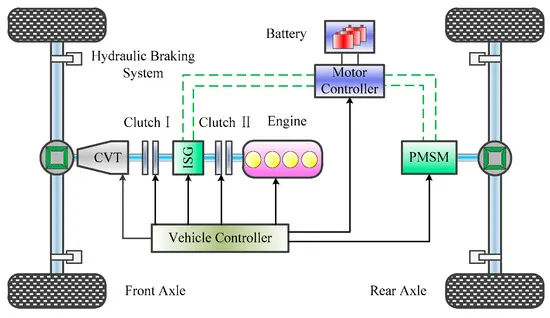
2.2. Dynamic Model
2.2.1. Motor Dynamic Model
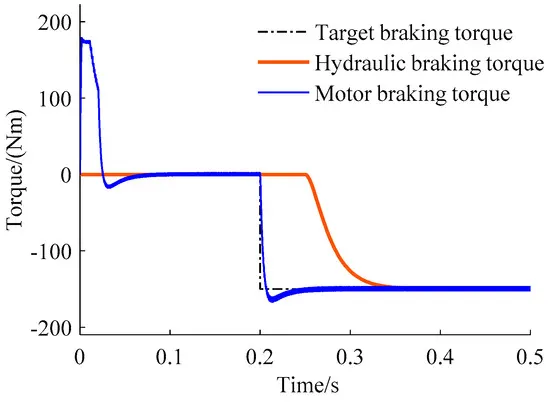
2.2.2. Hydraulic Dynamic Model
clc
clear all
omega = linspace(0,1500);
T = linspace(0,300);
Kc = 0.25;
Ki = 0.0075;
Kw = 0.0001;
[X,Y] = meshgrid(omega,T)
copper_loss = (Y.^2)*Kc;
iron_loss = X.*Ki;
Windage_loss = (X.^3)*Kw;
con = 20 ;
o_p = X.*Y;
input_power = copper_loss + iron_loss + Windage_loss + o_p + con ;
Eff = (o_p)./(input_power);
n = linspace(0.65, 0.95, 10);
grid off
box off
contour (X,Y,Eff,n)
xlabel('rpm')
ylabel('Torque')
zlabel('Effciency')