Week-11 Challenge: Braking
1) For a defined driving cycle, calculate the energy required for braking.
The Energy of Traction of wheels mainly compromises of Drag and Braking Energy. Where Braking Energy contributes the highest. In Fig.1.1. We can notice that when a standard driving cycle undergoes changes in speed, acceleration and deceleration. The vehicle at many points is brought to rest or decelerated (i.e. 80 Km/hr - 0 Km/hr) within 10- 15 sec. Hence a high braking energy is required. Hence the Braking energy also increases with deceleration of vehicle.
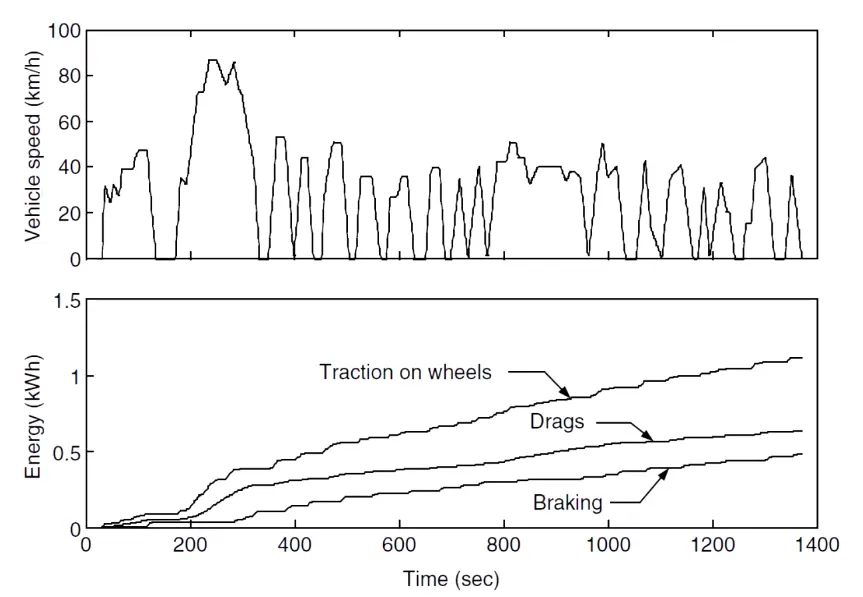
Fig.1.1.
As per the above Fig.1.1, Acceleration and deceleration at certain points are considered and the Brake power is calculated.
Please refer the attached sheet:
https://drive.google.com/file/d/1qmX9ke6DxR7bqUU7o7Vdn0lLB3t3VChu/view?usp=sharing
From the calculations, we can say that the Braking Energy requirement decreases as the difference in the deceleration speed decreases for a given set of time.
Case 1: Deceleration from 80Km/hr – 0 Km/ hr in 10 sec – Energy required – 247 KJ
Case 2: Deceleration from 45Km/hr – 23 Km/ hr in 10 sec – Energy required – 19 KJ
Case 3: Deceleration from 35Km/hr – 30 Km/ hr in 10 sec – Energy required – 0.96 KJ
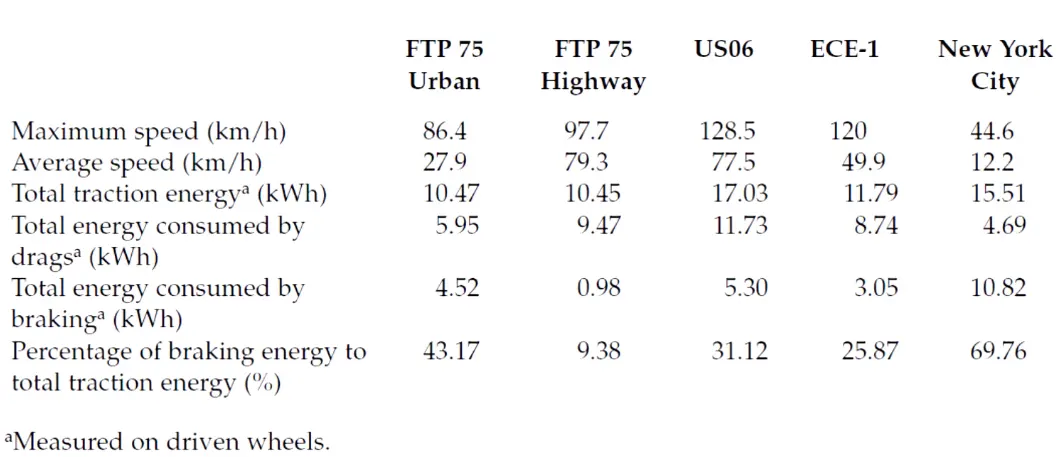
Fig.1.2.
Fig.1.2. shows the different energy consumptions for different drive cycles.
2) Why electric motor can’t develop braking torque at high speed similar to starting? How electric and mechanical brakes are coordinated?
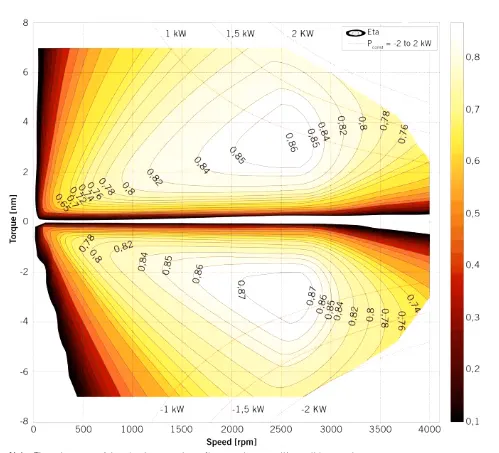
Fig.1.3.
The fig.1.3. Represents the two quadrants of the motor operation where in the first quadrant both torque and speed are +ve (Forward motoring) and in the second quadrant the speed is +ve and the torque is –ve. (Braking)
At High speed the torque will be less & operates at constant power region hence it is difficult to bring the vehicle to rest or decelerate immediately. The peak acceleration torque is greater than the peak deceleration torque. Hence Braking torque of EV motor is not as high as acceleration Torque.
The term braking comes from the term brake. We know that brake is an equipment to reduce the speed of any moving or rotating equipment, like vehicles, locomotives. The process of applying brakes can be termed as braking. Now coming to the term or question what is braking. First of all we can classify the term braking in two parts
- Mechanical Braking -
Mechanical braking mostly used in scooters, motor vehicles, and motorcycles where small power is required. It is essential in manufacturing power transmission applications, material handling, etc. It delivers forces to the axle or a wheel in order to stop motion. It helps to reduce the speed of the system slowly by the mechanical process when compared to electrical braking. The working of a mechanical brake depends on the pedal. When the pedal is pressed, the brake shoes are pushed outwards and rotates against the drum which is connected to the wheels. Hence the machine or vehicle gets slow down and stopped. And when the pedal is released, it goes to normal position due to the pullback action of spring shoes.
- Drum braking
- Disk braking
- Band braking
- Pawl and Ratchet braking
- Electrical Braking - Electrical braking is used to reduce the speed of the machine depending on flux and torque. This type of braking is mainly used for functional braking to control the speed of the machine. It is easy to handle and comfortable. But it cannot be used for emergency braking and parking braking.
- Plugging type braking
- DC injection type braking
- Eddy current braking
- Dynamic resistor type braking
- Regenerative braking
- Sharing DC bus type braking
Electrical and mechanical braking systems can are coordinated by using Brake stratergy subsystem
1) Serial Braking Stratergy
2) Parallel Braking Stratergy
Implementation of serial braking strategy
Once the brake pedal is pressed and depending on the level of depression, a brake torque is sent. Now this brake torque passes into the brake control strategy block. Here, firstly it is checked if battery state-of-charge is below 80% which is set as the maximum permissible level of charge. If that condition is satisfied, then the battery is recharged. The brake torque requested is compared to the maximum regenerative torque limit of the motor-generator. If the overall brake torque requested is less than or equal to the maximum regenerative torque, then the vehicle brakes purely on regenerative torque and the battery is charged. The amount of charge ultimately put in depends also on the motor-generator operation efficiency and the battery charging efficiency. If the overall brake torque requested is greater than what the motor-generator can provide, then the friction brakes kick-in. Now since the vehicle is front driven, it is checked if the total brake torque requested from front is less than or equal to maximum regenerative torque capability of motor-generator. If yes, then front braking is provided purely by regeneration and rear (non-driven axle) by friction. Once the total brake torque request increases further, then front friction brakes (driven axle) comes into play in combination with rear friction brakes and front regenerative braking, to satisfy the overall brake torque demand. This has been represented in a flow chart manner in the fig.1.4.
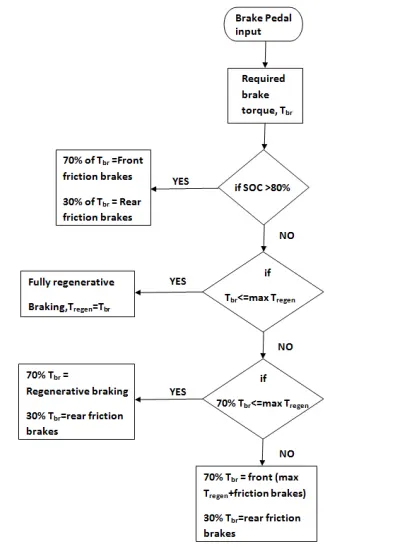
Fig.1.4.
Implementation of parallel braking strategy
Once the brake pedal is applied and a desired overall brake torque request is sent from the driver block. This brake torque on passing through the brake control strategy gets divided between regeneration and friction braking at all times. The strategy is so modeled with the comfort and brake pedal feel in mind. As a parallel regenerative braking is an add-on to the conventional systems, it is devoid of any integrated control. So to make the transition and co-performance of regenerative braking with friction smooth, it is assigned in such a way
that, there is a clear division between the amount of brake torque that will be achieved from regeneration and friction braking. On application of brakes and in keeping with the design of the motor-generator, it is designed to operate generator in a constant generator torque region. Motor-generator can provide a maximum of 322 Nm of generator torque at or under the base speed. The generator is scaled such that the base speed of the generator corresponds to a velocity of 124 [kmph], which is the maximum speed limit on most highways. Hence regeneration works, as long as the vehicle is braking from a speed of under 124 [kmph] and the requested brake torque on the front driven wheels, after the front-rear brake split is greater than or equal to maximum generator torque. If that condition is satisfied, then regenerative and friction braking operates in tandem else it’s just the friction brakes at the driven and non-driven axle. This has been represented in a flow chart manner in the fig.1.5.
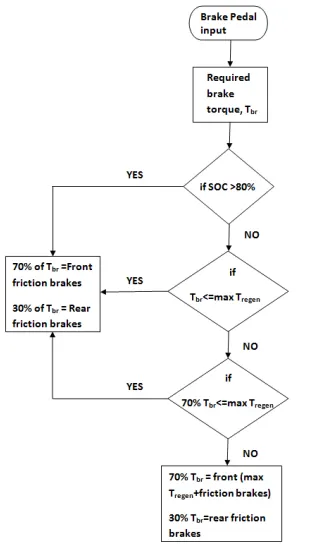
Fig.1.5.
3) Make a MATLAB program which plots contour of given motor speed, torque and efficiency values. Attach the code as a .m file attach a screenshot of all the plots
Matlab Code :
clear all
close all
clc
x = linspace(1,1000,250);
y = linspace(1,250,250);
kc = 0.3; %Copper Loss constant
ki = 0.009; %Iron Loss Constant
kw = 0.00005; %Windage Loss Constant
conL = 30;
[X,Y] = meshgrid(x,y);
pout = X.*Y;
B = kc*(Y.^2);
C = ki*X;
D = kw*(X.^3);
pin = pout+B+C+D+conL;
eta = pout./pin; %Efficiency
V = [0.5,0.55,0.6,0.65,0.7,0.75,0.8,0.85,0.9,0.95];
box off;
grid off;
contour(X,Y,eta,V);
xlabel('Speed in rad/s');
ylabel('Torque in N.m');
OUTPUT :
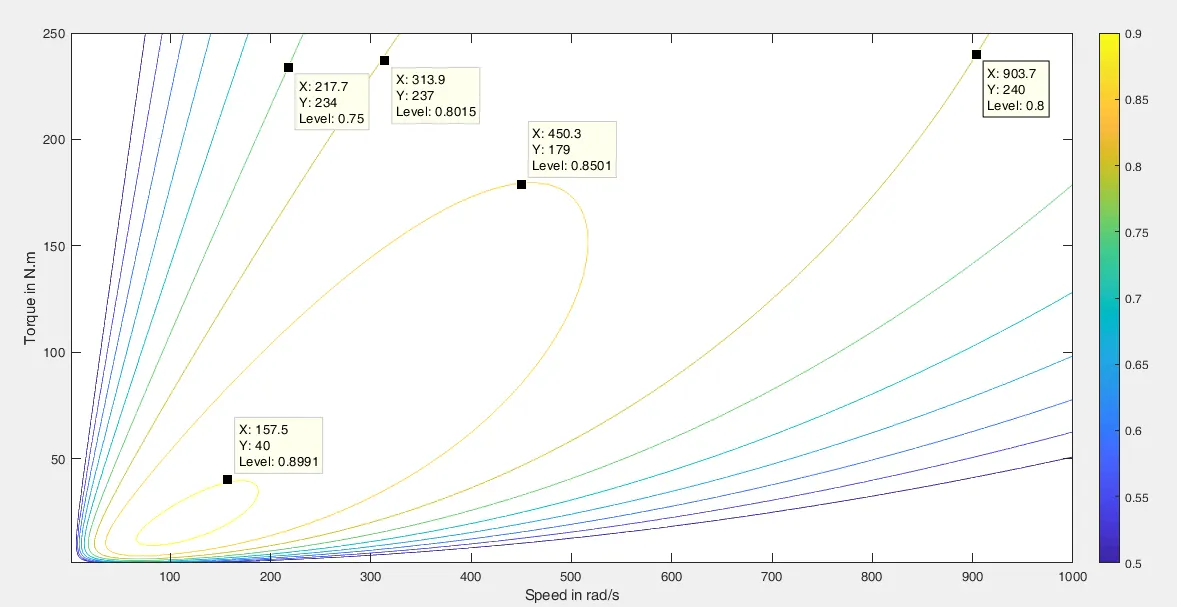
From the output graph you could notice that only at particular speed and torque the efficiency is at maximum i.e. 90 %. where Speed x = 157 rad/s @ 40 Nm Torque. As the Speed increases the efficiencies of the motor will be reduced.
Hence, to attain maximum efficiency the motor has to constantly run at around 157 rad/s speed @ 40 Nm.