Week-11 Challenge: Braking
Ans 1 : -
For a defined driving cycle, calculate the energy required for braking. The drive cycle is the US06 is a high acceleration aggressive driving schedule that is often identified as the "Supplemental FTP" driving schedule.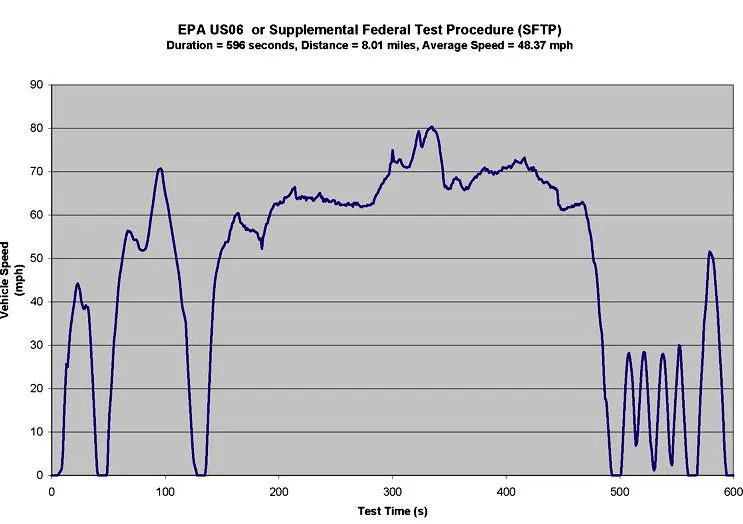
The braking energy calculated with the help excel sheet.
The link is https://drive.google.com/file/d/10VB1s85rNdu1MER__SzWNY078uS1M8eF/view?usp=sharing
The Braking energy is calculated = 1/2* (initial velocity ^2 - final velocity^2) * mass of the (vehicle+ Payload).
Ans 2:- Why electric motor can’t develop braking torque at a high speed similar to starting?
Whenever Friction torque + Additional loads = Motor Torque, the load remains in equilibrium (does not move, or moves under constant speed). Whenever Friction torque + Additional loads < Motor Torque, the load accelerates (Motor torque - Friction torque - Additional loads = Acceleration torque > 0). At high speeds, the BEMF is so close to Vb that the applicable Motor torque gets limited. Then, the bigger the Friction torque + Additional load is, the smaller the Acceleration torque becomes.
This situation does not occur at the beginning of acceleration because most of the torque is used to increase the kinetical energy of the load (and motor). But when the speed is already high and no extra load is applied it is not possible to increase the torque.
Therefore electric motor can't develop braking torque at a high speed similar to starting.
How electric and mechanical brakes are coordinated?
In an electric motor, the total brake distribution is in two aspects which are the electrical brake which is called regenerative brake, and mechanical brake. Brake force distribution must be uniform. If the regenerative braking power requirement is more than the charging limit of the battery or more than the regenerative capacity of the machine we must apply mechanical brakes as well. In practical cases, the combination of these two is applied. So usually it is a combined response of mechanical brake and regenerative brake. The reason for how these brake forces are combined, that particular phenomenon is called Brake Control Strategies. These are two Brake control strategies, which are
a.Series - In the case of series, we apply the mechanical brake and regenerative electric brake one after another. We can apply only one brake at a time either regenerative or apply mechanical brake.
b. Parallel - In the case of parallel we apply both brakes simultaneously. Both brakes applied at the same time.
Ans 3
- Make a MATLAB program which plots contour of given motor speed, torque and efficiency values. Attach the code as a .m file attach a screenshot of all the plots.
clear all
close all
clc
% speed array
x = linspace(0,1000);
% torque array
y = linspace(0,950);
% loss coefficient
Kc = 0.17; % copper loss
Ki = 0.005; % iron loss
Kw = 0.00015 % windage loss
ConL = 20 % motor constant
%meshgrid
[X,Y] = meshgrid(x,y);
copper_loss = Kc*(Y.^2);
Iron_loss = Ki*X;
Windage_loss = Kw*(X.^3);

%output power
Output = X.*Y;
input_power = copper_loss + Iron_loss + Windage_loss + Output + ConL;
Efficiency = Output./input_power;
n = linspace(0.6,0.95,10);
box off
grid off
contour(X,Y,Efficiency,n)
title('EFFICIENCY CONTOUR PLOT')
xlabel('speed rad/s')
ylabel('torque N/m')
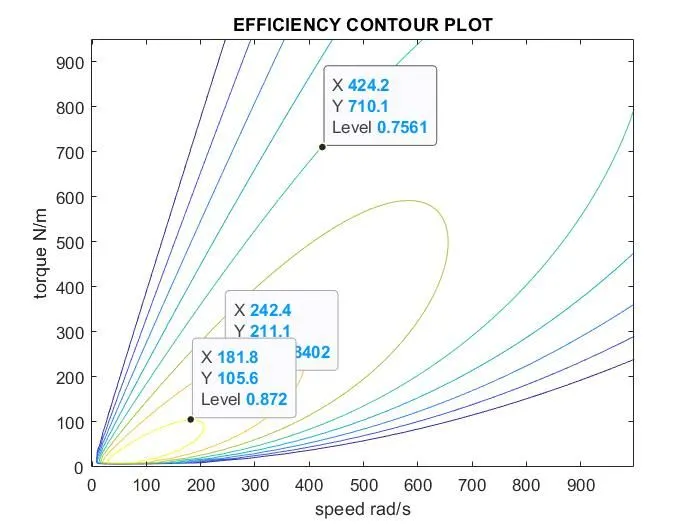
The above figure shows the efficiency of a motor for the range of speed. The innermost curve shows the highest efficiency 87.2 %. As we move from inward to outward direction the efficiency decreases. The region for high efficiency is for small range of speed and torque.