Car Crash simulation using the Explicit Dynamics Analysis
Aim:
To perform a parametric study using 3 different values of thickness for the car body. You need to apply the same conditions as the mentioned challenge. Analyze the
- Total deformation
- Equivalent stresses
Geometry:
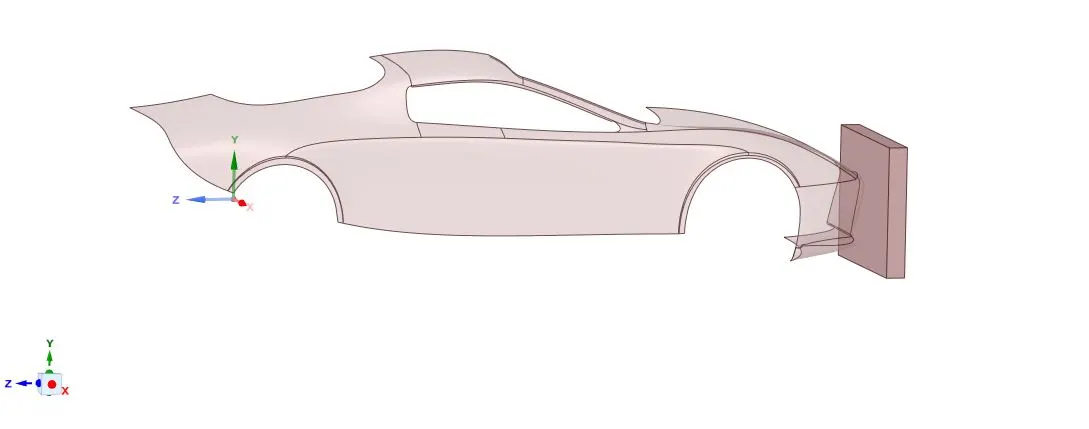
Now we need to upload the geometry and open it in space claim and see if there are any discontinuities in the model.
Materials:
Stainless Steel:
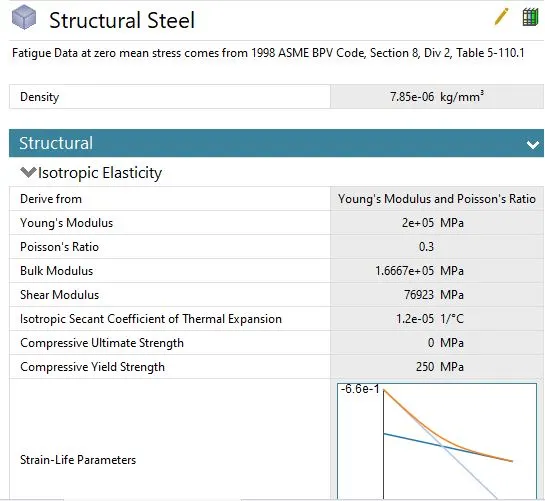
The material wall is set for structural steel material.
Stainless Steel NL:
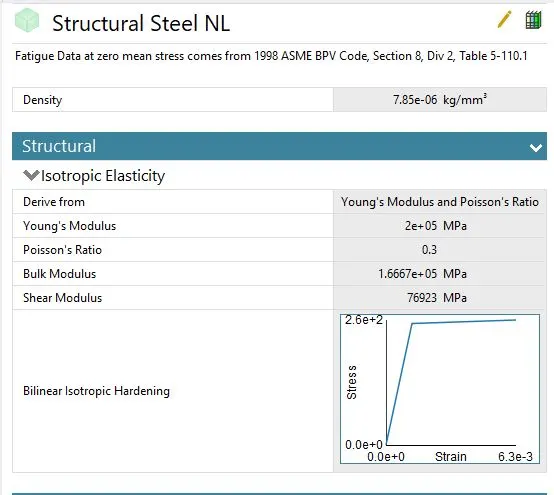
For the car body, we add stainless steel Non-linear is set.
Meshing Model:
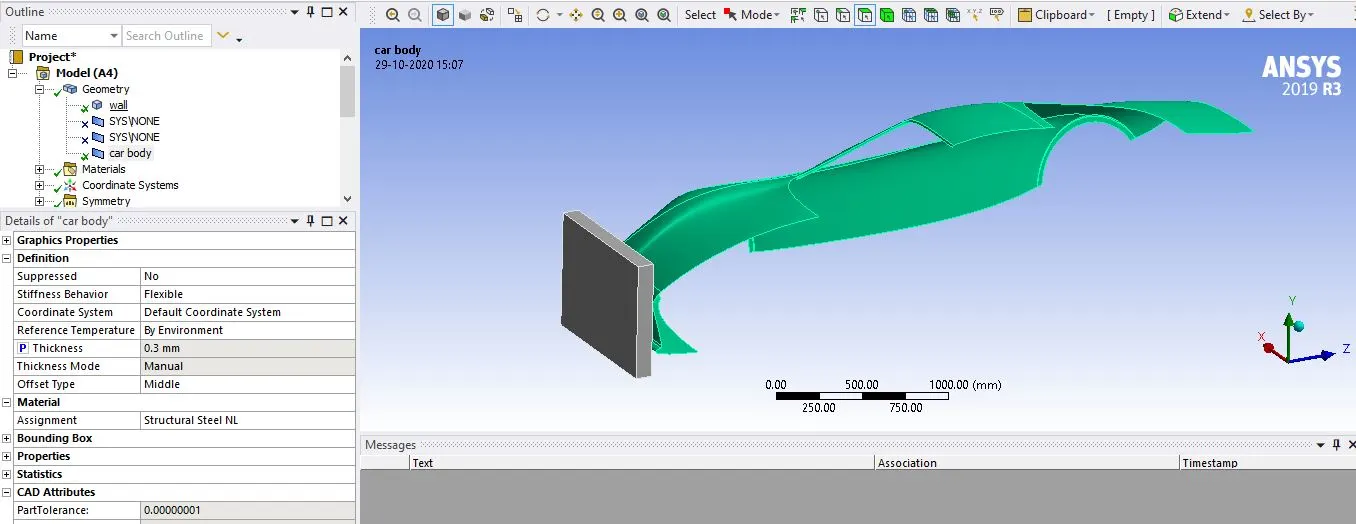
Enable on the box information of thickness and we see a P symbol in the box it indicates the parametric studies
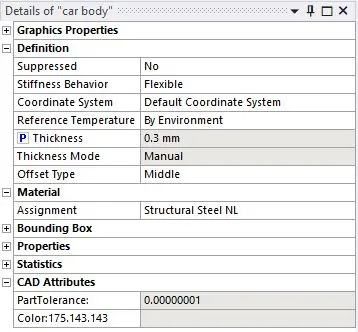
Thus parametric option is selected as we want to do a parametric study for various thicknesses.

Meshing:
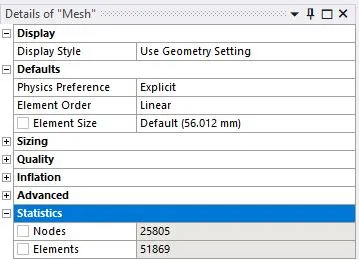
At certain locations, the mesh should be refined so we have used the element size as shown below.
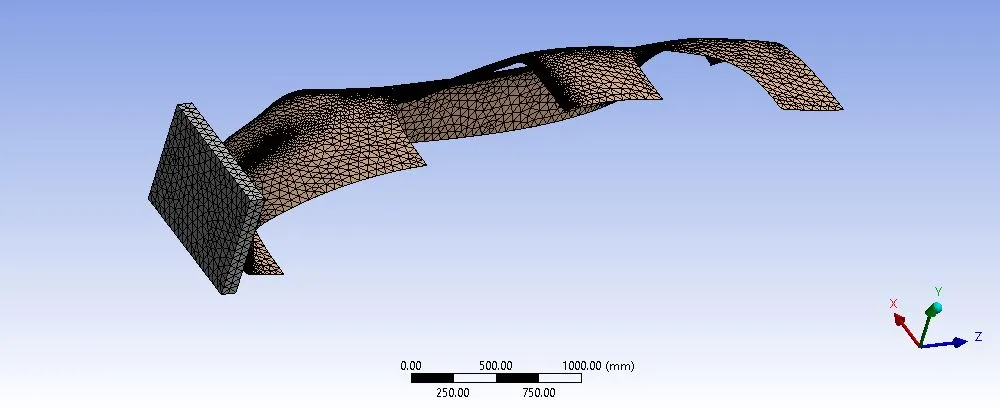
The Car body and Wall which comes in contact have meshed with an element size of 56mm.
The meshed model image and mesh metric graph can be seen below:
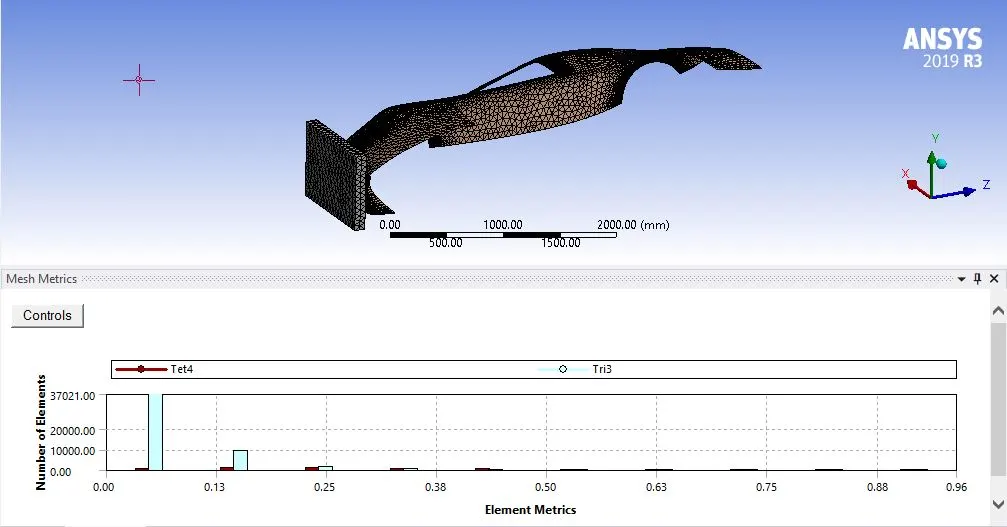
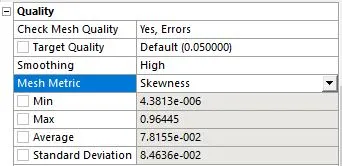
The mesh metric is utilized to identify the elements according to their quality using skewness. The quality of the mesh is acceptable as most of the elements lie within a high-quality range.
Symmetry Regions:
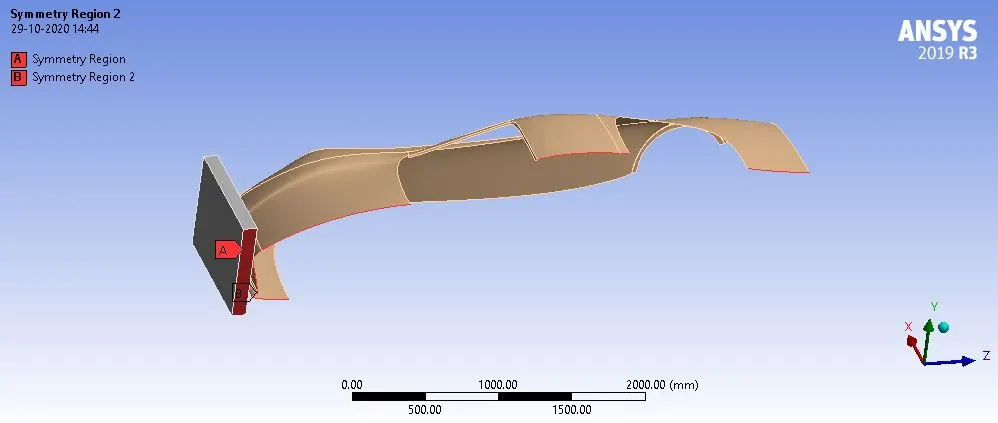
Symmetry regions applied on the x-axis for the car geometry
Body interaction:
The assembly is modeled in such a way that there will be a frictionless body interaction between the Wall and Car body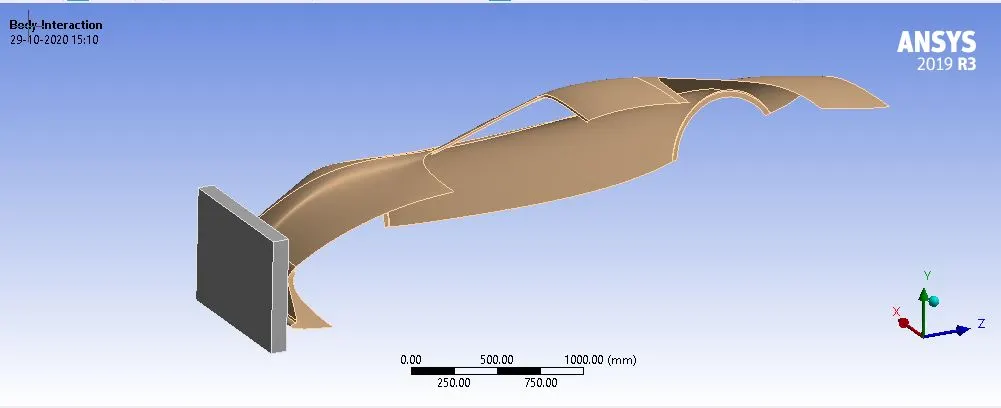
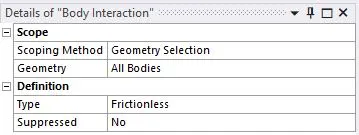
Frictionless body interaction between the Wall and Car body
Explicit Dynamics settings:
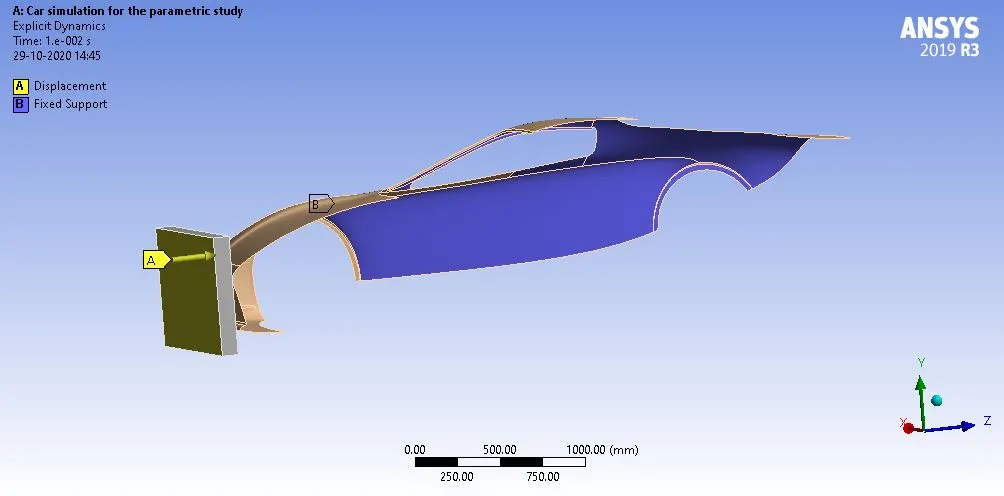
Both fixed and displacement velocity support applied to the specimen.
Analytical Settings:
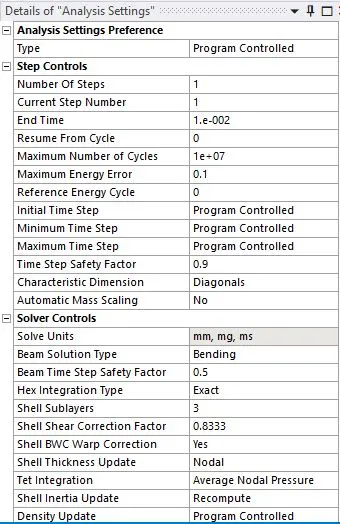
The analysis settings were used as per the requirement in the simulation.
Boundary conditions:
Fixed support:
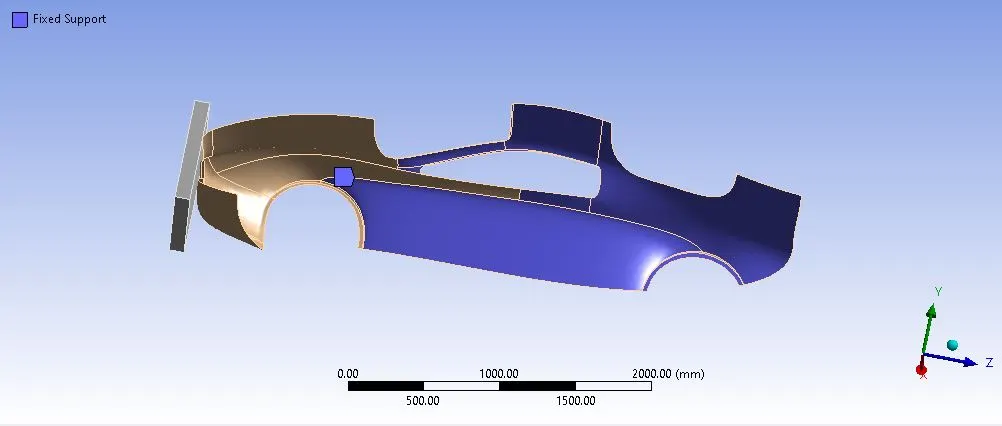
The fixed support applied to the car body for the Crash simulation
Displacement support:
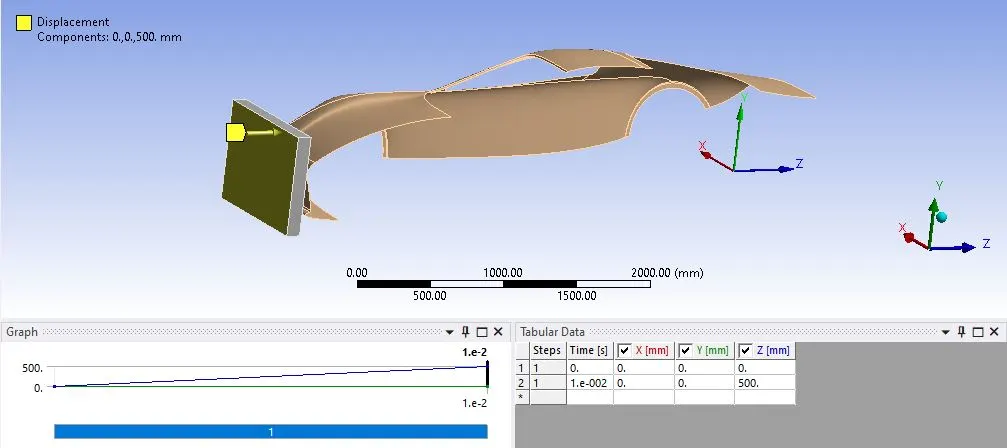
Displacement applied on the wall for the crash simulation
Results for the Car body thickness with 0.1
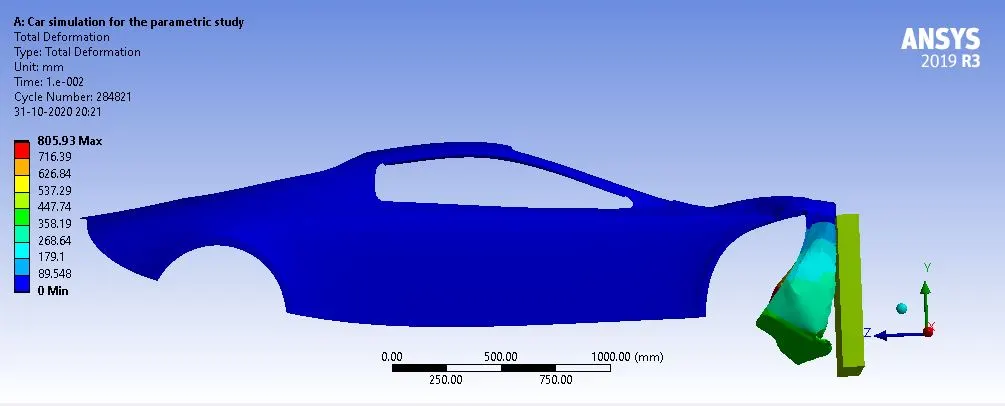
Total deformation on the car body
The maximum and minimum values of the total deformation on the car body are shown below.
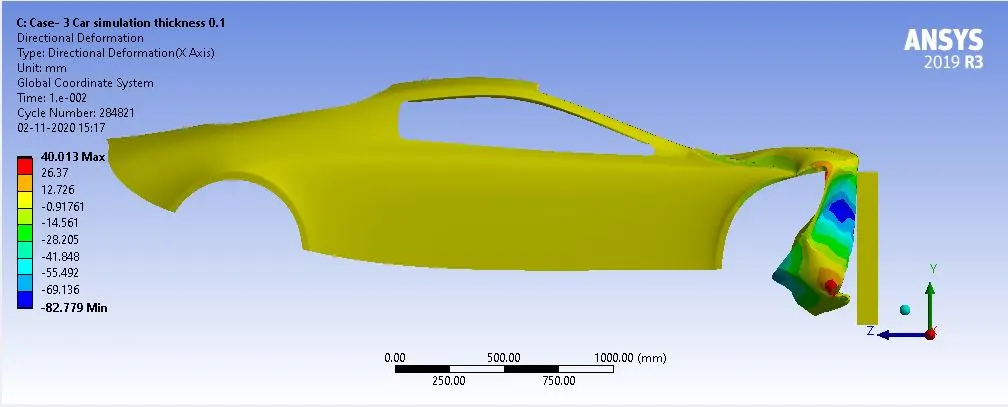
Directional deformation on the car body
The maximum and minimum values of the Directional deformation on the car body are shown below.
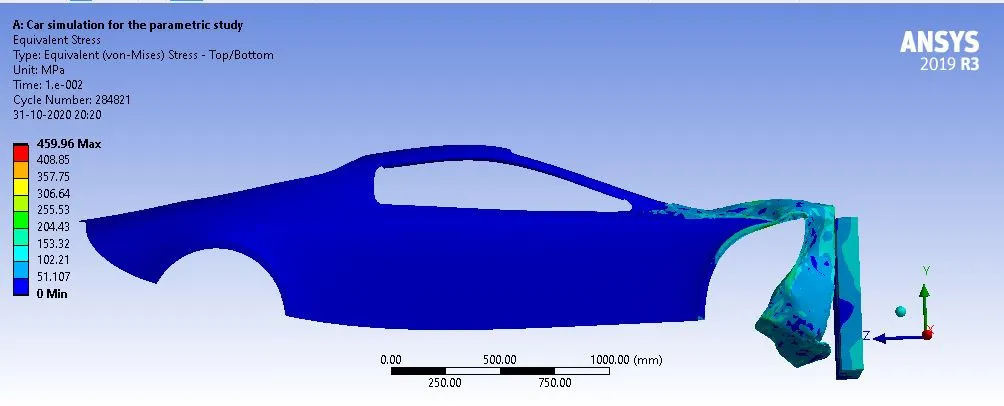
Equivalent stress on the car body
The maximum and minimum values of the Equivalent stress on the car body are shown below.
Results for the Car body thickness with 0.2
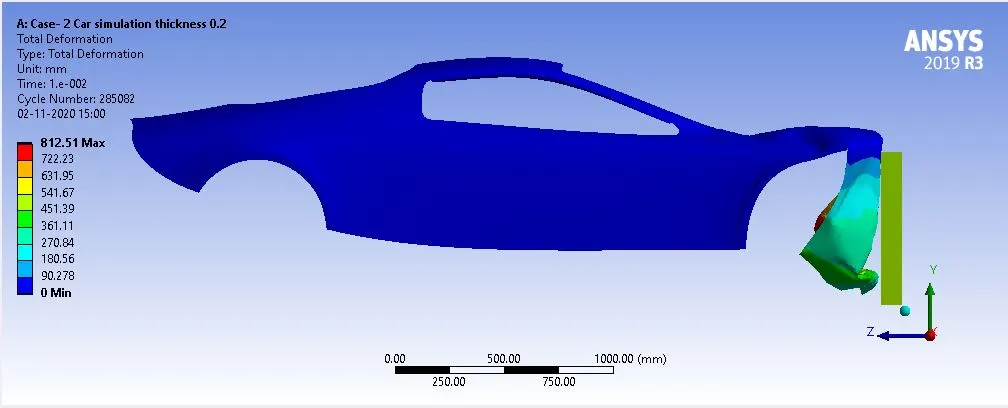
Total deformation on the car body
The maximum and minimum values of the total deformation on the car body are shown below.
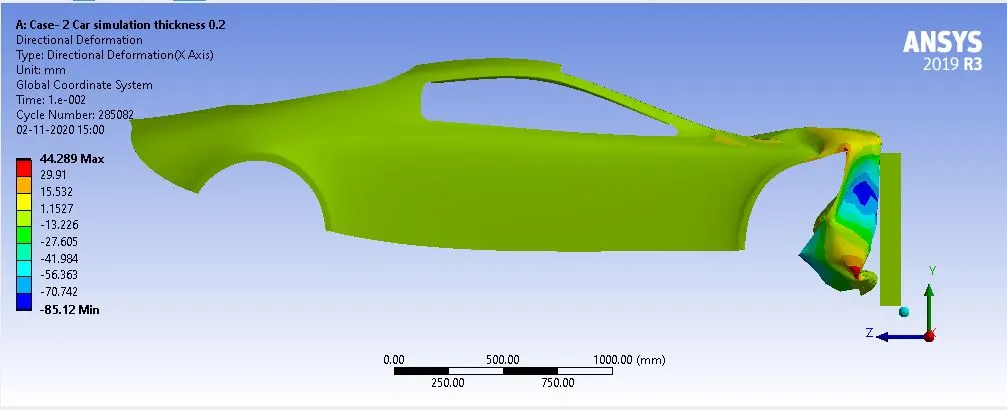
Directional deformation on the car body
The maximum and minimum values of the Directional deformation on the car body are shown below.
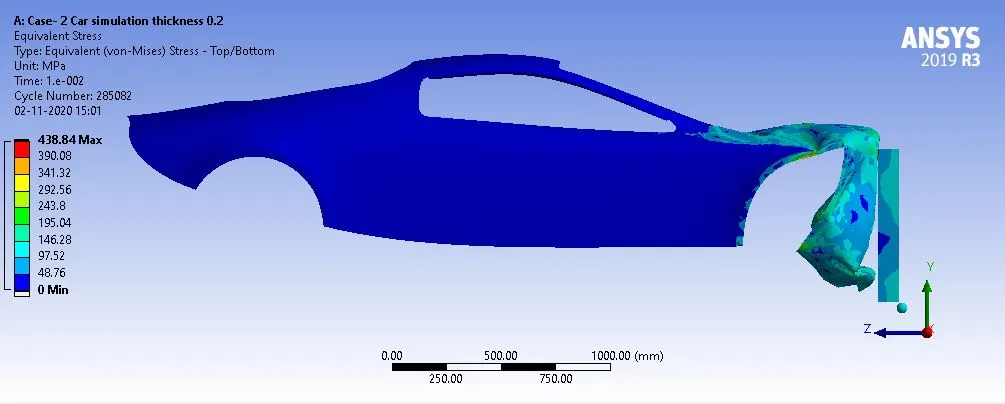
Equivalent stress on the car body
The maximum and minimum values of the Equivalent stress on the car body are shown below.
Result for the Car body thickness with 0.3
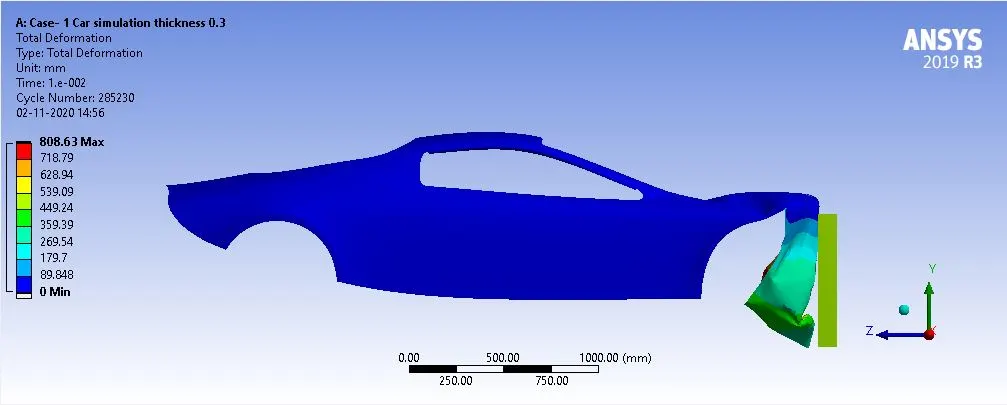
Total deformation on the car body
The maximum and minimum values of the total deformation on the car body are shown below.
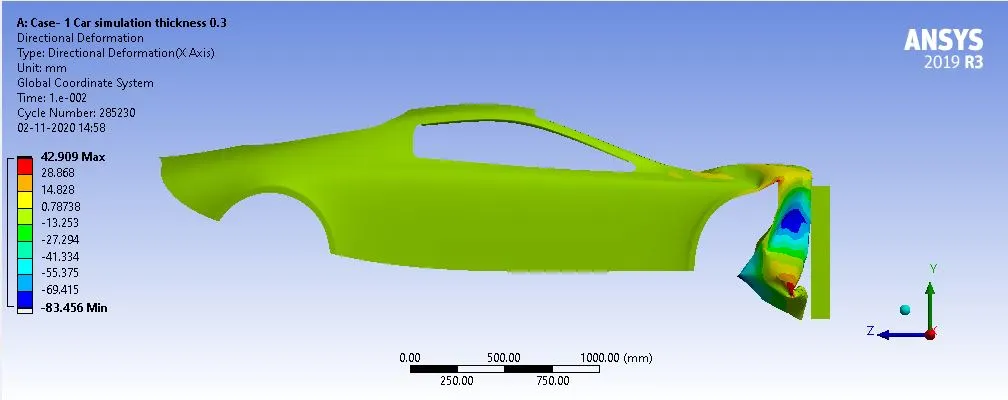
Directional deformation on the car body
The maximum and minimum values of the Directional deformation on the car body are shown below.
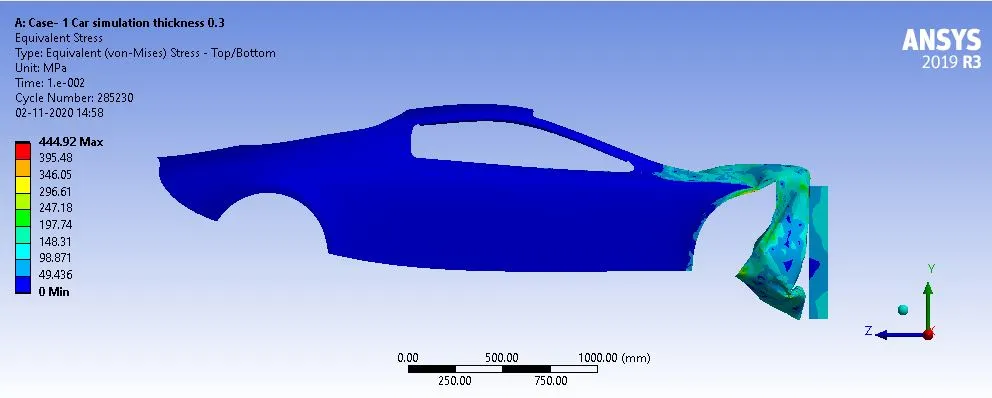
Equivalent stress on the car body
The maximum and minimum values of the Equivalent stress on the car body are shown below.
Conclusion:
Table of Design points:

From the above table, it can be seen that on decreasing the thickness the deformation value goes on decreasing and due to this stress also decreases along with decreasing thickness.
Outline of all Parameters:
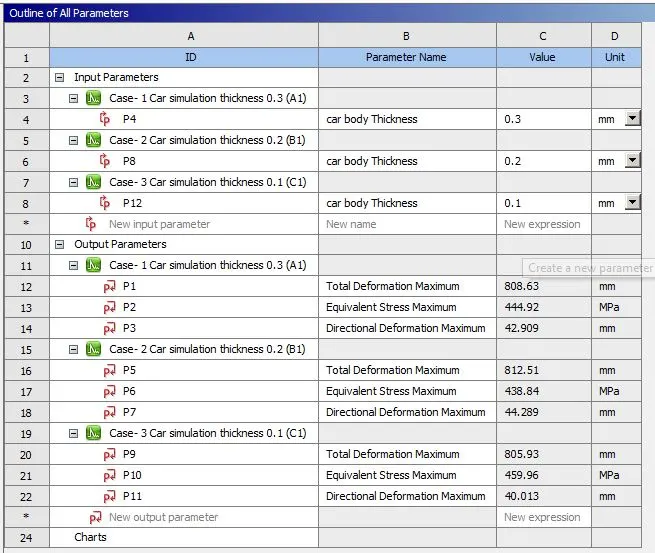
The total parametric studies output data has been shown above in the image. And completed the parametric study successfully