Week - 10 Hyperelastic Material Models
AIM : calculate the Mooney Rivlin and Ogden material constants and compare the both using stress-strain data from a Dogbone specimen tensile test with 100 percent strain.
OBJECTIVE :
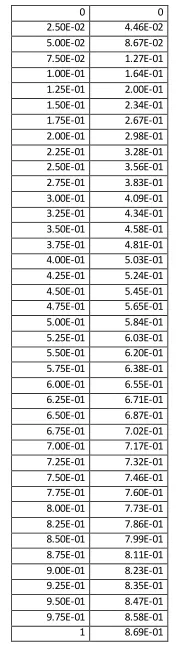
- Extract the engg stress- strain data in MPa/(mm/mm) from the given raw data image and do the cleaning of data.
- Calculate Mooney Rivlin and Ogden material constants and compare between them.
- Validate the constants by using them in the following material card.
THEORY :
- Mooney Rivlin Material : Mooney Rivlin material desfined as
`W = sum C_(ij)(I_1-3)^i(I_2-3)^j`
where Cij are empirically determined material constatnts.
I1 and I2 are the first and second invariants.
W is hydrostatic work term which will be included in strain energy functional. By varying the index values of i and j we can change the constitutive equations and use it approximately for our component. - Ogden Material : this material model is derived from the equation
`W(lambda_1, lambda_2, lambda_3)= sum_(p=1)^n mu_p/ alpha_p(lambda_1^(alphap)+lambda_2^(alphap) +lambda_3^(alphap)-3)`
mu and alpha are ogden constants
PROCEDURE :
- Extract the data from the given raw data image file.
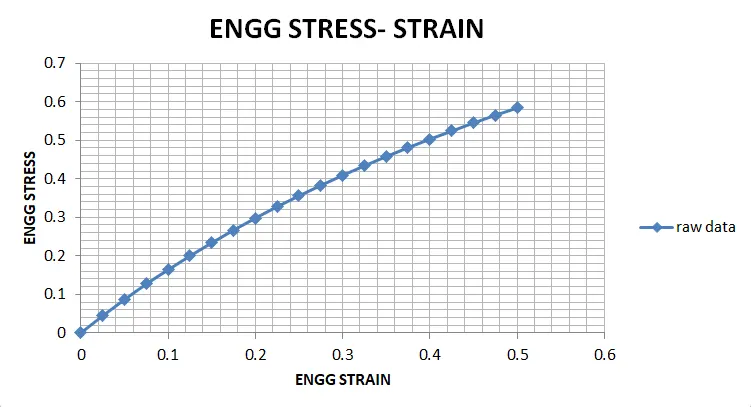
- extracted data plotted of Engg Stress- Strain
- the data we taken is to the point 5.00E-01 engg strain and 5.84E-01.
- Import the Dogbone Specimen into LS-PrePost.
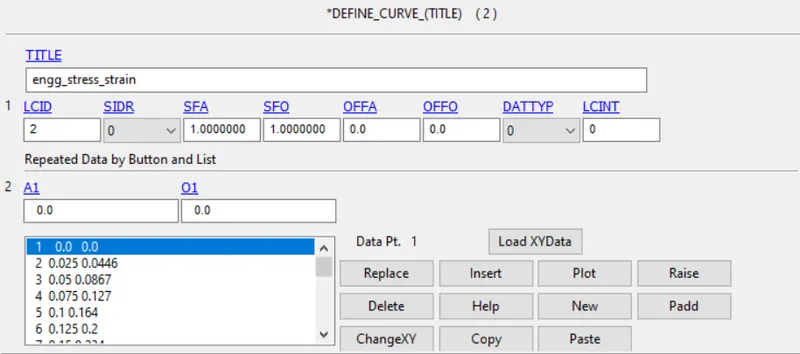
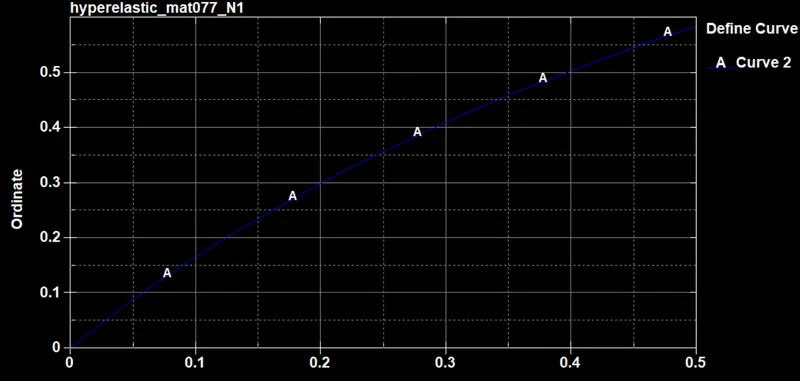
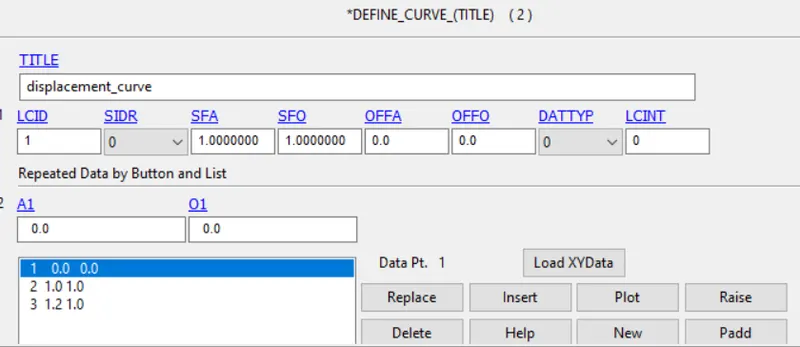
- Define curve of the following Engg stress- strain data by using define curve card.
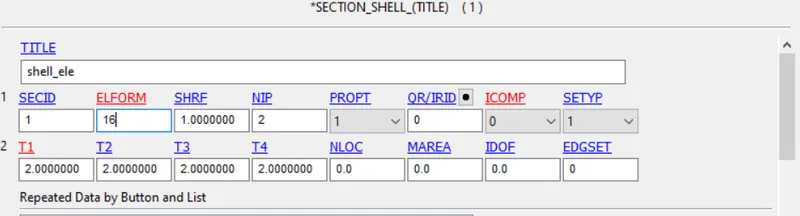
- SECTION_SHELL card is used to define as shell section elements for the dogbone specimen with element formulation 16 and thickness as 2mm
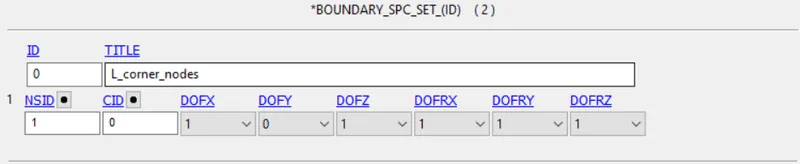
- Boundary Conditon applied using BOUNDARY_SPC_SET and PRESCRIBED_BOUNDARY_MOTION.
- As we doing Tensile test, to fix one end of the specimen we constrain all the DOF except Y- direction for contraction while testing.
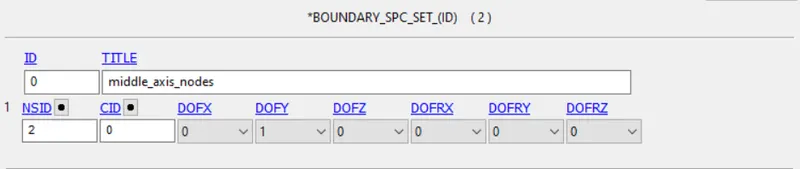
- now, middle nodes in both corner get arrested in Y-direction so that it can maintain its axis for specimen.
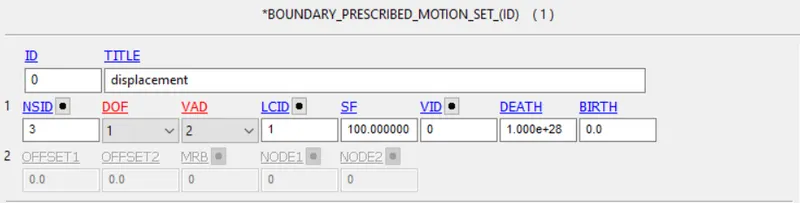
- For the right side edge nodes we apply PRESCRIBED_BOUNDARY_MOTION for displacement in X- direction.
- here the displacement is defined with respect to time using DEFINE_CURVE card.
- CONTROL_IMPLICIT_GENERAL card is used to activate the Implicit Analysis for Tensile Test.

- CONTROL_IMPLICIT_AUTO card is used to adjust the timestep automatically while running test.

- CONTROL_TERMINATION card is used to determine the end time of the simulation as 1ms.

- DATABASE_BINARY_D3PLOT card is used to store the output data of the tensile test with the given interval timestep of 0.01ms.
- DATABASE_EXTENT_BINARY is used to define STRFLG as 1 to store computed data of the elastic strain.
- MATERIAL CARD :
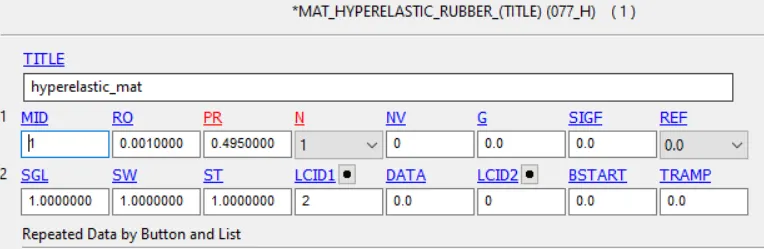
MAT_HYPERELASTIC_RUBBER card used to define the material properties of hyperelastic material for the dogbone specimen elements. - N=1 is set to find the Mooney Rivlin material constants and load the curve data of engg stress strain in LCID.
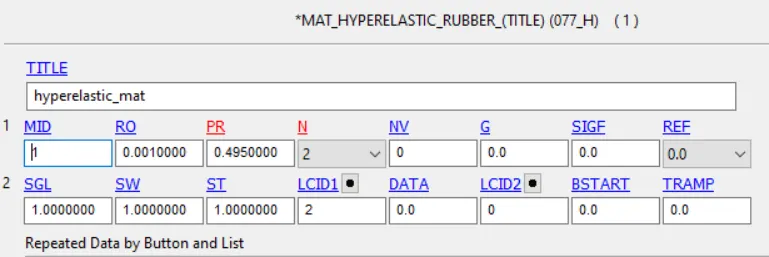
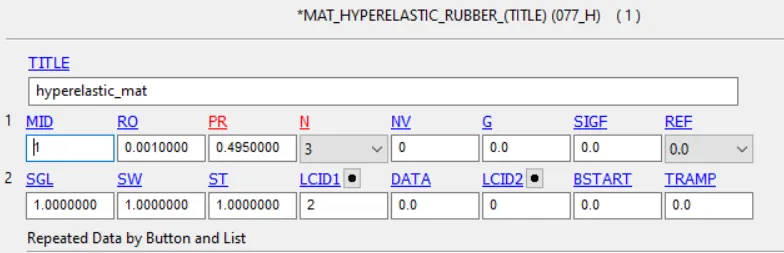
- Similarly we take N= 2 and 3 to get the Mooney Rivlin material constants.
- save the file with using .k extension and run the test.
- After the successfull run of the test the output files are stored in the following assigned location.
- the d3hsp file of the following models opened seperately in Notepad++.
- the value of Mooney constants for N=1 are as
Mooney constant c1 = 0.2082E+00 Mooney constant c2 = 0.1038E+00 - the value of Mooney constants for N=2 are as
Hyperelastic Constant C10= 0.2123E+00 Hyperelastic Constant C01= 0.9508E-01 Hyperelastic Constant C11= -0.5392E+00 Hyperelastic Constant C20= 0.1830E+00 Hyperelastic Constant C02= 0.3996E+00 Hyperelastic Constant C30= 0.0000E+00 - the value of Mooney constants for N=3 are as
Hyperelastic Constant C10= 0.1613E+00 Hyperelastic Constant C01= 0.1478E+00 Hyperelastic Constant C11= -0.3843E+01 Hyperelastic Constant C20= 0.1631E+01 Hyperelastic Constant C02= 0.2346E+01 Hyperelastic Constant C30= -0.7246E-01 - To validate the material model, the value of N in material card is set to ZERO and the value of Mooney Rivlin Constants are assigned.
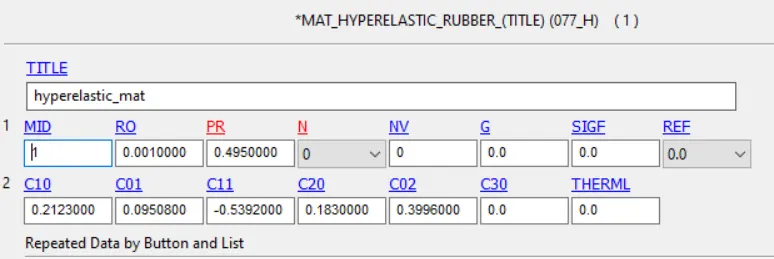
- save the file and run the file for tensile test with same conditions.
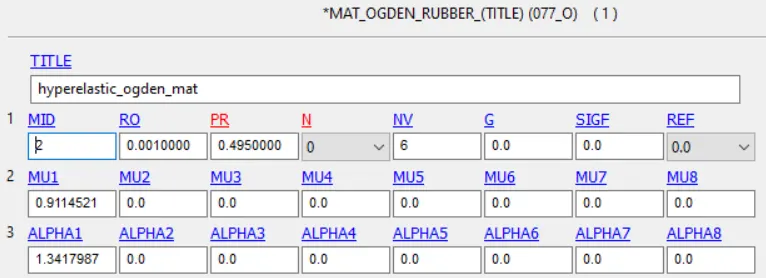
- Similarly we run Tensile test by using OGDEN_RUBBER material card.
- To find OGDEN Material Constants, the value of N is set to be 1,2 and 3 seperately.
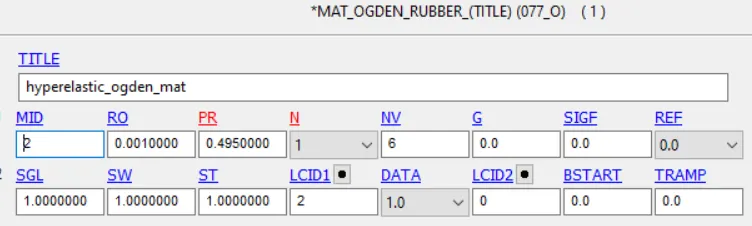
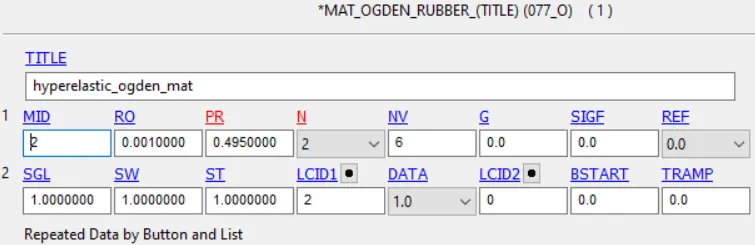
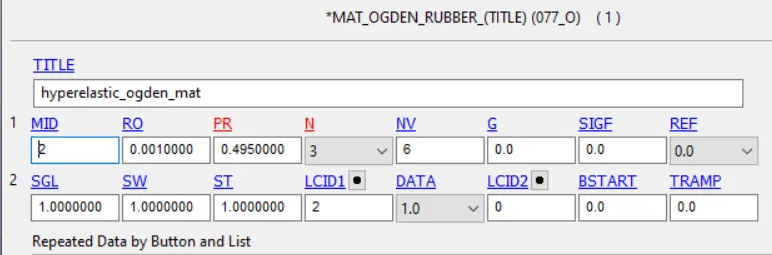
- the output file d3hsp file for ogden rubber material opened in notepad++.
- the values of Ogden constants while N=1
mu(1)= 9.1145211941364E-01 alpha(1)= 1.3417986826832E+00 - the values of Ogden constants while N=2
mu(1)= 1.0154180079001E+00 mu(2)= 1.7140859254594E+00 alpha(1)= 1.2802059946916E+00 alpha(2)=-4.5428513121422E-02 - the values of Ogden constants while N=3
mu(1)= 5.2009287842598E-02 mu(2)= 1.7835344245279E+00 mu(3)= 2.6730832691892E-01 alpha(1)= 2.8616428966198E+00 alpha(2)= 7.5526430881141E-01 alpha(3)=-1.0282035613356E+00 - For Material model validation, the value of N is set to be zero and the Ogden constants are assigned.
RESULTS AND CONCLUSION :
VON-MISES STRESS
- HYPERELASTIC RUBBER (MOONEY RIVLIN) N=1
https://youtu.be/6mIXr1YclBk - OGDEN RUBBER N=1
https://youtu.be/nr3z5ZMJmWs
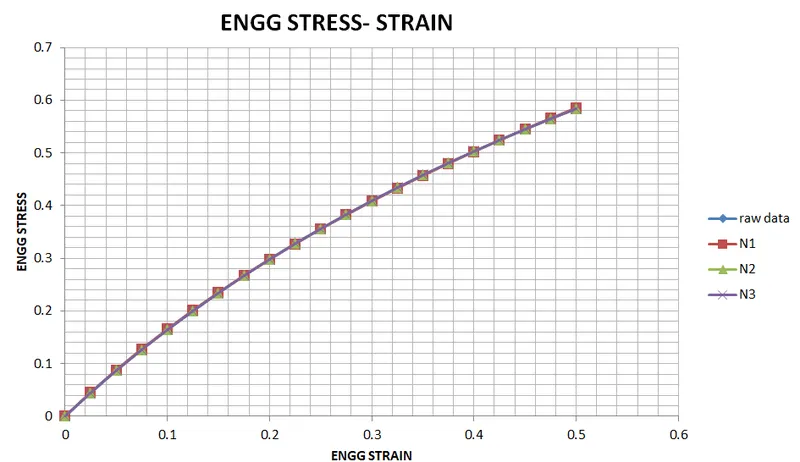
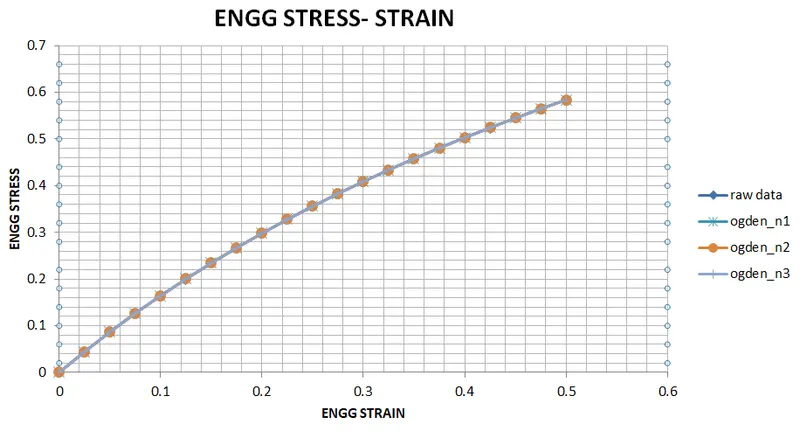
PLOTTING OF EXPERIMENTAL DATA OF CONSTANTS WITH RAW DATA
(1) Mooney-Rivlin material
(2) Ogden Material
CONCLUSION :
- From above data you can see the comparision between Mooney Rivlin and Ogden material constants output Engg stress- strain for N=1.we learned to verify and validate material model of hyper elastic material card.
- the stress-strain data extracted from the d3hsp file is converted into Engg stress- strain and compare with given raw data.
- the results from both the simulation of tensile test showed a slight deviation in decimal values.
- Result shows both the hyperelastic material cards are valid for the use to describe the hyperelastic behaviour.