Week - 10 Hyperelastic Material Models
OBJECTIVE:
- To calculate the Mooney Rivlin and Ogden material constants and compare the both using stress-strain data from a dogbone specimen tensile test with 100 percent strain.
- The given material data is the engineering stress-strain in MPa/(mm/mm).
- The comparison should be shown from the d3hsp file and using simulation.
Note:
The unit system used is g-mm-ms, N, MPa, N-mm.
PROCEDURE:
Analysis setup for Material model verification:
- Experimental Data:
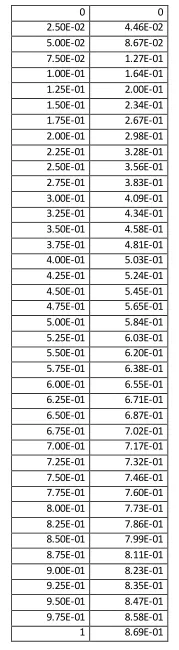
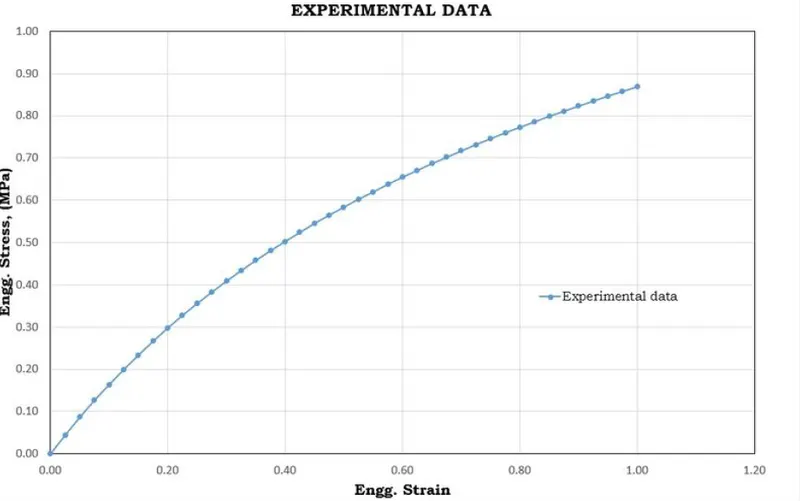
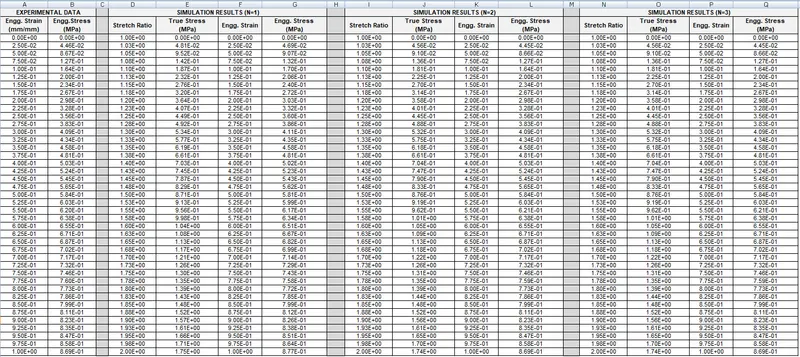
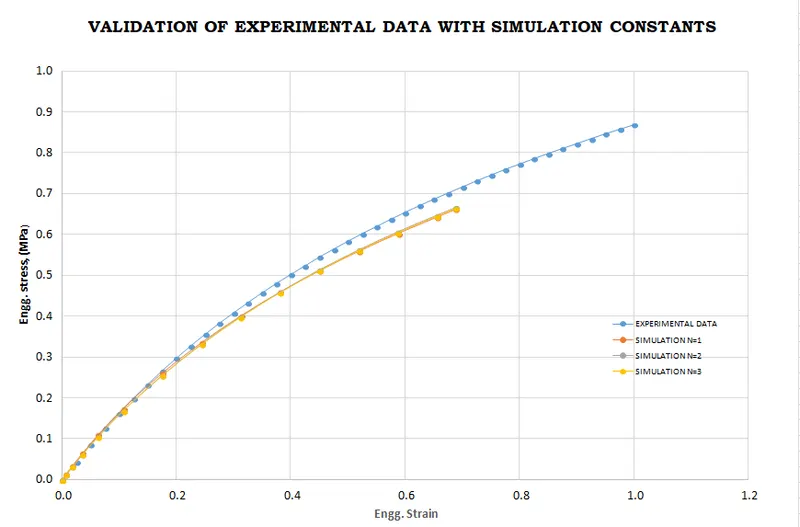
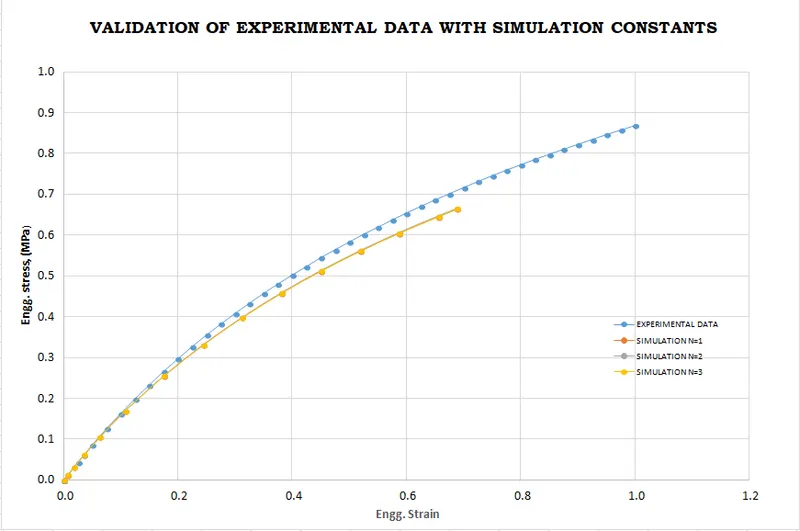
The given data of Engg. stress and strain of hyperelastic material are plotted in excel is as shown above.
- Hyperelastic Material Model: Theory
Rubber is generally considered to be fully incompressible since the bulk modulus greatly exceeds the shear modulus in magnitude. To model the rubber as an unconstrained material a hydrostatic work term, 𝑊𝐻(𝐽), is included in the strain energy functional which is a function of the relative volume, 𝐽,
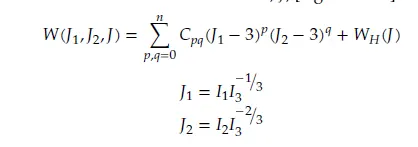
i) The Mooney-Rivlin rubber model is obtained by specifying 𝑛 = 1,2,3
if n=1`W=C_10(I_1-3)+C_01(I2-3)` where `C_10` and `C_01` are Mooney-Rivlin constants. MAT_77_H material card is used to find these constants and obtain a curve matching with experimental data.
similarly if n=2 or 3 , we Mooney-Rivlin get constants C01,C10,C11,C20,C02,C30
ii) The Ogden rubber model.
Similarly, Ogden constants are found using the MAT_77_0 model and using n=1/2/3 and choose the best fit one.
- Model and boundary condition :
A dogbone tensile test specimen as shown below is used for analysis.
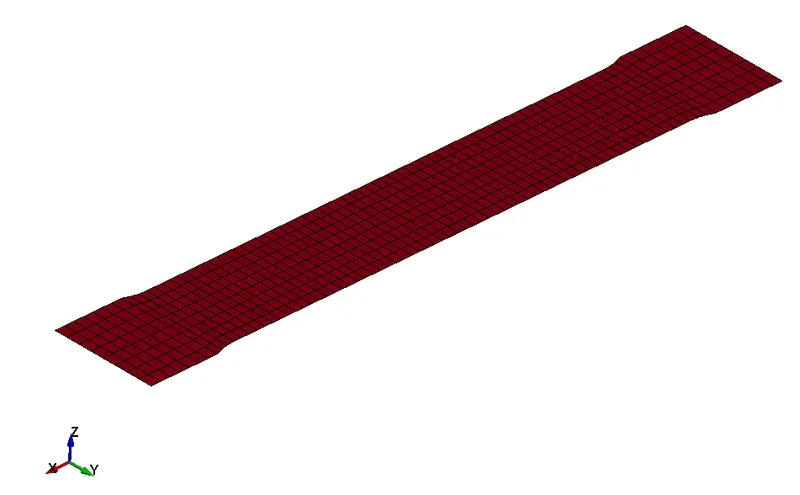
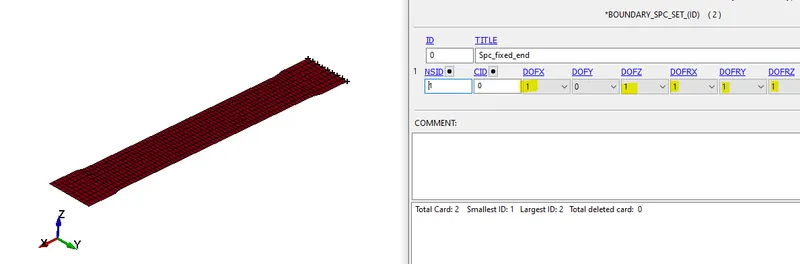
boundary conditions:
a.all node in on end is fixed in all of except UY
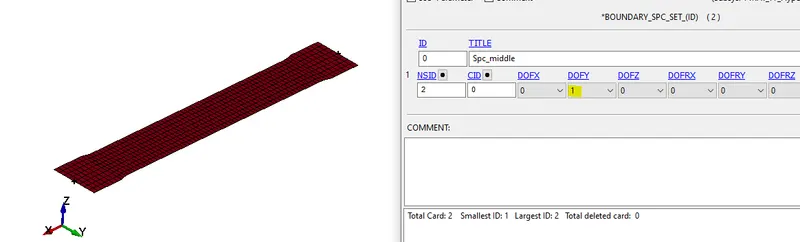
b.Middle node on each side is fixed in Uy
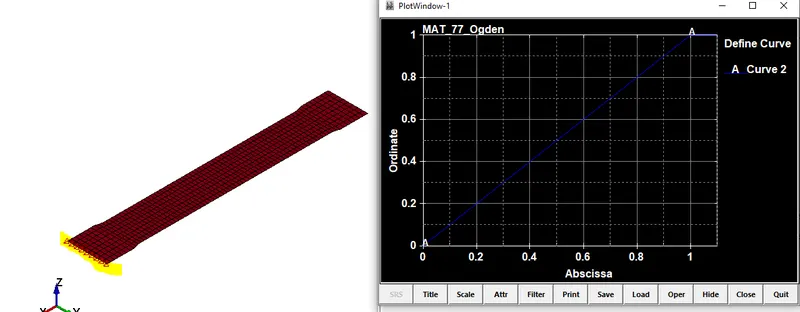
c.displacement load
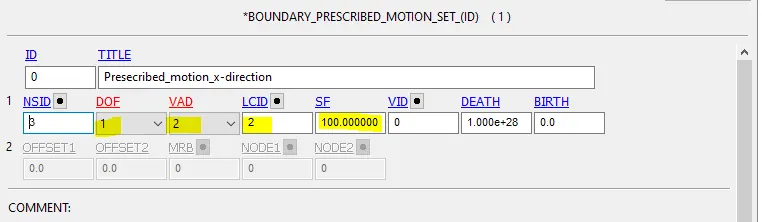
scale factor f100 is used in *prescribed_motion_set
4.Analysis setup:
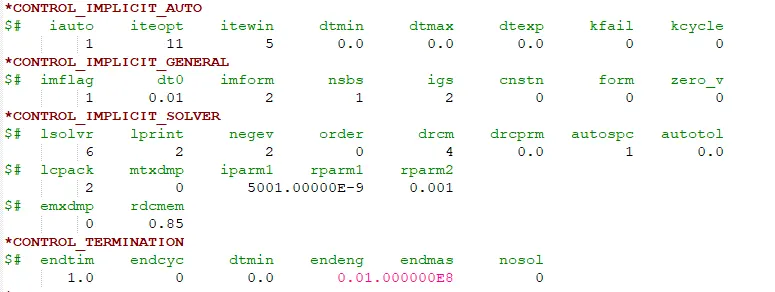
the implicit analysis is used with the following settings
5.database:
database d3plot with an interval of 0.01ms and extent binary with strflg =1 is used to get strain tensor data.

---------------------------------------------------------------------------------------------------------------------------------------------------------------------------------------------------------------------
6.GET Mooney and Ogden constants.
a. for Mooney Rivlin model:
set the value of N in *mat to 1 then run the analysis and we can kill it after the simulation is started Because these constants are calculated before the solver solves the model.
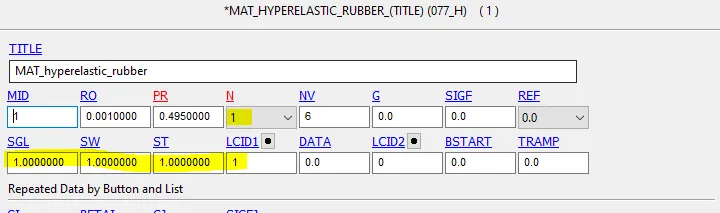
open the d3hsp file and search for load curve fit values as shown.
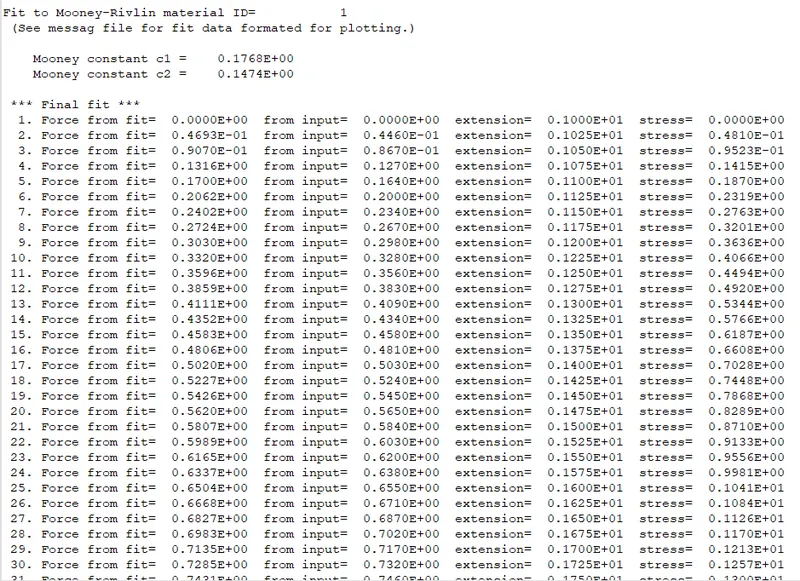
Mooney constants are extracted to use for further analysis. similarly constants for N=2, N=3 are calculated and tabulated.
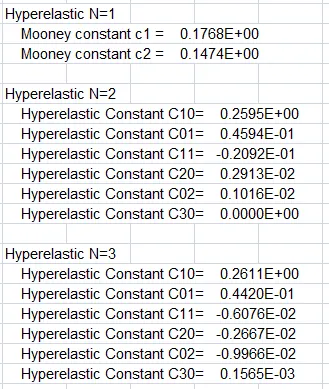
extension and stress values to visualize the curved. similarly constants for N=2, N=3 are calculated and tabulated.
b. for Ogden model:
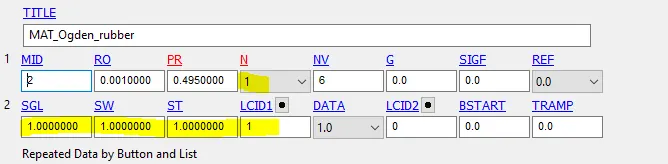
similar to the Mooney model, set the value of N in *mat to 1 then run the analysis and we can kill it after the simulation is started Because these constants are calculated before the solver solves the model.
open the d3hsp file and search for load curve fit values as shown
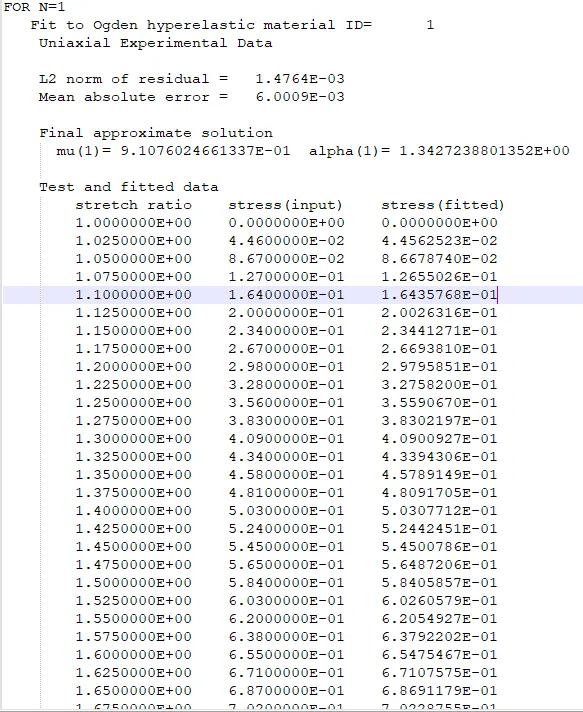
mu, alpha constants are extracted to use for further analysis. similarly constants for N=2, N=3 are calculated and tabulated.
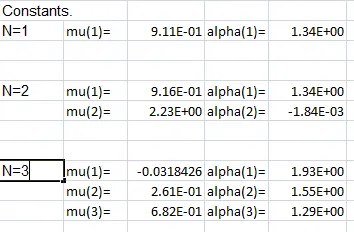
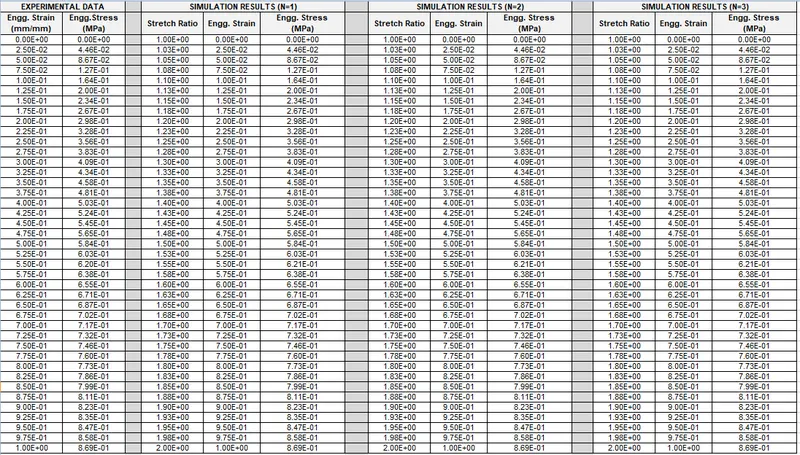
stretch ratio and stress(fitted) values to visualize the curved. similarly constants for N=2,N=3 are calculated and tabulated.
Ogden:
---------------------------------------------------------------------------------------------------------------------------------------------------------------------------------------------------------------------
7. Validation by extracting stress and strain results for an element in the tensile test specimen.
a.Mooney model:
set the value of N=0, and enter Mooney constants extracted for N=1,2,3 in three different analysis models.
below is an example of a material model with constants calculated from N=3.
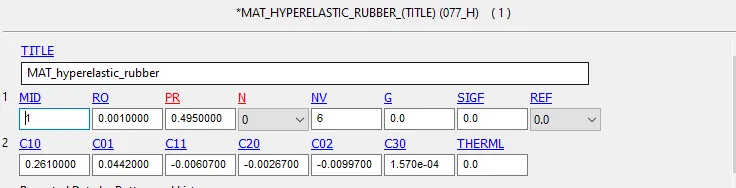
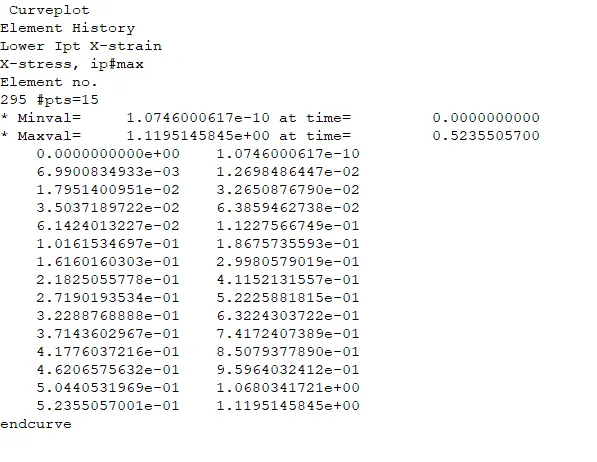
plot the x-strain and x-stress for element no 295.
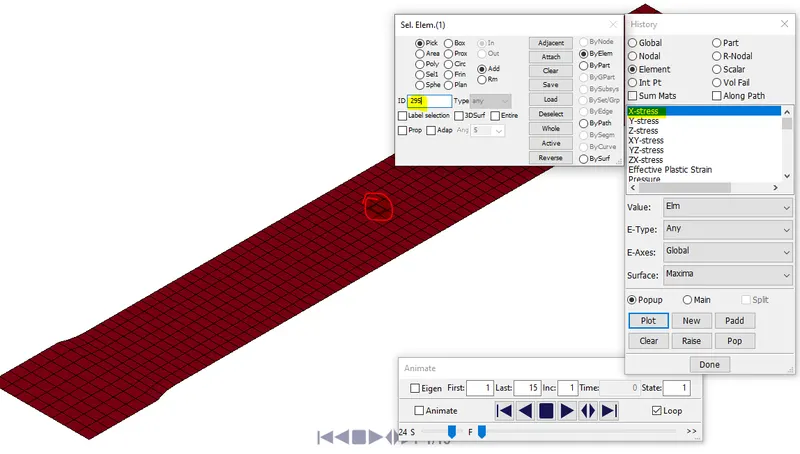
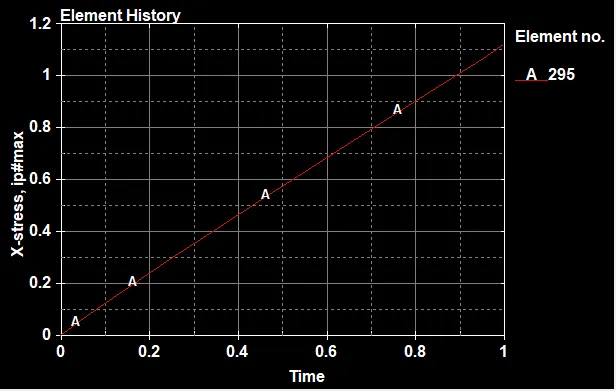
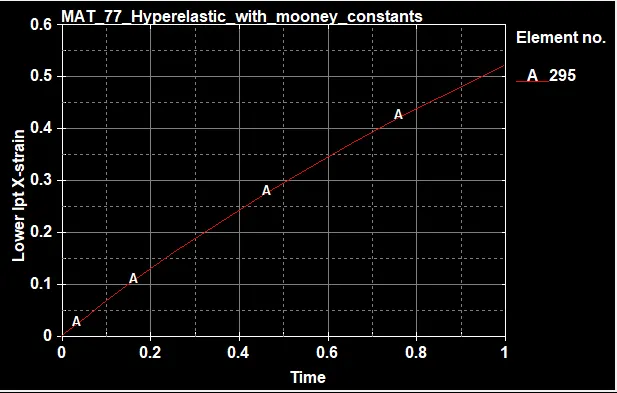
save the results in separate files.
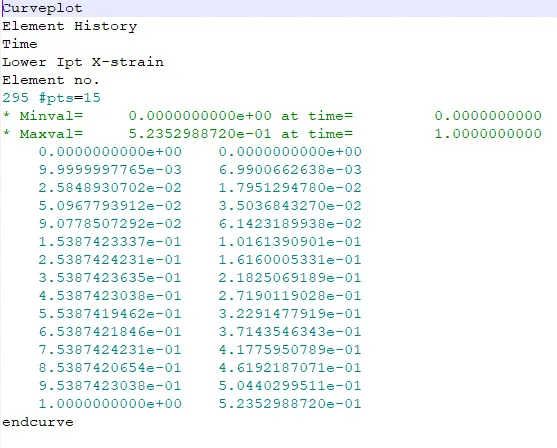
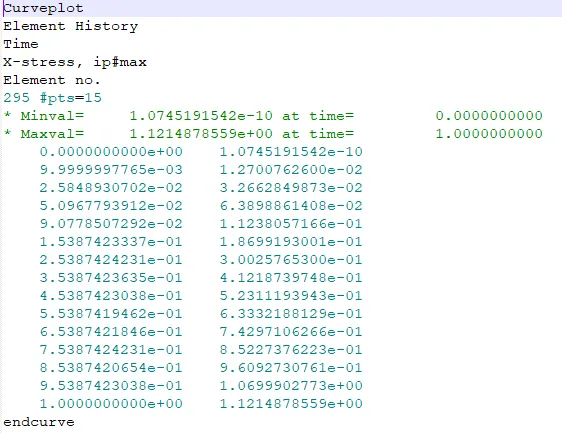
use XY plot to plat strain vs stress.
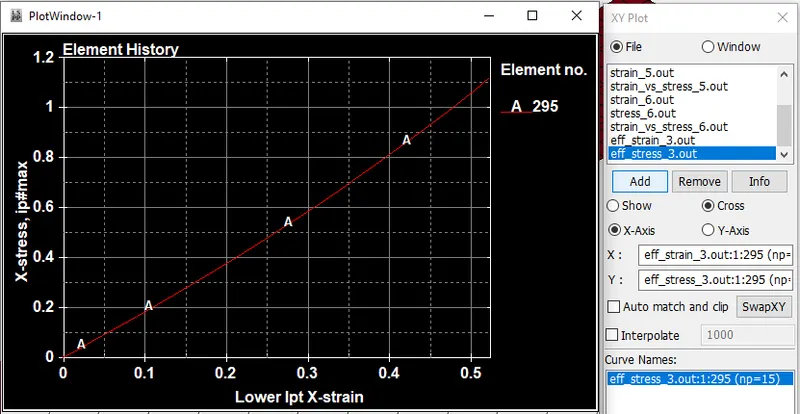
save the stress and strain results for element no.295 for each case.
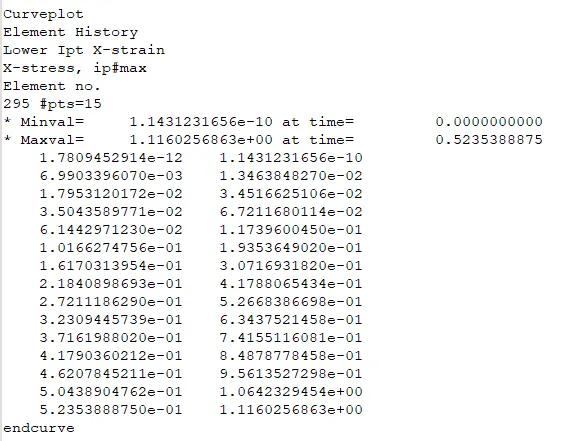
these values are true stress and true strain, which is then converted o engineering stress and strain.
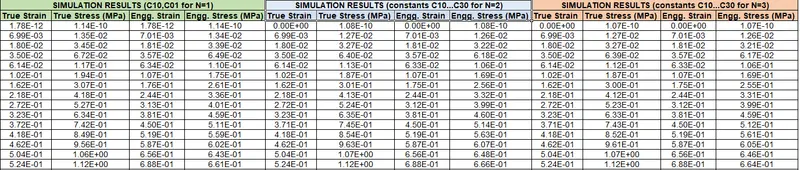
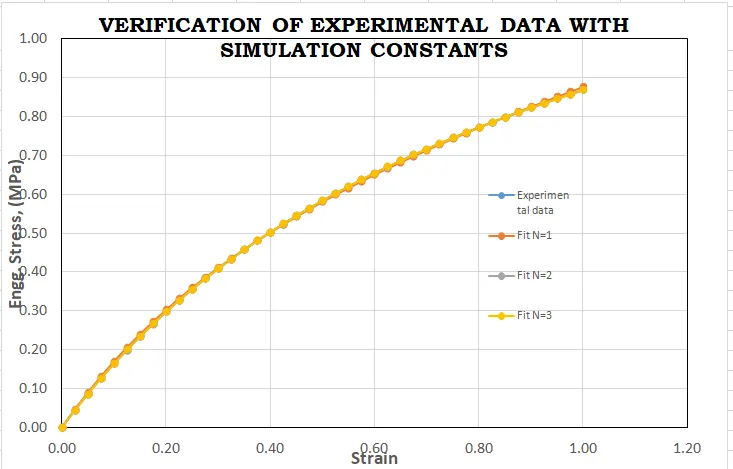
then results are compared with experimental data.
similarly, results are extracted and compared for the Ogden model.
b.Ogden model
set the value of N=0, and enter Mooney constants extracted for N=1,2,3 in three different analysis models.
below is an example of a material model with constants calculated from N=3.
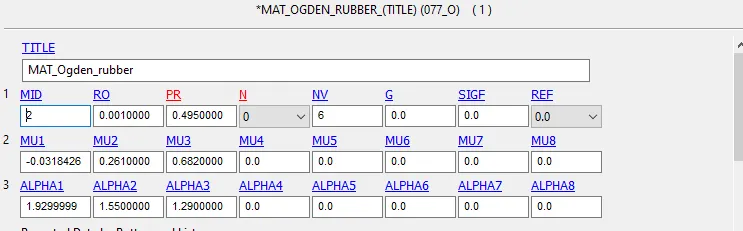
stress and strain results for element no.295 are extracted for each case.
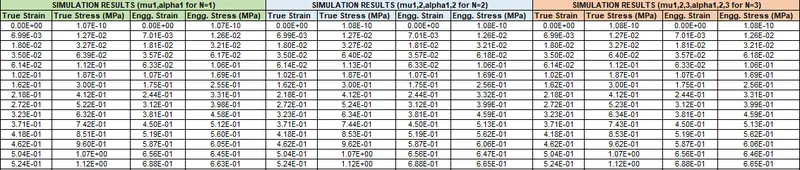
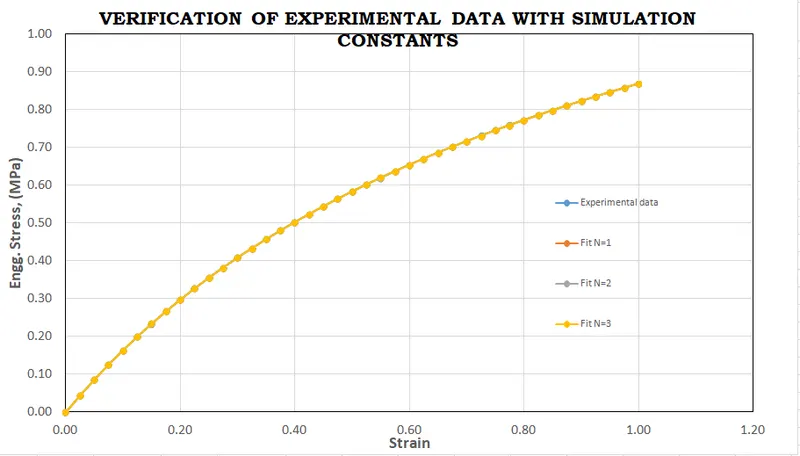
then results are compared with experimental data.
ogden:
Inference:
From the graphs, both material models are similar to the given material data. The Ogden material model has polynomials ranging from 1 to 8 and can better adjust to experimental data.
Conclusion:
1.The Mooney-Rivlin and Ogden material constants are obtained from the d3hsp file by inputting the value of polynomial N=1 in the material card MAT_77_H and MAT_77_O
2.The stretch stress curve data obtained from d3hsp for both hyperelastic constitutive models were verified with
experimental material data and found to be a close fit.
3. The simulation results of the tensile test for both material models with experimental data showed a slight deviation due to
high non-linear behavior of the given hyperelastic material and the Poisson’s ratio.
4. From the simulation results, both hyperelastic constitutive material models were found to be valid to describe the
the behavior of the given material data.