Week 10 Bullet penetrating a Bucket Challenge

Introduction:
Most penetration analysis and armor design in the past have dealt with cartridges that have military-style steel jacketed and armor-piercing bullets. Body armor studies have typically focused on handgun ammunition.
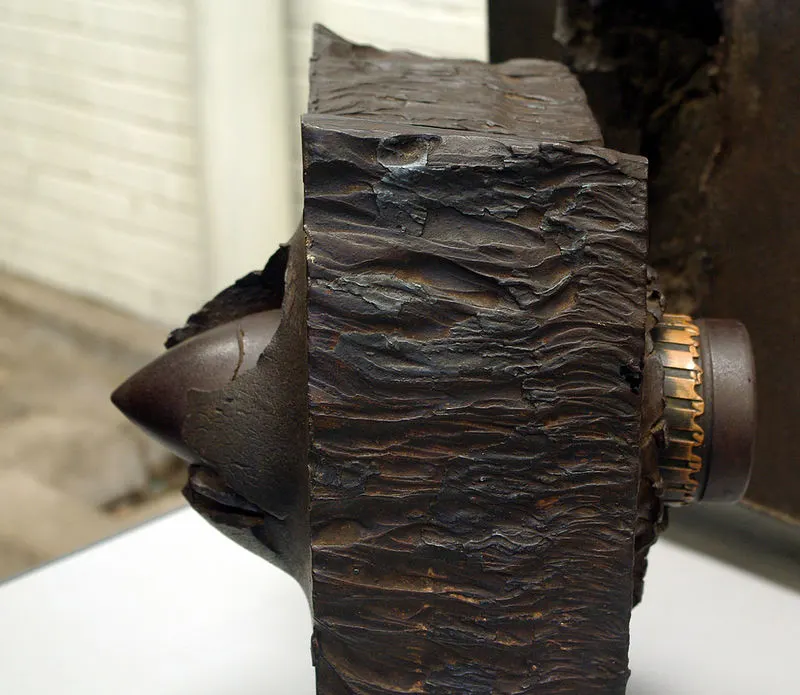
These types of analyses are usually carried to develop the material which can resist the bullet up to some extent. So, the material can be used as a bullet-proof. Thus by comparing the behavior of different material on penetration of the bullet, we can find or develop a bullet-proof material.
_____________________________________________________________________________________________________________________
Analysis:
Here we will perform the analysis of bullet penetration on a bucket with different Non-Linear material of bucket.
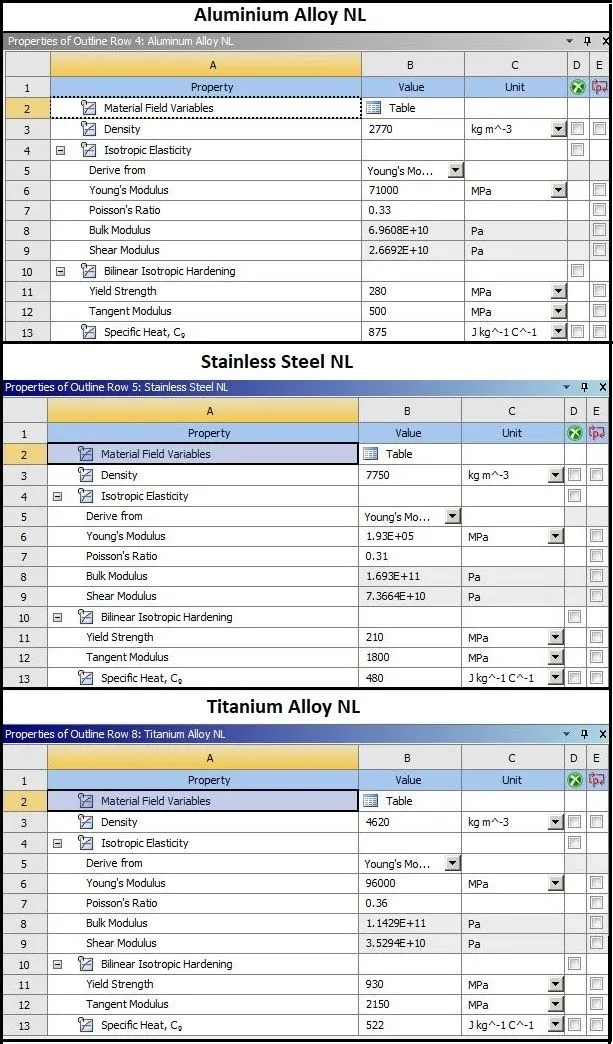
There are three different cases as per different Non-Linear material of Bucket as given below:
CASE_1: Aluminium Alloy NL
CASE_2: Stainless Steel NL
CASE_3: Titanium Alloy NL
_____________________________________________________________________________________________________________________
Geometry:
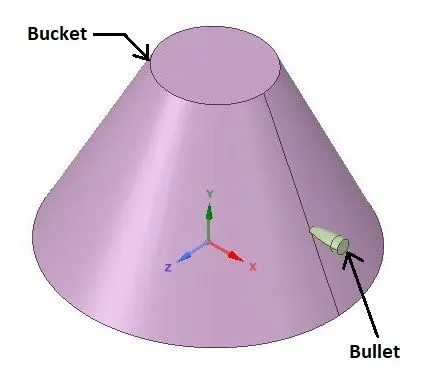
- Here we can see a Thin Bucket and a small Bullet in above image.
_____________________________________________________________________________________________________________________
Material Specifications:
_________________________________________________________________________________________________________
Mesh:
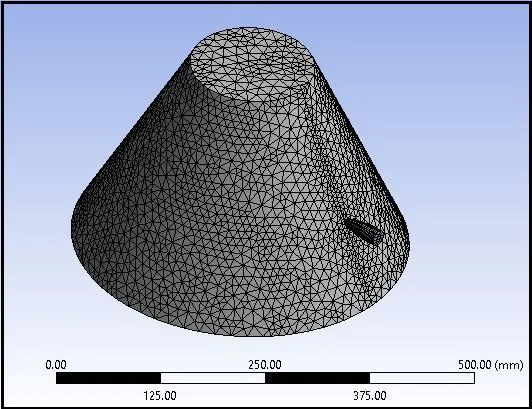
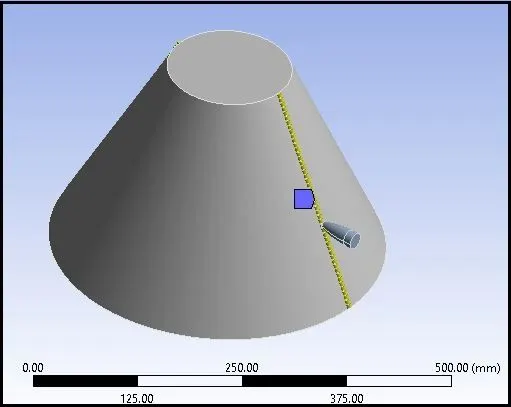
Mesh Details:
Meshing parameters for Tension as well as Torsion test are as given below:
- Edge Sizing: 2 Spited Edges
- Element Size: 6 mm
- Statistics:
No.of Nodes: 5214
No.of Elements: 13601
_________________________________________________________________________________________________________
Procedure:
- Import model in Explicit Dynamics in Geometry section.
- Then go to Mechanical model section.
- Check or Rename the Part of the setup as “Bucket” & “Bullet” as shown in above geometry image.
Boundary Conditions:
- After meshing as described above, create Boundary Conditions as given below:
Analysis Settings:
- No.of Steps: 1
- End Time: 0.01 s
- Maximum Number of Cycles:1e+07
- Maximum Energy Error: 5
- Initial Time Step: Program Controlled
- Minimum Time Step: Program Controlled
- Maximum Time Step: Program Controlled
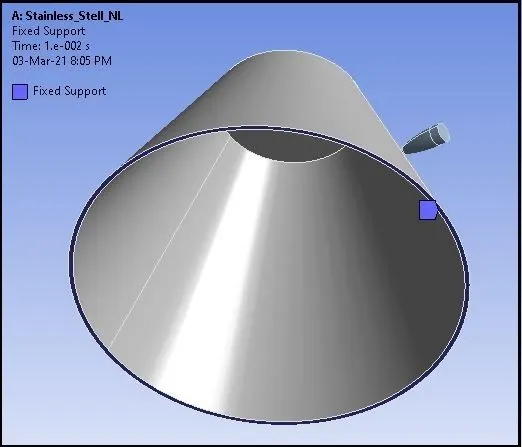
Fix Support (For CASE_1, 2,& 3):
- Keep bottom face of the Bucket as a fixed to hold it while the bullet is penetrating.
Velocity (For CASE_1, 2,& 3):
- Apply velocity to Bullet in the negative X-Direction as given below:
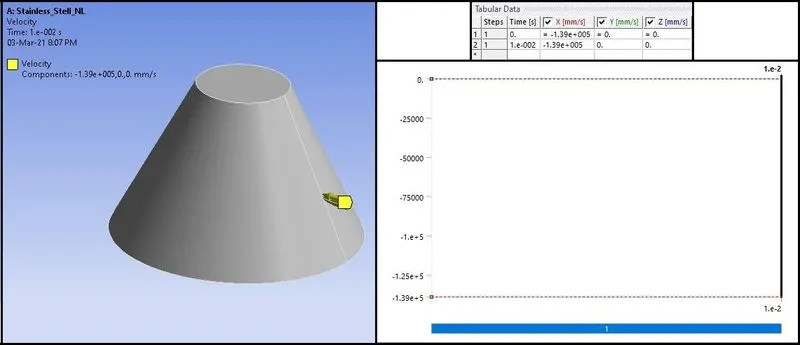
- Here the velocity of the Bullet is 139000 mm/s.
Solution:
- After giving proper boundary conditions, create desired solutions for output results.
- Create Solutions for :
- Total Deformation
- Equivalent Stress
_________________________________________________________________________________________________________
Results:
Now we will see all the results for CASE_1, CASE_2 & CASE_3.
CASE_1 (Aluminium Alloy NL)
Stress Contours:
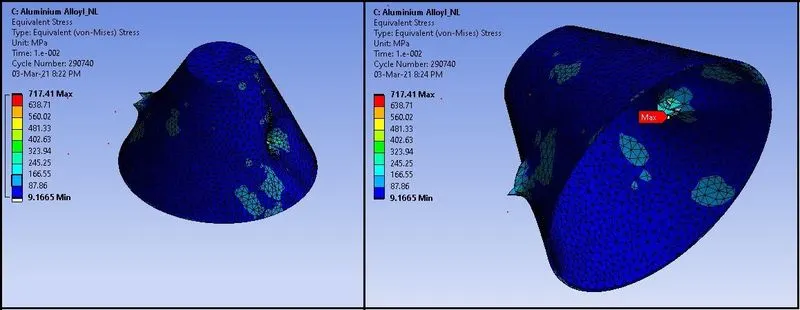
Stress Plot & Data:
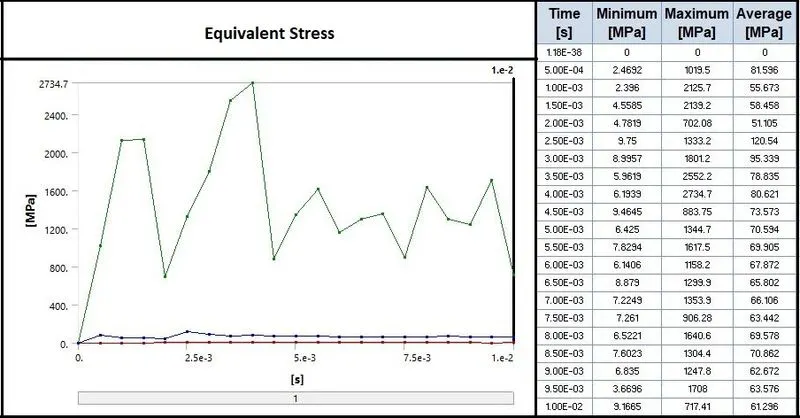
- Here maximum stress is 717.41 Mpa.
- At 1e-3 s, when the bullet starts to penetrate, we can see some spikes in plot.
- Maximum stress is generating when the bullet impacts on the bucket.
- When bullet enters the bucket, stress is 2125 Mpa at 1e-3 s.
- When bullet exits the bucket, stress is maximum up to 2734 Mpa at 4e-3 s.
Total Deformation Contours:
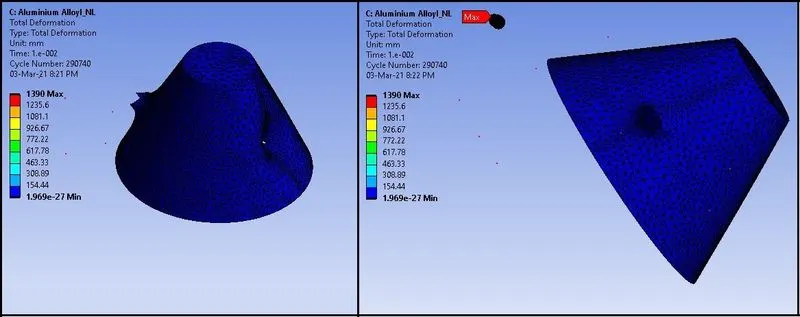
Total Deformation Plot & Data:
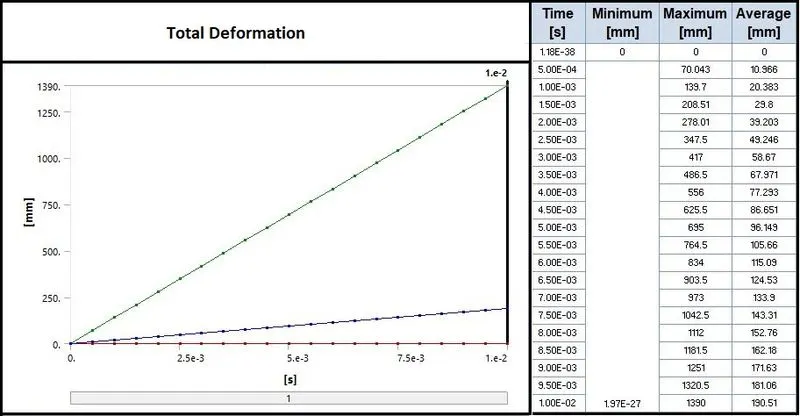
- Here the deformation is the distance traveled by the bullet, which is maximum 1390 mm.
_ _ _ _ _ _ _ _ _ _ _ _ _ _ _ _ _ _ _ _ _ _ _ _ _ _ _ _ _ _ _ _ _ _ _ _ _ _ _ _ ___ _ _ _ _ _ _ _ _ _ _ _ _ _ _ _ _ _ _ _ _ _ _ _ _ _ _ _ _ _ _ _ _ _
CASE_2 (Stainless Steel NL)
Stress Contours:
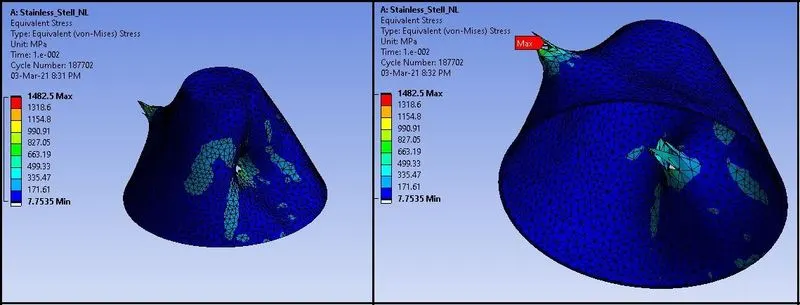
Stress Plot & Data:
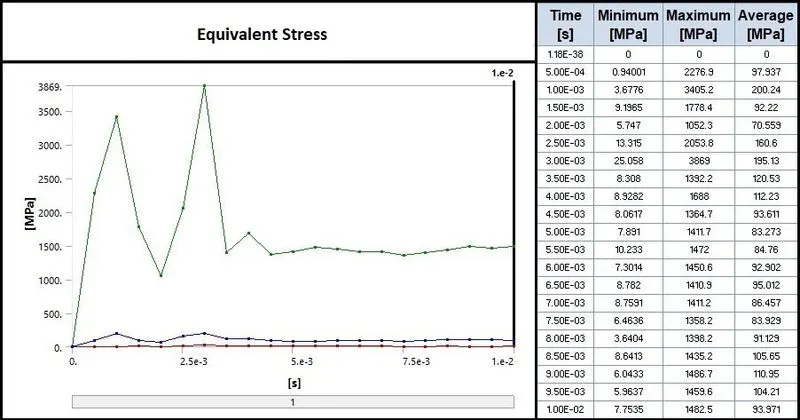
- Here maximum stress is 1482.5 Mpa.
- At 1e-3 s, when the bullet starts to penetrate, we can see some spikes in plot.
- Maximum stress is generating when the bullet impacts on the bucket.
- When bullet enters the bucket, stress is 3405 Mpa at 1e-3 s.
- When bullet exits the bucket, stress is maximum up to 3869 Mpa at 3e-3 s.
Total Deformation Contours:
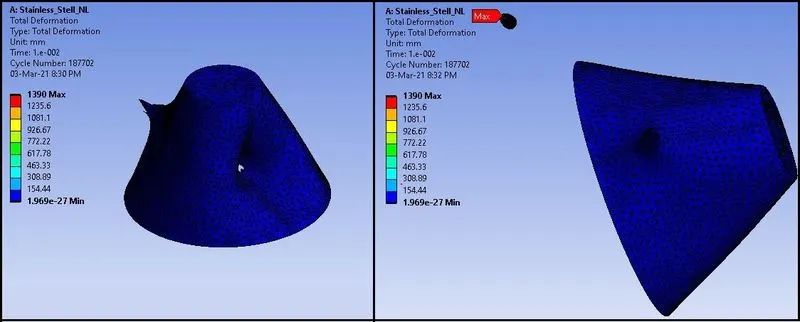
Total Deformation Plot & Data:
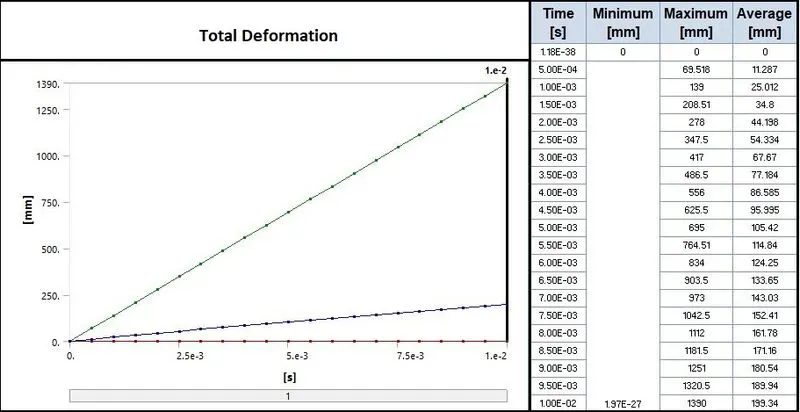
- Here the deformation is the distance traveled by the bullet, which is maximum 1390 mm.
_ _ _ _ _ _ _ _ _ _ _ _ _ _ _ _ _ _ _ _ _ _ _ _ _ _ _ _ _ _ _ _ _ _ _ _ _ _ _ _ ___ _ _ _ _ _ _ _ _ _ _ _ _ _ _ _ _ _ _ _ _ _ _ _ _ _ _ _ _ _ _ _ _ _
CASE_3 (Titanium Alloy NL)
Stress Contours:
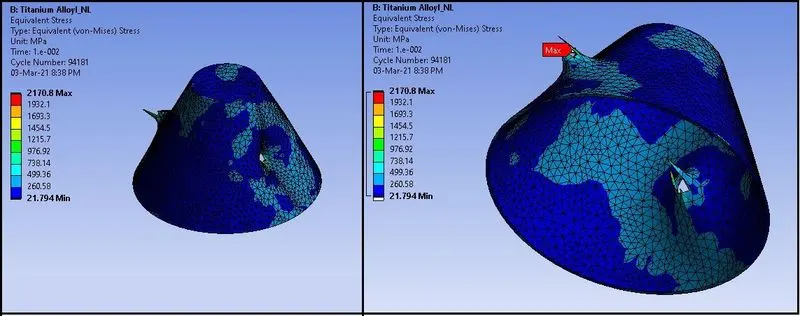
Stress Plot & Data:
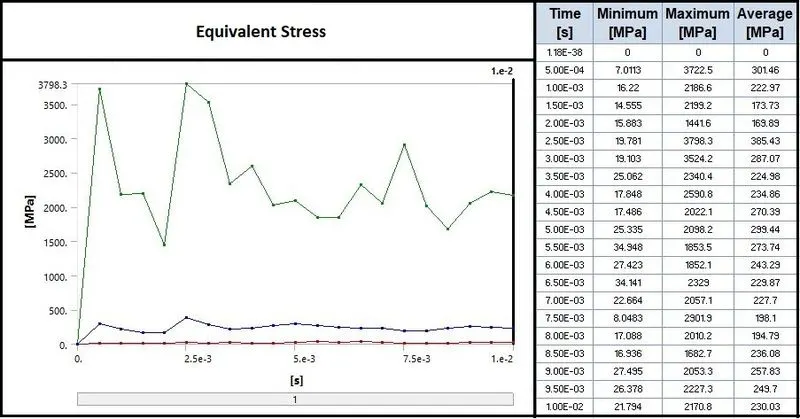
- Here maximum stress is 2170.8 Mpa.
- At 5e-4 s, when the bullet starts to penetrate, we can see some spikes in plot.
- Maximum stress is generating when the bullet impacts on the bucket.
- When bullet enters the bucket, stress is 3722.5 Mpa at 5e-4 s.
- When bullet exits the bucket, stress is maximum up to 3798 Mpa at 2.5e-3 s.
Total Deformation Contours:
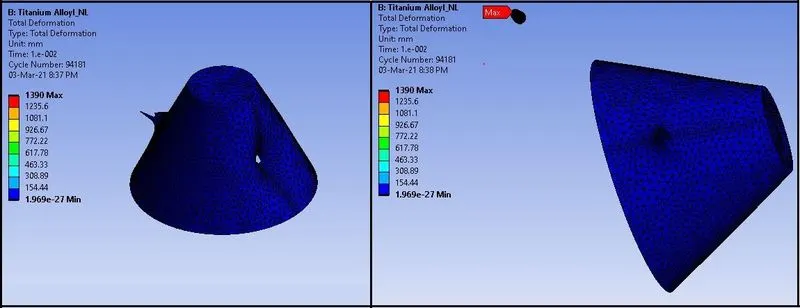
Total Deformation Plot & Data:
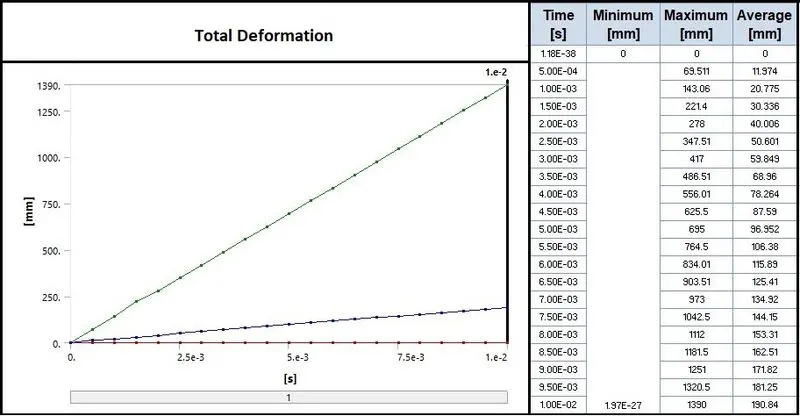
- Here the deformation is the distance traveled by the bullet, which is maximum 1390 mm.
_________________________________________________________________________________________________________
Comparison:

- By comparing the stress results, we can see that Aluminium Alloy NL gives the minimum stress on bullet penetration in CASE_1.
- In CASE_2 Stainless Steel NL, stress is little higher compared to Aluminium Alloy NL.
- In CASE_3, with Titanium Alloy NL, stress generation is maximum.
- It means, Bullet cannot penetrate very easily to Titanium Alloy.
_________________________________________________________________________________________________________
Conclusion:
- From the results, we can conclude that Titanium Alloy has the highest strength and higher young’s modulus, so the stress is also getting higher. So it is capable to resist penetration.
- On the real time testing of the different material, we can also see the deviation of the bullet on penetration and in some cases, it may trap or captured by the material also.
- Generally the materials like Kevlar are use as bullet proofing, which resist the bullet easily and also light in weight.
- Main objective of these type of analyses is to find the material for damage reduction and deviation.
- Damage reduction reduces the damage a bullet does per inch of the material it passes through.
- Deviation determines how much the bullet changes the direction per inch of the material it passes through.
- Effect of penetration depends on the thickness and the density of the material.
- In our case, for Titanium Alloy, we can observe the stretching of the material on penetration due to its flexibility.
- So, high strength and density also decrease the penetration with increase in stress.
- In Titanium Alloy NL case, stress is the higher, which means the plastic deformation of the material is large. So the resistance to the penetration will also be higher.
- So, due to high strength and high density, it gives less penetration gives the less damage.
_________________________________________________________________________________________________________
References:
- Terminal ballistics - Wikipedia
- Ballistic reliability study on SiC/UHMWPE composite armor against armor-piercing bullet - ScienceDirect
- httpwww_bg_utp_edu_plartkones42012j20o20kones20201220no20420vol_201920zaleska-fornal.pdf
- Influence of thickness and projectile shape on penetration resistance of the compliant composite - ScienceDirect
- Determination of penetration depth at high velocity impact using finite element method and artificial neural network tools - ScienceDirect
- Bullet Penetration in iron and steel plate (pakguns.com)
- dvi (metu.edu.tr)
- (24) (PDF) Bullet penetration into wooden targets | Bart Koene - Academia.edu
_________________________________________________________________________________________________________
Animations:
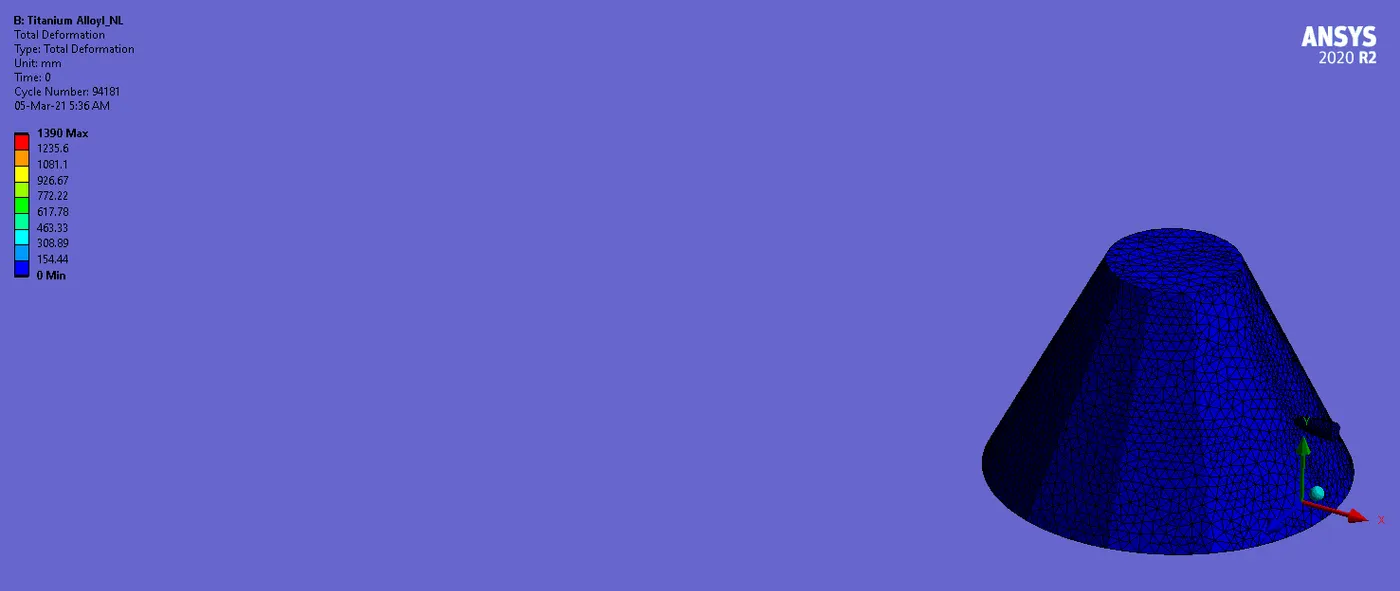
Here the animations for Stress and Total Deformation regarding the Bullet penetration on the Bucket is given for CASE_3 (Titanium Alloy NL) as below:
Stress:
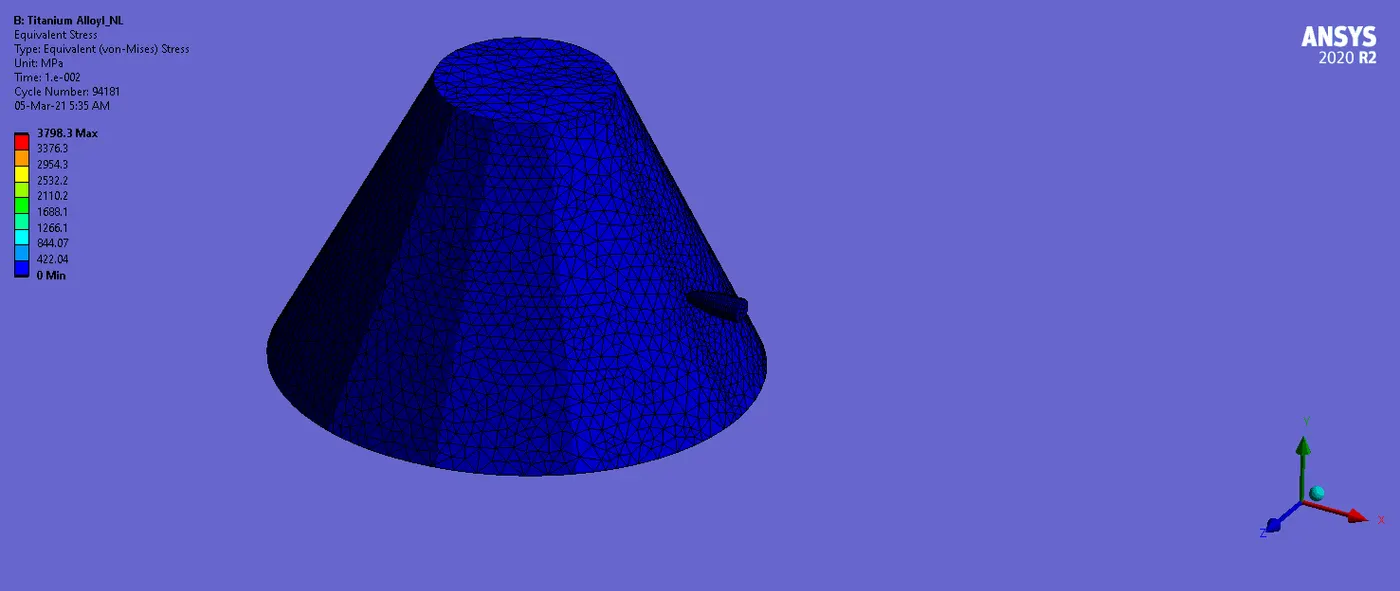
Total Deformation:
_________________________________________________________________________________________________________
Thanks & Regards,
Dharmesh Joshi