Week 1 Understanding Different Battery Chemistry
Li-ion Batteries
A lithium-ion battery, also known as a Li-ion battery, is a kind of secondary battery that can be recharged. Electric vehicles are becoming more popular for use in the military and aerospace, and lithium-ion batteries are frequently used for portable electronics.
Lithium-ion uses a cathode, or positive electrode, an anode, or negative electrode, and an electrolyte as a conductor, similar to the lead- and nickel-based architecture. The anode is made of porous, non-aqueous carbon, and the cathode is a metal oxide. When there is a discharge, the ions move through the electrolyte and separator from the anode to the cathode; when there is a charge, the ions move in the opposite direction from the cathode to the anode.
Types of Li-ion Cells
Lithium Cobalt Oxide (LiCoO2) — LCO
Li-cobalt is a common material for laptops, digital cameras, and mobile devices due to its high specific energy. A cobalt oxide cathode and a graphite carbon anode make up the battery. Lithium ions move from the anode to the cathode during discharge; the cathode has a layered structure. On charge, the flow changes. Li-cobalt has a constrained range of load capabilities, a short life span, and poor thermal stability (specific power).
Lithium Manganese Oxide (LiMn2O4) — LMO
The Materials Research Bulletin first reported on Li-ion with manganese spinel in 1983. Lithium manganese oxide served as the cathode material for the Li-ion cell that Moli Energy commercialised in 1996. The structure creates a three-dimensional spinel structure on the electrode to enhance ion flow, which lowers internal resistance and enhances current handling. The additional benefits of spinel are high thermal stability and improved safety, but its cycle and calendar life is constrained.
Lithium Nickel Cobalt Aluminium Oxide (LiNiCoAlO2) — NCA
Since 1999, lithium nickel cobalt aluminium oxide batteries, or NCAs, have been used for specific purposes. Due to its high specific energy, respectable specific power, and lengthy lifespan, it is comparable to NMC. Cost and safety are less appealing. Lithium nickel oxide has been developed further into NCA, which adds aluminium for more stability in the chemistry.
Lithium Nickel Manganese Cobalt Oxide (LiNiMnCoO2) — NMC
An effective Li-ion system uses nickel, manganese, and cobalt as the cathode (NMC). These systems can be customised to function as Energy Cells or Power Cells, similar to Li-manganese. For instance, NMC in a 18650 cell optimised for specific power has a capacity of only about 2,000mAh but delivers a continuous discharge current of 20A. NMC in the same cell optimised for moderate load conditions has a total of about 2,800mAh and can deliver 4A to 5A. In India, the most popular brand of NMC cell is HLY which comes in a form factor of 26650 and has a capacity of about 5,000mAh & can deliver 3C.
Lithium Iron Phosphate (LiFePO4) — LFP
Li-phosphate has a low resistance and good electrochemical performance. Phosphate cathode material on a nanoscale enables this. The main advantages include a high current rating, a long cycle life, good thermal stability, increased safety, and abuse tolerance. If kept at high voltage for an extended period of time, lithium-phosphate is more resilient to full-charge conditions and experiences less stress than other lithium-ion systems. In exchange, its lower nominal voltage of 3.2V/cell lowers the specific energy below that of lithium-ion with a cobalt blend. In India, the most popular brand of LFP cell is HX which comes in a form factor of 32700 and has a capacity of about 6,000mAh & can deliver 3C. Nowadays a new form factor of 33140 has a capacity of 15,000mAh and is getting more popular as it can deliver more than 30% of capacity when compared with 32700.
Lithium Titanate (Li2TiO3) — LTO
Since the 1980s, lithium titanate anodes have been used in batteries. In the anode of a typical lithium-ion battery, lithium titanate takes the place of graphite and forms a spinel structure. Lithium manganese oxide or NMC can be used as the cathode. Li-titanate batteries deliver a high discharge current of 10C, or 10 times the rated capacity, and have a nominal cell voltage of 2.40V. They can also be quickly charged. It is claimed that the cycle count is higher than that of a typical Li-ion. At -30°C, lithium titanate has 80% capacity and excellent low-temperature discharge characteristics. The only disadvantage here is the low energy density of this chemistry, which acts as a significant drawback while designing a battery pack for a 2-Wheeler segment of vehicles.
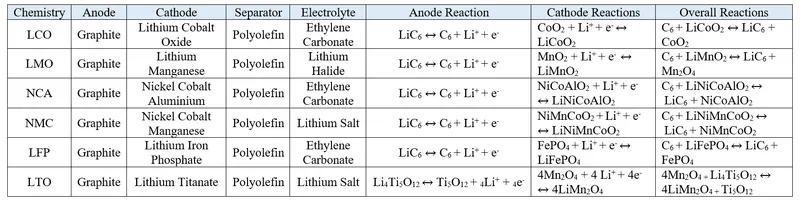
The materials & chemical reactions are as follows