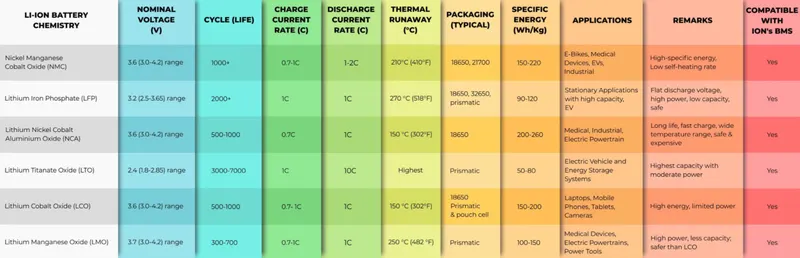
Week 1 Understanding Different Battery Chemistry
1) Electric vehicles are a promising technology to reduce emissions, but its development enormously depends on the technology used in batteries.Nowadays batteries based on lithium-ion-(Li-ion) seems to be the most suitable for traction, especially nickel-manganese-cobalt (NMC) and nickel-cobaly-Aluminium (NCA).
An appropriate model of these batteries is fundamental for the simulation of several processes inside an EV, such as the state of charge (SoC) estimation, capacity and power fade analysis.
Li-ion Batteries
A lithium-ion battery is a type of rechargable battery. they are commonly used for portable electronics and electric vehicles and are growing in popularity.
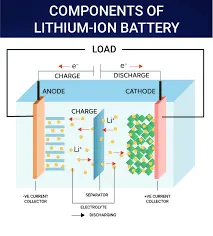
Types of Li-ion Batteries
a) Lithium cobalt Oxide - LCO
b) Lithium Manganese Oxide - LMO
c)Lithium Nickel Cobalt Aluminium Oxide - NCA
d) Lithium Nickel Manganese Cobalt Oxide - NMC
e)Lithium Iron Titanate - LTO
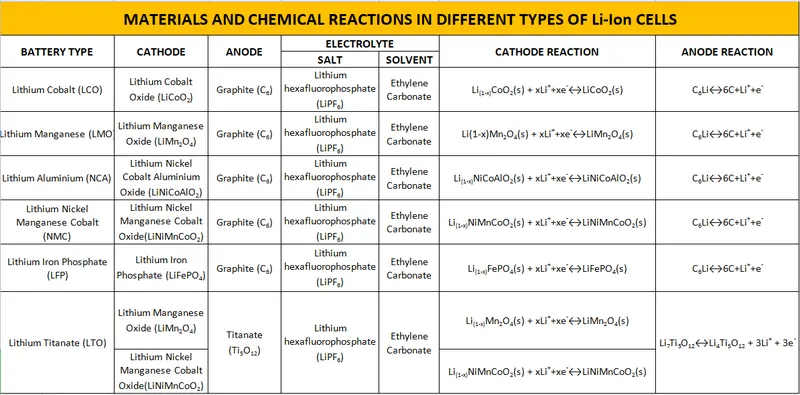
A table which includes materials & chemical reactions occurring at the anode and cathode of LCO, LMO, NCA, NMC, LFP and LTO type of lithium ion cells.
2) The differences between each type of Li+ion batteries based on their characteristics
There are different types of lithium-ion-batteries and tge main difference between them lies in their cathode materials. Different kinds of lithium-ion batteries offer different features.
The six lithium-ion -batteries types that we will be comparing are Lithium Cobalt Oxide, Lithium Mnaganese Oxide, Lithium Nickel Manganese Cobalt Oxide, Lithium Aluminium Oxide and Lithium Titanate
a) Battery performance
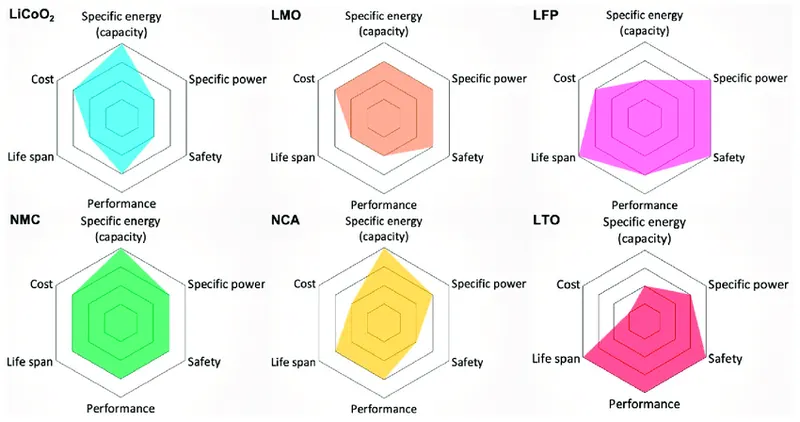
b) Lifespan, Safety, Cost, Performance