Week 1 Understanding Different Battery Chemistry
AIM :-
1. Prepare a table which includes materials & chemical reactions occurring at the anode and cathode of LCO, LMO, NCA, NMC, LFP and LTO type of lithium ion cells.Give your detailed explanation on it
Explanation:-
A lithium-ion battery is a family of rechargeable battery types in which lithium ions move from the negative electrode to the positive electrode during discharge and back when charging. Chemistry, performance, cost and safety characteristics vary across lithium-ion battery types. Unlike lithium primary batteries (which are disposable), lithium-ion batteries use an intercalated lithium compound as the electrode material instead of metallic lithium.
Lithium-ion batteries are common in consumer electronics. They are one of the most popular types of rechargeable battery for portable electronics, with one of the best energy-to-weight ratios, high open circuit voltage, low self-discharge rate, no memory effect and a slow loss of charge when not in use. Beyond consumer electronics, lithium-ion batteries are growing in popularity for military, electric vehicle and aerospace applications due to their high energy density.Li-ion batteries with high power and high energy are used for new applications such as electric vehicles, for which safety concern is essential. We review the state of the art in the research to optimize the safety of all the elements of the batteries already available on the market. We also report on the recent batteries that are not yet commercialized, but have been tested as demonstrators, which pass all the security tests without the help of any battery monitoring system with almost unlimited cycling life, which is expected to reduce significantly the cost of th'e electric vehicles.
COMPONENT OF LI+ION BATTERY:
While the battery is discharging and providing an electric current, the anode releases lithium ions to the cathode, generating a flow of electrons from one side to the other. When plugging in the device the opposite will happen that the lithium ions are released by the cathode and received by the anode. The charging and discharging processes are shown.
The 6 commonly used lithium ion batteries are listed below.
- Lithium cobalt oxide (LiCoO2) - LCO.
- Lithium Manganese oxide (LiMn2O4) - LMO.
- Lithium Nickel Manganese cobalt oxide (liNiMnCoO2) - NMC.
- Lithium Iron phosphate (LiFePO4) - LFP.
- Lithium Nickel Cobalt Aluminium Oxide (LiNiCoAlO2) - NCA.
- Lithium Titanate (Li2TiO3) - LTO.
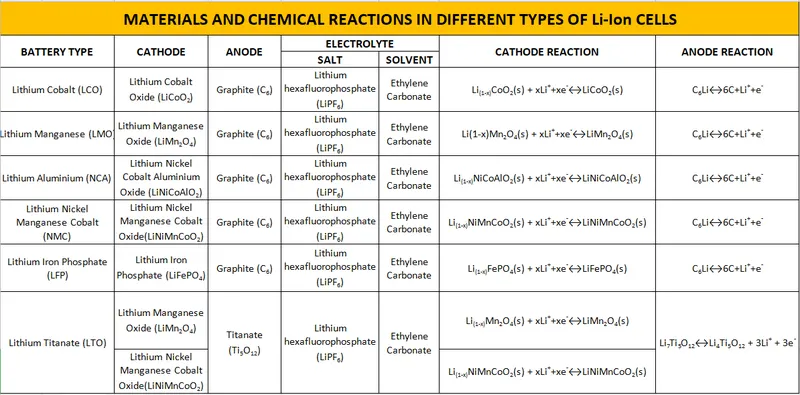
Lithium ion Cobalt (LOC):-
The cobalt and oxygen bond together to form layers of octahedral cobalt oxide structures, separated by sheets of lithium. It’s important that this structure allows the cobalt ions to change their valence states between Co+3 and Co+4 (lose and gain a negatively-charged electron) when charging and discharging
C6+LiCoO2⟷LixC6+Li1−xCoO2
Lithium Manganese(LMO):-
This type of lithium battery uses a cathode made from lithium-manganese spinel (Li+Mn3+Mn4+O4). Spinel is a type of mineral with a distinctive AB2O4 structure. The spinel structure has very good thermal stability, improving the battery’s safety. It also promotes ion flow within the electrolyte and lessens the internal resistance that contributes to the loss of a battery’s power over time.
MnO2 + Li + +e<---------->LiMnO4
Lithium Almonium(LCA):-
Lithium Nickel cobalt aluminium oxides (NCA) battery has been around since 1999 for special applications. It shares similarities with NMC by offering high specific energy, reasonably good specific power and a long life span.
Li1-xMO2+LixCn<---------------------->LiMO2+nC
Lithium Nikel Mangannese Cobalt(NMC):-
Lithium manganese batteries are often coupled with a lithium nickel manganese cobalt oxide battery, producing a combination that is used in many electric vehicles. High bursts of energy (for rapid acceleration) are provided by the lithium-manganese component, and a long driving range is provided by the lithium nickel manganese cobalt oxide component.

LITHIUM IRON PHOSPHATE
A lithium iron phosphate battery cell is similar to the lithium cobalt oxide cell. The anode is still graphite and the electrolyte is also much the same. The difference is that the lithium cobalt dioxide cathode has been replaced with the more stable lithium iron phosphate. In fact, no lithium or iron ions remain in the iron phosphate (FePO4) cathode of a fully charged cell. The lithium ions can intercalate into or out of the cathode material through well-defined tunnels in its structure without significantly altering the iron phosphate framework.
LiFePO4+6C→LiC6+FePO4
Lithium Titanate oxide (LTO) batteries is a type of rechargable battery which has the advantage of being faster to charge than other lithium ion batteries but its disadvantage of having a much lower energy density.


2.Compare the differences between each type of Li+ion batteries based on their characteristics
For ease of choosing a battery from laymans perspective, the 6 key features are given a value within 0-5 range for all of the, are given with the same parameters which are considered in case of 5 point hexagonal analysis of the batteries. They are following point of below
- Specific energy.
- Specific power.
- Safety.
- Performance.
- Life span.
- Cost.
LCO :
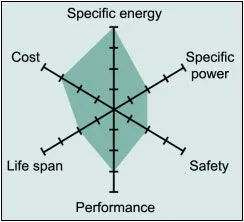
Li-cobalt excels on high specific energy but offers only moderate performance specific power, safety and life span.
LMO :
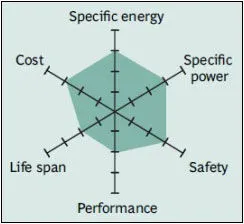
Although moderate in overall performance, newer designs of Li-manganese offer improvements in specific power, safety and life span.
NMC :
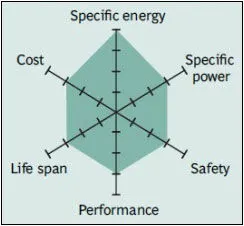
NMC has good overall performance and excels on specific energy. This battery is the preferred candidate for the electric vehicle and has the lowest self heating rate.
LFP :
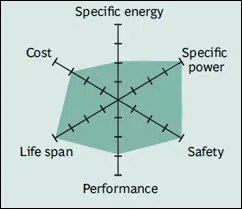
Li-phosphate has excellent safety and long life span but moderate specific energy and elevated self discharge.
NCA :
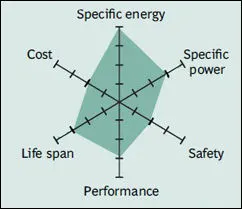
High energy and power densities as well as a good life span make NCA a candidate for EV powertrains. High cost and marginal safety are negative.
LTO :
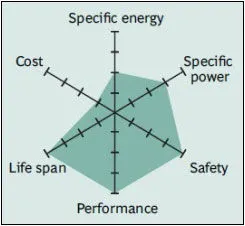
Li-titanate excels in safety, low temperature performance and life span. Efforts are being made to improve the specific energy and lower the cost.