Week 1 Understanding Different Battery Chemistry
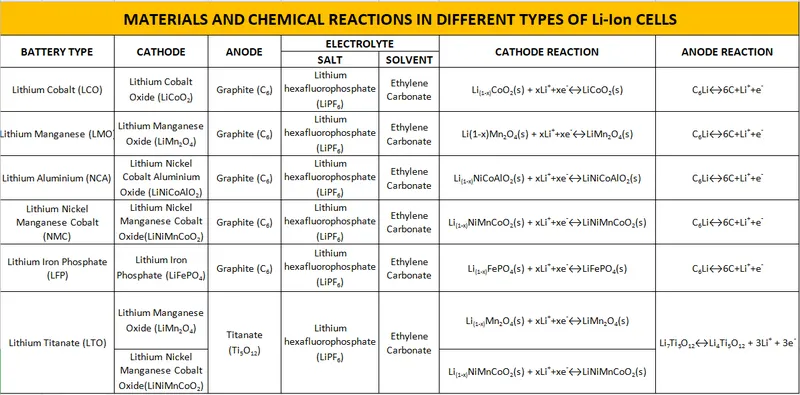
Q1) Table Including the Materials and chemical reactions at electrodes of different Lithium Ion cells
Lithium Cobalt Oxide Cell
LCO (Lithium cobalt oxide) was invented in the year 1991. Its anode material is LiaC6, the cathode material is LibCoO2 and the carrier is Li+.It is used in various applications ranging from electronic devices to all laptops and phone batteries.The majority of lithium-ion batteries for the portable devices are cobalt based. The system contains a cobalt oxide cathode (positive electrode) and graphite carbon anode.
Lithium Manganese Oxide cell
LMO (Lithium magnesium oxide) was invented in the year 1996. Its anode material is LiaC6, the cathode material is LibMn2O4 and the carrier is Li+. It is used in different applications like power tools and electric cars.LMO batteries have the ability to deliver a lot of energy in a short period of time, which makes them extremely useful for use in power tools like drills.In 1996, lithium manganese oxide was first used as a cathode material.
Lithium Nickel Cobalt Aluminium Cell
NCA (Lithium nickel cobalt aluminum oxide) battery was invented in the year 1999. Its anode material is LiaC6, the cathode material is LibNi0.8Co0.15Al0.05O2 and the carrier is Li+. It is used in different applications like power grid applications, medical devices and electric cars. Most notably Tesla deploys NCA batteries in their electric vehicles system. NCA batteries can store the same amount of energy as NMC.
Lithium Nickel Manganese Cobalt Cell
NMC (Nickel Manganese Cobalt Oxide) battery was invented in the year 2008. Its anode material is LiaC6, the cathode material is LibNi1–x–yCoxMnyO2 and the carrier is Li+. They commonly use it in different applications like Energy Systems and electric cars.NMC combines the best of nickel and manganese. Nickel has high specific energy but poor stability; manganese can form a spinel structure so as to achieve low internal resistance yet provides a low specific energy. Joining the metals increases the strengths from both parts.NMC batteries are widely used for power tools, energy storage systems (EES) which need frequent cycling and electrical power-trains like automotives.
Lithium Titanate Oxide Cell
LTO (Lithium tintate) was invented in the year 2008. Its anode material is Li4+aTi5O12, the cathode material is LibFePO4 and the carrier is Li+. They use it in different applications like UPS, electrical power trains, solar powered street lights, fast charge stations and forklifts. Li-titanate is used instead of the graphite in the anode of a common lithium-ion battery and the material is formed into a spinel structure. The cathode material is either LMO or NMC.
Q2.).Comparison between each type of Li+ion batteries based on their characteristics