Week 1 Understanding Different Battery Chemistry
AIM:-
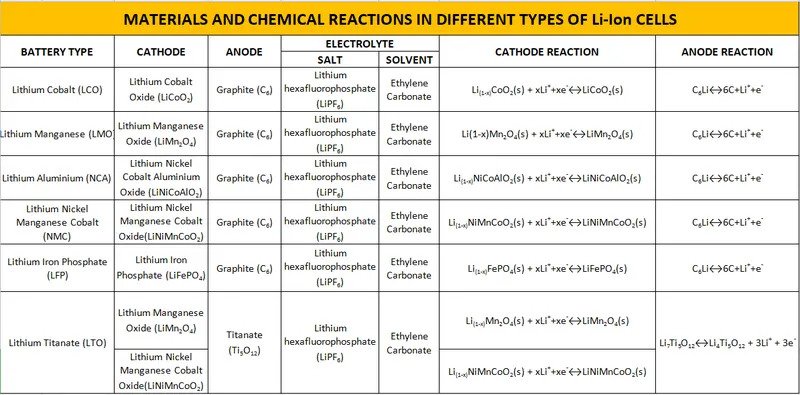
- To Prepare a table which includes materials & chemical reactions occurring at the anode and cathode of LCO, LMO, NCA, NMC, LFP and LTO type of lithium ion cells.Give your detailed explanation on it
- To Compare the differences between each type of Li+ion batteries based on their characteristics
ANSWER:-
FOR QUESTION 1:-
- Lithium ion batteries can be designed for optimal capacity with the drawback of limited loading,slow charging and reduced longiveity.an industrial battery may have a moderate ampere rating but the focus is on durability. specific energy only provides part of battery performance.
- Before looking into the materials and chemical reactions of different types of lithium ion batteries.A battery is ,ade up of an anode ,cathode,seperator,electrolyte and two current collectors(positive&negative_.the anode and cathode store the lithium.
- The electrolyte carries positively charged lithium ions from the anode to the cathode and vice versa through the seperator .the movement of the lithium ions creates free electrons in the anode which creates a charge at the positive current collector.the electrical currentthen flow from the current collector through a device being powered to the negative current collector.the seperator blocks the flow of electrons inside the battery.
PARTS OF LITHIUM ION BATTERY:-
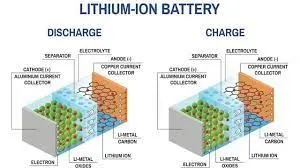
Working of lithium ion battery:
The development and application of lithium-ion batteries in the past 40 years, from wearable devices to electric vehicles, from communication base stations to space stations, all kinds of lithium-ion batteries of different sizes and weights are connected with our lives. The lithium-ion battery is an epoch-making invention, and its emergence quickly promotes the evolution of civilization and technology
The working principle of lithium-ion batteries can be explained in terms of charge state and discharge state. As its name, lithium-ion batteries use the transfer of "lithium" ions to complete the charge/discharge circuit.
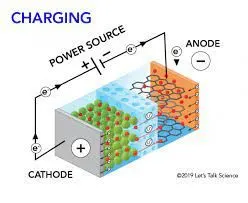
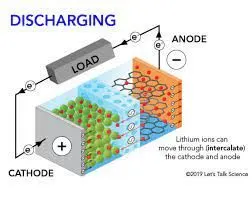
The commonly used lithium ion batteries are follows:-
- Lithium cobalt oxide(LiCoO2)-LCO
- Lithium manganese oxide(LiMn2O4)-LMO
- Lithium nickel manganese cobalt oxide(liNiMnCoO2)-NMC
- Lithium ion phosophate (LiFePO4)-LFP
- Lithium nickel cobalt aluminium oxide (LiNiCoAiO2)-NCA
- Lithium titanate(Li2TiO3)-LTP.
Each lithium ion batteries provides different characteristics and are used in different applications accordingly.
|
CHARGE V/CELL
|
CAPACITY AT CUT-OFF VOLTAGE*
|
CHARGE TIME
|
CAPACITY WITH FULL SATURATION
|
|---|---|---|---|
|
3.80
|
~40%
|
120 min
|
~65%
|
|
3.90
|
~60%
|
135 min
|
~75%
|
|
4.00
|
~70%
|
150 min
|
~80%
|
|
4.10
|
~80%
|
165 min
|
~90%
|
|
4.20
|
~85%
|
180 min
|
100%
|
1)LCO:-
It has high specific energy but low specific power which means that charging and discharging with Current Rate (C) above rated values shorten the battery’s life. It has a cobalt Oxide Cathode and Graphite anode. The cathode is layered.
During discharge, the Li-ions move from anode to cathode. The flow reverses during charging. The graphite anode limits its cycle life hence it has a short life span. It has low thermal stability. Its main applications are mobile phones, laptops, cameras, etc.
Lithium cobalt oxide (LCO) battery was invented in the year of 1991.its anode material is LiaC6,the cathode material is LibCoO2 and the carrier is Li+.it is used in various applications ranging from electronic devices to all laptops and phone batteries.the majority of lithium ion batteries for portable devices are cobalt based.the system containg a cobalt oxide cathode(+ve electrode) graphite carbon anode(-ve electrode)

2)LMO:-
The Manganese Oxide forms a 3D-spinel structure that improves the ion flow on the electrode. This results in lower internal resistance, which enables fast charging and high-current discharging. Adding to these, spinel structure also packs extra thermal stability. Making it safer compared to LCO. The LMO has a lower cycle life.
Most Li-manganese batteries blend with lithium nickel manganese cobalt oxide (NMC) to enhance the precise energy and prolong battery life. These three active metals, as well as silicon enhancement, can enhance specific energy (capacity), specific power (load capability) or longevity.

Li-manganese has high power and less capacity. It is used for power tools, medical devices as well as in electric vehicle powertrain.
3)NMC:-
The cathodic combination of Nickel Manganese Cobalt is successful as it can be tailored to be either Energy cells or Power Cells. NMC has a good performance and excels in specific energy. This Lithium-ion battery can deliver a continuous discharge current.

The advantage of Nickel is its high specific energy but it has poor stability. Whereas Manganese achieves low internal resistance by forming a spinal structure. Unlike Nickel, Manganese offers low specific energy.
Their combination enhances each other’s performances. New electrolytes can boost capacity. It has the lowest self-heating rate and improved cycle life. This is a battery of choice for electric powertrains and Industrial applications.
4)LiFe04:-
In this type, Li- Phosphate is used as the cathode since it has good electrochemical performance with low resistance. This is because of the nano-scale phosphate cathode material.Various advantages of this Lithium-ion battery chemistry include – long lifecycle, good thermal stability, high current rating, enhanced safety, and tolerance in case of abuse.

Li-Phosphate is often used to replace lead-acid batteries as it has a moderate specific energy and has a very low tolerance for moisture, which reduces its cycle life drastically.Other characteristics include a very flat voltage discharge curve but low capacity. LFP is one of the safest Li-ions in the market.
5)LTO:-
In this technology, Li-titanate replaces the graphite in the anode of a typical Lithium-ion battery and the material forms into a spinel structure.The cathode can be lithium manganese oxide or NMC. Li-titanate can be fast-charged and delivers a high discharge current 10 times the rated capacity. The cycle count is higher than the regular Li-ion batteries.
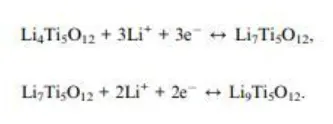
Li-titanate excels in safety and has excellent low-temperature discharge characteristics and life span. The applications this lithium ion battery chemistry power include electric powertrains, UPS and solar-powered street lighting.
FOR QUESTION 2:-
To Compare the differences between each type of Li+ion batteries based on their characteristics.
The main differances between the lithium ion batteries can be differential on the characteristics.
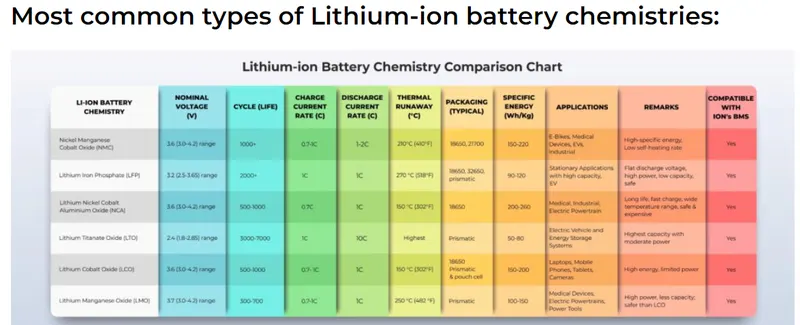
- nominal voltage:-Most batteries actually have a voltage slightly higher than what you see on the label. A 12 volt lead acid battery is usually, in reality, a 12.6 or 12.7 volt battery. Manufacturers make batteries this way because producing units of exactly X volts is actually surprisingly hard. Voltages vary even between batches coming off the same production line. As such it is safer to have a margin of error so they cannot be accused of marketing a 12 volt battery while selling an 11.7 volt unit.
- cycle life:-The cycle life of batteries is the number of charge and discharge cycles that a battery can complete before losing performance. The cycle life of Li-ion batteries is affected significantly by the depth of discharge. The depth of discharge is the amount of a battery’s storage capacity that is utilized. For example, a battery that is discharged only by 20% of its full energy capacity has a much greater cycle life than a battery that is discharged more deeply by 80% of its capacity so that only 20% of its full energy charge remains. Fig. 6 shows the cycle life of a typical Li-ion cell.
- charge current rate:-The capacity of a battery is generally rated and labelled at the 1C Rate (1C current), this means a fully charged battery with a capacity of 10Ah should be able to provide 10 Amps for one hour.The advised charge rate of an Energy Cell is between 0.5C and 1C; the complete charge time is about 2–3 hours. Manufacturers of these cells recommend charging at 0.8C or less to prolong battery life; however, most Power Cells can take a higher charge C-rate with little stress.
- dischare current rate:-Batteries gradually self-discharge even if not connected and delivering current. Li-ion rechargeable batteries have a self-discharge rate typically stated by manufacturers to be 1.5–2% per month. The rate increases with temperature and state of charge.t is defined as the discharge current divided by the theoretical current draw under which the battery would deliver its nominal rated capacity in one hour. A 1C discharge rate would deliver the battery's rated capacity in 1 hour. A 2C discharge rate means it will discharge twice as fast (30 minutes).
- thermal runway:-Thermal runaway is an uncontrolled reaction that can occur in lithium-ion batteries. Damage to the battery or a short-circuit can cause heat and pressure to build up in the battery. If this reaches a certain level it triggers chemical reactions that generate more heat and pressure, causing a positive-feedback loop.
- specife energy :-Common specifications include the type of cell the battery is in, its standard voltage, its mAH rating, its standard charge (for rechargeable), and its rapid charge (for rechargeable).
| A 3.6v Li-ion battery from a Nokia 3310 mobile phone | |
|---|---|
| Specific energy | 100–265 W·h/kg(0.36–0.875 MJ/kg) |
| Self-discharge rate | 0.35% to 2.5% per month depending on state of charge |
| Cycle durability | 400–1,200 cycles |
| Nominal cell voltage | 3.6 / 3.7 / 3.8 / 3.85 V, LiFePO4 3.2 V, Li4Ti5O12 2.3 V |
Types of batterys:-
Lithium-ion battery Types SP SE SF LS CS PF Lithium Cobalt Oxide
L
H
L
L
L
M
Lithium Manganese Oxide
M
M
M
L
L
L
Lithium Nickel Manganese Cobalt Oxide
M
H
M
M
L
M
Lithium Iron Phosphate
H
L
H
H
L
M
Lithium Nickel Cobalt Aluminum Oxide
M
H
L
M
M
M
Lithium Titanate
M
L
H
H
H
H
- SP stands for specific power
- SE stands for specific energy
- SF stands for safety
- LS stands for lifespan
- CS stands for cost
- PF stands for performance
- L stands for low
- M stands for moderate
- H stands for high
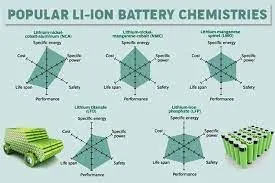
for case of chooosing a battery from laymans perspective ,the 6 key features are given a value within 0-5 range for all of the ,are given with the same parameters which are considered in case of 5 point hexagonal analysis of the batteries.they are.
- specific energy
- specific power
- safety
- performance
- life span
- cost
LCO:-
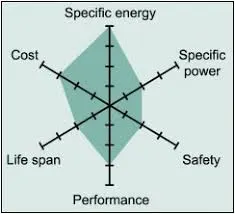
Li-cobalt excel on high specific energy but offers only moderate performance specific power,safety&life span
LMO:-
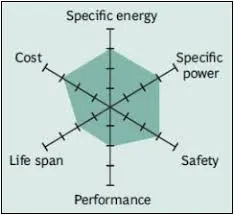
Althrough moderate in overall perforamnce ,newer designs of Li_manganese offer improvements in specific power,safety&life span
NMC:-
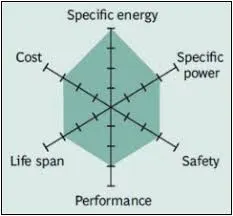
NMC has good overall performance and excels on specific energy.this batery is the preferred candidate for the electric vehicle and has the lowest self heating rate
LFP:-
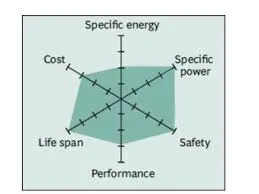
Li-phosphate has excellent safety and long life span but moderate specific energy and elevated self discharge
NCA:-
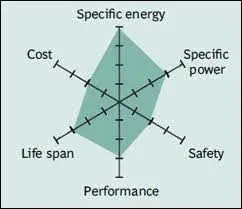
High energy and power densities as well as a good life span make NCA a candidate for EV powertrain.high cost and marginal safety are negative.
LTO:-
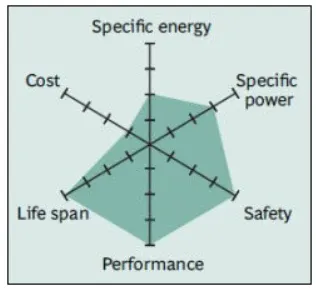
Li-titanate excels in safety ,low temperature performance and life span.efforts are being made to improve the specific energy and lower the cost.
- these types of lithium ion batteries are some of the most popular.as technology is continously seeing more development ,new lithium technologies are always being develoiped and those which exists are being developed.