Week 1 Understanding Different Battery Chemistry
Understanding Different Battery Chemistry
Aim:
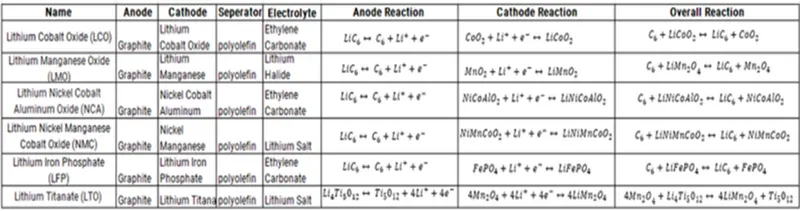
1.Prepare a table which includes materials & chemical reactions occurring at the anode and cathode of LCO, LMO, NCA, NMC, LFP and LTO type of lithium ion cells. Give your detailed explanation on it
2.Compare the differences between each type of Li + ion batteries based on their characteristics
Ans:
1.Prepare a table which includes materials & chemical reactions occurring at the anode and cathode of LCO, LMO, NCA, NMC, LFP and LTO type of lithium ion cells. Give your detailed explanation on it
Lithium ion battery:
Lithium-ion batteries are available in many different shapes and sizes. Inside, however, they typically look the same. To understand how a lithium-ion battery works, it’s important to know the role that individual parts play.
The Cell
A lithium-ion battery is made up of several parts. The cell, serving as the workhorse of the battery, is the most critical component of the battery.
The cell is comprised of the following battery materials:
- Electrodesare the two battery ends. One is the anode and the other is the cathode.
- The anodestores the lithium and is typically made from carbon.
- The cathodealso stores the lithium and is made from a chemical compound that is a metal oxide.
- The separatorblocks the flow of negative and positive electrons inside the battery but allows for ions to pass through.
- The electrolyteliquid sits between the two electrodes. It carries the positively charged lithium ions from the anode to the cathode and vice versa depending on whether the battery is charging or discharging.
The Battery Pack
The battery pack, which holds the lithium-ion cells, operates much like a computer. It contains the following:
- At least one temperature sensorto monitor the battery’s temperature.
- A voltage converterand regulator circuit that focuses on keeping the voltage and current at safe levels.
- A Euro connector, which allows power and information to move in and out of the battery pack.
- The celltap which oversees the cells’ voltages in the battery pack.
- A battery monitoring system, a small computer that oversees the whole battery and ensures safety to the user.
- NMC (NCM) – Lithium Nickel Cobalt Manganese Oxide (LiNiCoMnO2)
- LFP – Lithium Iron Phosphate (LiFePO4/C)
- LNMO – Lithium Nickel Manganese Spinel (LiNi0.5Mn1.5O4)
- NCA – Lithium Nickel Cobalt Aluminium Oxide (LiNiCoAlO2)
- LMO – Lithium Manganese Oxide (LiMn2O4)
- LCO – Lithium Cobalt Oxide (LiCoO2)
Lithium Cobalt Oxide(LiCoO2) — LCO
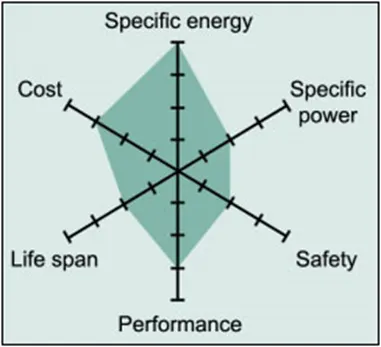
Its high specific energy makes Li-cobalt the popular choice for mobile phones, laptops and digital cameras. The battery consists of a cobalt oxide cathode and a graphite carbon anode. The cathode has a layered structure and during discharge, lithium ions move from the anode to the cathode. The flow reverses on charge. The drawback of Li-cobalt is a relatively short life span, low thermal stability and limited load capabilities (specific power).
The drawback of Li-cobalt is a relatively short life span, low thermal stability and limited load capabilities (specific power). Like other cobalt-blended Li-ion, Li-cobalt has a graphite anode that limits the cycle life by a changing solid electrolyte interface (SEI), thickening on the anode and lithium plating while fast charging and charging at low temperature. Newer systems include nickel, manganese and/or aluminum to improve longevity, loading capabilities and cost.
Li-cobalt should not be charged and discharged at a current higher than its C-rating. This means that an 18650 cell with 2,400mAh can only be charged and discharged at 2,400mA. Forcing a fast charge or applying a load higher than 2,400mA causes overheating and undue stress. For optimal fast charge, the manufacturer recommends a C-rate of 0.8C or about 2,000mA. (See BU-402: What is C-rate). The mandatory battery protection circuit limits the charge and discharge rate to a safe level of about 1C for the Energy Cell.
The hexagonal spider graphic summarizes the performance of Li-cobalt in terms of specific energy or capacity that relates to runtime; specific power or the ability to deliver high current; safety; performance at hot and cold temperatures; life span reflecting cycle life and longevity; and cost. Other characteristics of interest not shown in the spider webs are toxicity, fast-charge capabilities, self-discharge and shelf life.
Lithium Manganese Oxide (LiMn2O4) — LMO
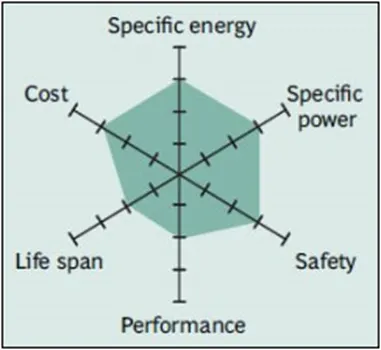
Li-ion with manganese spinel was first published in the Materials Research Bulletin in 1983. In 1996, Moli Energy commercialized a Li-ion cell with lithium manganese oxide as cathode material. The architecture forms a three-dimensional spinel structure that improves ion flow on the electrode, which results in lower internal resistance and improved current handling. A further advantage of spinel is high thermal stability and enhanced safety, but the cycle and calendar life are limited.
Low internal cell resistance enables fast charging and high-current discharging. In an 18650 package, Li-manganese can be discharged at currents of 20–30A with moderate heat buildup. It is also possible to apply one-second load pulses of up to 50A. A continuous high load at this current would cause heat buildup and the cell temperature cannot exceed 80°C (176°F). Li-manganese is used for power tools, medical instruments, as well as hybrid and electric vehicles.
Li-manganese has a capacity that is roughly one-third lower than Li-cobalt. Design flexibility allows engineers to maximize the battery for either optimal longevity (life span), maximum load current (specific power) or high capacity (specific energy). For example, the long-life version in the 18650 cell has a moderate capacity of only 1,100mAh; the high-capacity version is 1,500mAh.
Most Li-manganese batteries blend with lithium nickel manganese cobalt oxide (NMC) to improve the specific energy and prolong the life span. This combination brings out the best in each system, and the LMO (NMC) is chosen for most electric vehicles, such as the Nissan Leaf, Chevy Volt and BMW i3. The LMO part of the battery, which can be about 30 percent, provides high current boost on acceleration; the NMC part gives the long driving range.
Li-ion research gravitates heavily towards combining Li-manganese with cobalt, nickel, manganese and/or aluminum as active cathode material. In some architecture, a small amount of silicon is added to the anode. This provides a 25 percent capacity boost; however, the gain is commonly connected with a shorter cycle life as silicon grows and shrinks with charge and discharge, causing mechanical stress.
These three active metals, as well as the silicon enhancement can conveniently be chosen to enhance the specific energy (capacity), specific power (load capability) or longevity. While consumer batteries go for high capacity, industrial applications require battery systems that have good loading capabilities, deliver a long life and provide safe and dependable service.
Lithium Nickel Manganese Cobalt Oxide (LiNiMnCoO2) — NMC
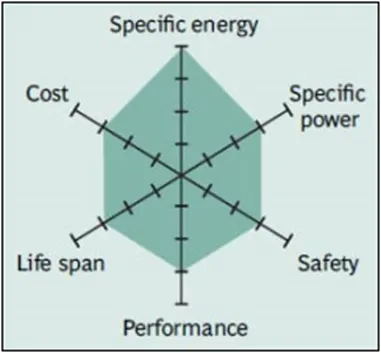
One of the most successful Li-ion systems is a cathode combination of nickel-manganese-cobalt (NMC). Similar to Li-manganese, these systems can be tailored to serve as Energy Cells or Power Cells. For example, NMC in an 18650 cell for moderate load condition has a capacity of about 2,800mAh and can deliver 4A to 5A; NMC in the same cell optimized for specific power has a capacity of only about 2,000mAh but delivers a continuous discharge current of 20A. A silicon-based anode will go to 4,000mAh and higher but at reduced loading capability and shorter cycle life. Silicon added to graphite has the drawback that the anode grows and shrinks with charge and discharge, making the cell mechanically unstable.
The secret of NMC lies in combining nickel and manganese. An analogy of this is table salt in which the main ingredients, sodium and chloride, are toxic on their own but mixing them serves as seasoning salt and food preserver. Nickel is known for its high specific energy but poor stability; manganese has the benefit of forming a spinel structure to achieve low internal resistance but offers a low specific energy. Combining the metals enhances each other strengths.
NMC is the battery of choice for power tools, e-bikes and other electric powertrains. The cathode combination is typically one-third nickel, one-third manganese and one-third cobalt, also known as 1-1-1. This offers a unique blend that also lowers the raw material cost due to reduced cobalt content. Another successful combination is NCM with 5 parts nickel, 3 parts cobalt and 2 parts manganese (5-3-2). Other combinations using various amounts of cathode materials are possible.
Battery manufacturers move away from cobalt systems toward nickel cathodes because of the high cost of cobalt. Nickel-based systems have higher energy density, lower cost, and longer cycle life than the cobalt-based cells but they have a slightly lower voltage.
There is a move towards NMC-blended Li-ion as the system can be built economically and it achieves a good performance. The three active materials of nickel, manganese and cobalt can easily be blended to suit a wide range of applications for automotive and energy storage systems (EES) that need frequent cycling. The NMC family is growing in its diversity.
Lithium Iron Phosphate (LiFePO4) — LFP
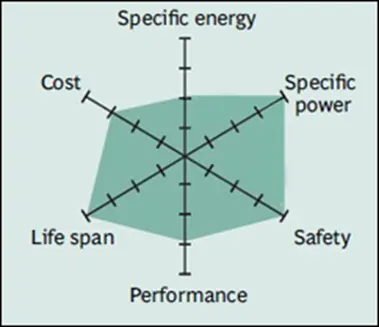
In 1996, the University of Texas (and other contributors) discovered phosphate as cathode material for rechargeable lithium batteries. Li-phosphate offers good electrochemical performance with low resistance. This is made possible with nano-scale phosphate cathode material. The key benefits are high current rating and long cycle life, besides good thermal stability, enhanced safety and tolerance if abused.
Li-phosphate is more tolerant to full charge conditions and is less stressed than other lithium-ion systems if kept at high voltage for a prolonged time. (See BU-808: How to Prolong Lithium-based Batteries). As a trade-off, its lower nominal voltage of 3.2V/cell reduces the specific energy below that of cobalt-blended lithium-ion. With most batteries, cold temperature reduces performance and elevated storage temperature shortens the service life, and Li-phosphate is no exception. Li-phosphate has a higher self-discharge than other Li-ion batteries, which can cause balancing issues with aging. This can be mitigated by buying high quality cells and/or using sophisticated control electronics, both of which increase the cost of the pack. Cleanliness in manufacturing is of importance for longevity.
Li-phosphate is often used to replace the lead acid starter battery. Four cells in series produce 12.80V, a similar voltage to six 2V lead acid cells in series. Vehicles charge lead acid to 14.40V (2.40V/cell) and maintain a topping charge. Topping charge is applied to maintain full charge level and prevent sulfation on lead acid batteries.
With four Li-phosphate cells in series, each cell tops at 3.60V, which is the correct full-charge voltage. At this point, the charge should be disconnected but the topping charge continues while driving. Li-phosphate is tolerant to some overcharge; however, keeping the voltage at 14.40V for a prolonged time, as most vehicles do on a long road trip, could stress Li-phosphate. Time will tell how durable Li-Phosphate will be as a lead acid replacement with a regular vehicle charging system. Cold temperature also reduces performance of Li-ion and this could affect the cranking ability in extreme cases.
Lithium Nickel Cobalt Aluminum Oxide (LiNiCoAlO2) — NCA
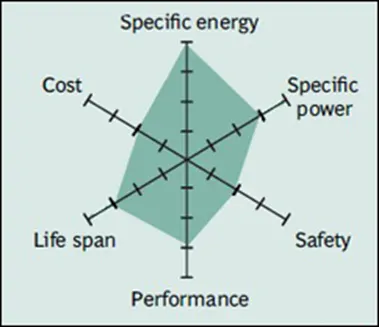
Lithium nickel cobalt aluminum oxide battery, or NCA, has been around since 1999 for special applications. It shares similarities with NMC by offering high specific energy, reasonably good specific power and a long life span. Less flattering are safety and cost.
Lithium Titanate (Li2TiO3) — LTO
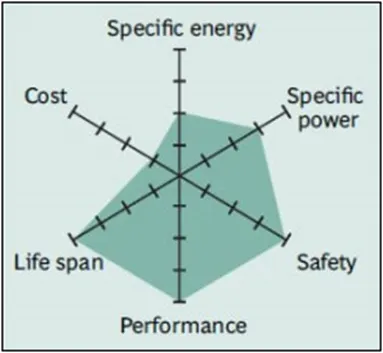
Batteries with lithium titanate anodes have been known since the 1980s. Li-titanate replaces the graphite in the anode of a typical lithium-ion battery and the material forms into a spinel structure. The cathode can be lithium manganese oxide or NMC. Li-titanate has a nominal cell voltage of 2.40V, can be fast charged and delivers a high discharge current of 10C, or 10 times the rated capacity. The cycle count is said to be higher than that of a regular Li-ion. Li-titanate is safe, has excellent low-temperature discharge characteristics and obtains a capacity of 80 percent at –30°C (–22°F).
LTO (commonly Li4Ti5O12) has advantages over the conventional cobalt-blended Li-ion with graphite anode by attaining zero-strain property, no SEI film formation and no lithium plating when fast charging and charging at low temperature. Thermal stability under high temperature is also better than other Li-ion systems; however, the battery is expensive. At only 65Wh/kg, the specific energy is low, rivalling that of NiCd. Li-titanate charges to 2.80V/cell, and the end of discharge is 1.80V/cell. illustrates the characteristics of the Li-titanate battery. Typical uses are electric powertrains, UPS and solar-powered street lighting.
2.Compare the differences between each type of Li + ion batteries based on their characteristics
Ans: