Understanding Different Battery Chemistry
Objective:
1.Prepare a table that includes materials & chemical reactions occurring at the anode and cathode of LCO, LMO, NCA, NMC, LFP and LTO type of lithium-ion cells. Give your detailed explanation on it
2.Compare the differences between each type of Li+ion batteries based on their characteristics
Solution:
1.
Lithium-ion battery chemistry
As the name suggests, lithium ions (Li+) are involved in the reactions driving the battery. Both electrodes in a lithium-ion cell are made of materials that can intercalate or ‘absorb’ lithium ions (a bit like the hydride ions in the Nihm Batterie. Intercalation is when charged ions of an element can be ‘held’ inside the structure of a host material without significantly disturbing it. In the case of a lithium-ion battery, the lithium ions are ‘tied’ to an electron within the structure of the anode. When the battery discharges, the intercalated lithium ions are released from the anode, and then travel through the electrolyte solution to be absorbed (intercalated) in the cathode.
LITHIUM COBALT OXIDE (LiCoO2)
The most common lithium-ion cells have an anode of carbon (C) and a cathode of lithium cobalt oxide (LiCoO2). In fact, the lithium cobalt oxide battery was the first lithium-ion battery to be developed from the pioneering work of R Yazami and J Goodenough and sold by Sony in 1991. The cobalt and oxygen bond together to form layers of octahedral cobalt oxide structures, separated by sheets of lithium. It’s important that this structure allows the cobalt ions to change their valence states between Co+3 and Co+4 (lose and gain a negatively charged electron) when charging and discharging.
Of all the various lithium-ion batteries, these guys have the greatest energy density, which is why they’re currently the batteries found in our phones, digital cameras, and laptops. Their drawback is their thermal instability. Their anodes can overheat and, at high temperatures, the cobalt oxide cathode can decompose, producing oxygen. If you combine oxygen and heat, you’ve got a pretty good chance of starting a fire and, as the chemicals sometimes used in the electrolyte solution, such as diethyl carbonate, are flammable, there can be some safety issues with this battery.
Lithium-ion batteries have in-built protection to prevent overheating, and to prevent the complete discharge of the battery which can also be damaging. Additionally, these protection circuits can sometimes be used to prevent the over-charging of lithium-ion batteries, which can have serious consequences. Lithium-ion batteries come in a wide variety of shapes and sizes, and some contain in-built protection devices, such as venting caps, to improve safety.
Chemical reaction Involved:
DURING DISCHARGE
At the anode, lithium is oxidised. Lithium ions are released from the carbon, along with electrons:
At the cathode, lithium-ions are absorbed by the lithium dioxide, and the electrode is reduced as it also receives the electrons from the circuit:
The overall reaction is:
LITHIUM IRON PHOSPHATE (LiFePO4)
This cell has a high discharge rate and, because phosphate (PO4) can cope with high temperatures, the battery has good thermal stability, improving its safety. This makes it a good choice for things like electric vehicles and power tools, and for storing energy at power stations. It also has a long cycle life, meaning it can be discharged and charged many times. However, it has a lower energy density than a lithium cobalt oxide cell, and a higher self-discharge rate.
A lithium iron phosphate battery cell is similar to the lithium cobalt oxide cell. The anode is still graphite and the electrolyte is also much the same. The difference is that the lithium cobalt dioxide cathode has been replaced with the more stable lithium iron phosphate. In fact, no lithium or iron ions remain in the iron phosphate (FePO4) cathode of a fully charged cell. The lithium ions can intercalate into or out of the cathode material through well-defined tunnels in its structure without significantly altering the iron phosphate framework.
The cathode of this type of cell is made of negatively charged phosphate anions, bonded with positively charged iron cations in a structure that is capable of storing lithium ions within the iron phosphate molecules. The bonding arrangement in this structure means that the oxygen atoms are tightly bonded into the structure, which gives the cathode its chemical stability.
Chemical Reactions involved:
DURING DISCHARGE
At the anode, lithium is oxidised. Lithium ions are released from the carbon, along with electrons:
At the cathode, lithium ions are absorbed by the lithium dioxide, and the electrode is reduced as it also receives the electrons from the circuit:
The overall reaction is:
LITHIUM MANGANESE OXIDE (LiMn2O4)
This type of lithium battery uses a cathode made from lithium-manganese spinel (Li+Mn3+Mn4+O4). Spinel is a type of mineral with a distinctive AB2O4 structure. The spinel structure has very good thermal stability, improving the battery’s safety. It also promotes ion flow within the electrolyte and lessens the internal resistance that contributes to the loss of a battery’s power over time.
While this type of lithium battery offers high discharge and recharge rates (also due to the spinel structure of the cathode) it has a lower capacity and shorter lifetime.
Lithium Nickel Manganese Cobalt Oxide (LiNiMnCoO2) — NMC
One of the most successful Li-ion systems is a cathode combination of nickel-manganese-cobalt (NMC). Similar to Li-manganese, these systems can be tailored to serve as Energy cells or Power cells. For example, NMC in a 18650 cell for moderate load condition has a capacity of about 2,800mAh and can deliver 4A to 5A; NMC in the same cell optimized for specific power has a capacity of only about 2,000mAh but delivers a continuous discharge current of 20A. A silicon-based anode will go to 4,000mAh and higher but at reduced loading capability and shorter cycle life. Silicon added to graphite has the drawback that the anode grows and shrinks with charge and discharge, making the cell mechanically unstable.
The secret of NMC lies in combining nickel and manganese. An analogy of this is table salt in which the main ingredients, sodium, and chloride, are toxic on their own but mixing them serves as seasoning salt and food preserver. Nickel is known for its high specific energy but poor stability; manganese has the benefit of forming a spinel structure to achieve low internal resistance but offers low specific energy. Combining the metals enhances each other strengths.
NMC is the battery of choice for power tools, e-bikes, and other electric powertrains. The cathode combination is typically one-third nickel, one-third manganese and one-third cobalt, also known as 1-1-1. Cobalt is expensive and in limited supply. Battery manufacturers are reducing the cobalt content with some compromise in performance. A successful combination is NCM532 with 5 parts nickel, 3 parts cobalt, and 2 parts manganese. Other combinations are NMC622 and NMC811. Cobalt stabilizes nickel, a high energy active material
2.Compare the differences between each type of Li+ion batteries based on their characteristics
Summary Table
| Lithium Cobalt Oxide: LiCoO2 cathode (~60% Co), graphite anode Short form: LCO or Li-cobalt. Since 1991 |
|
| Voltages | 3.60V nominal; typical operating range 3.0–4.2V/cell |
| Specific energy (capacity) | 150–200Wh/kg. Specialty cells provide up to 240Wh/kg. |
| Charge (C-rate) | 0.7–1C, charges to 4.20V (most cells); 3h charge typical. Charge current above 1C shortens battery life. |
| Discharge (C-rate) | 1C; 2.50V cut off. Discharge current above 1C shortens battery life. |
| Cycle life | 500–1000, related to depth of discharge, load, temperature |
| Thermal runaway | 150°C (302°F). Full charge promotes thermal runaway |
| Applications | Mobile phones, tablets, laptops, cameras |
| Comments 2019 update: |
Very high specific energy, limited specific power. Cobalt is expensive. Serves as Energy Cell. Market share has stabilized. Early version; no longer relevant. |
| Lithium Manganese Oxide: LiMn2O4 cathode. graphite anode Short form: LMO or Li-manganese (spinel structure) Since 1996 |
|
| Voltages | 3.70V (3.80V) nominal; typical operating range 3.0–4.2V/cell |
| Specific energy (capacity) | 100–150Wh/kg |
| Charge (C-rate) | 0.7–1C typical, 3C maximum, charges to 4.20V (most cells) |
| Discharge (C-rate) | 1C; 10C possible with some cells, 30C pulse (5s), 2.50V cut-off |
| Cycle life | 300–700 (related to depth of discharge, temperature) |
| Thermal runaway | 250°C (482°F) typical. High charge promotes thermal runaway |
| Applications | Power tools, medical devices, electric powertrains |
| Comments 2019 update: |
High power but less capacity; safer than Li-cobalt; commonly mixed with NMC to improve performance. Less relevant now; limited growth potential. |
Summary Table
| Lithium Nickel Manganese Cobalt Oxide: LiNiMnCoO2. cathode, graphite anode Short form: NMC (NCM, CMN, CNM, MNC, MCN similar with different metal combinations) Since 2008 |
|
| Voltages | 3.60V, 3.70V nominal; typical operating range 3.0–4.2V/cell, or higher |
| Specific energy (capacity) | 150–220Wh/kg |
| Charge (C-rate) | 0.7–1C, charges to 4.20V, some go to 4.30V; 3h charge typical. Charge current above 1C shortens battery life. |
| Discharge (C-rate) | 1C; 2C possible on some cells; 2.50V cut-off |
| Cycle life | 1000–2000 (related to depth of discharge, temperature) |
| Thermal runaway | 210°C (410°F) typical. High charge promotes thermal runaway |
| Cost | ~$420 per kWh (Source: RWTH, Aachen) |
| Applications | E-bikes, medical devices, EVs, industrial |
| Comments 2019 update: |
Provides high capacity and high power. Serves as Hybrid Cell. Favorite chemistry for many uses; market share is increasing. Leading system; dominant cathode chemistry. |
| Lithium Iron Phosphate: LiFePO4 cathode, graphite anode Short form: LFP or Li-phosphate. LIP is also common. Since 1996 |
|
| Voltages | 3.20, 3.30V nominal; typical operating range 2.5–3.65V/cell |
| Specific energy (capacity) | 90–120Wh/kg |
| Charge (C-rate) | 1C typical, charges to 3.65V; 3h charge time typical |
| Discharge (C-rate) | 1C, 25C on some cells; 40A pulse (2s); 2.50V cut-off (lower that 2V causes damage) |
| Cycle life | 2000 and higher (related to depth of discharge, temperature) |
| Thermal runaway | 270°C (518°F) Very safe battery even if fully charged |
| Cost | ~$580 per kWh (Source: RWTH, Aachen) |
| Applications | Portable and stationary needing high load currents and endurance |
| Comments 2019 update: |
Very flat voltage discharge curve but low capacity. One of safest Li-ions. Used for special markets. Elevated self-discharge. Used primarily for energy storage, moderate growth. |
| Lithium Nickel Cobalt Aluminum Oxide: LiNiCoAlO2 cathode (~9% Co), graphite anode Short form: NCA or Li-aluminum. Since 1999 |
|
| Voltages | 3.60V nominal; typical operating range 3.0–4.2V/cell |
| Specific energy (capacity) | 200-260Wh/kg; 300Wh/kg predictable |
| Charge (C-rate) | 0.7C, charges to 4.20V (most cells), 3h charge typical, fast charge possible with some cells |
| Discharge (C-rate) | 1C typical; 3.00V cut-off; high discharge rate shortens battery life |
| Cycle life | 500 (related to depth of discharge, temperature) |
| Thermal runaway | 150°C (302°F) typical, High charge promotes thermal runaway |
| Cost | ~$350 per kWh (Source: RWTH, Aachen) |
| Applications | Medical devices, industrial, electric powertrain (Tesla) |
| Comments 2019 update: |
Shares similarities with Li-cobalt. Serves as Energy Cell. Mainly used by Panasonic and Tesla; growth potential. |
| Lithium Titanate: Cathode can be lithium manganese oxide or NMC; Li2TiO3 (titanate) anode Short form: LTO or Li-titanate Commercially available since about 2008. |
|
| Voltages | 2.40V nominal; typical operating range 1.8–2.85V/cell |
| Specific energy (capacity) | 50–80Wh/kg |
| Charge (C-rate) | 1C typical; 5C maximum, charges to 2.85V |
| Discharge (C-rate) | 10C possible, 30C 5s pulse; 1.80V cut-off on LCO/LTO |
| Cycle life | 3,000–7,000 |
| Thermal runaway | One of safest Li-ion batteries |
| Cost | ~$1,005 per kWh (Source: RWTH, Aachen) |
| Applications | UPS, electric powertrain (Mitsubishi i-MiEV, Honda Fit EV), solar-powered street lighting |
| Comments 2019 update: |
Long life, fast charge, wide temperature range but low specific energy and expensive. Among safest Li-ion batteries. Ability to ultra-fast charge; high cost limits to special application. |
Solid-state Li-ion: High specific energy but poor loading and safety.
Lithium-sulfur: High specific energy but poor cycle life and poor loading
Lithium-air: High specific energy but poor loading, needs clean air to breath, and has a short life.
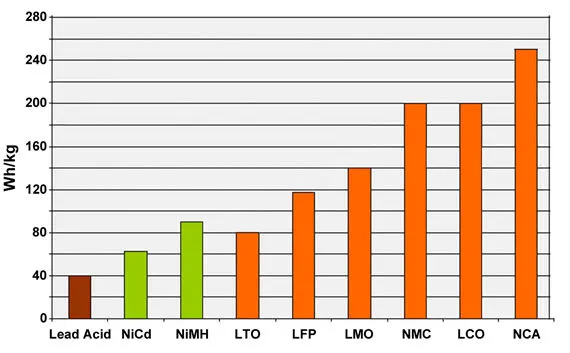
Figure 15 compares the specific energy of lead-, nickel- and lithium-based systems. While Li-aluminum (NCA) is the clear winner by storing more capacity than other systems, this only applies to specific energy. In terms of specific power and thermal stability, Li-manganese (LMO) and Li-phosphate (LFP) are superior. Li-titanate (LTO) may have low capacity but this chemistry outlives most other batteries in terms of life span and also has the best cold temperature performance. Moving towards the electric powertrain, safety, and cycle life will gain dominance over overcapacity. (LCO stands for Li-cobalt, the original Li-ion.)
Reference: